Most people assume asteroid defense is a science fiction problem of last-minute nukes and chaotic panic. Matt O'Dowd dismantles that myth immediately, arguing that the real challenge isn't the impact itself, but the decades of subtle gravitational math required to predict it. He reveals that saving the world depends less on explosive power and more on identifying tiny, invisible windows in space called 'gravitational keyholes'—a concept that transforms planetary defense from a frantic race into a precise, solvable geometry problem.
From Smudge to Probability
O'Dowd begins by grounding the audience in the messy reality of observation. He describes a newly discovered object not as a looming doom, but as a 'moving smudge' on a screen. 'You know its exact angular position... but you have no idea how far away it is,' he notes, highlighting the initial 'degeneracy' where a small, close object looks identical to a large, distant one. This framing is effective because it strips away the Hollywood drama to reveal the genuine scientific hurdle: we cannot calculate a threat until we can calculate distance.
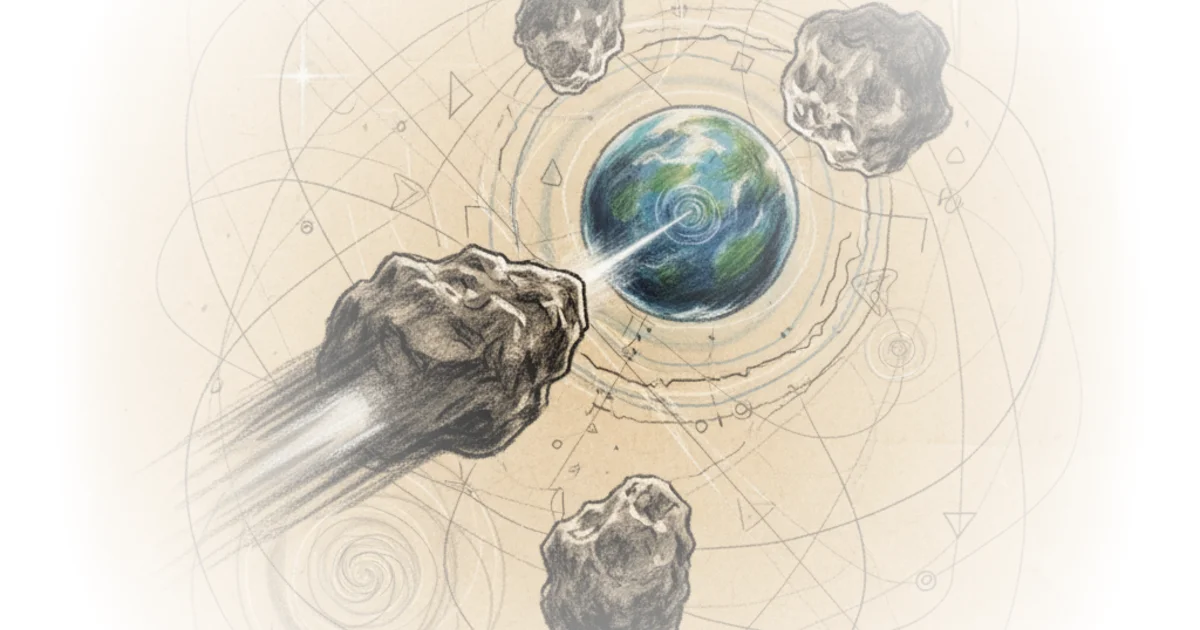
The author then pivots to the mathematical tools that resolve this uncertainty. He credits the work of Gauss and Laplace, who solved the problem of determining orbits from just three observations. 'With only three observations reasonably separated in time it should be possible to determine which Keplerian orbit your moving smudge is really on,' O'Dowd explains. This historical context adds weight to the modern application, showing that the backbone of our planetary defense is centuries-old calculus, not just new technology.
The real solar system is a messy place, and your asteroid is going to be tugged off its perfect Keplerian orbit by the gravitational fields of the planets.
However, O'Dowd is careful to note that simple orbital mechanics aren't enough. He introduces the 'Yarkovsky effect,' a subtle nudge caused by the asteroid radiating heat, which compounds over time. 'These only have a tiny influence in the moment but that influence and so the uncertainty compounds over time,' he writes. This is a crucial distinction for the reader: the danger isn't just the rock, but the accumulation of tiny, invisible errors in our prediction models.
The Geometry of Survival
The commentary shifts to the most compelling part of O'Dowd's argument: the concept of gravitational keyholes. He explains that during a close approach to Earth, an asteroid can be deflected into a specific, narrow region of space. 'These regions are called gravitational keyholes and they can be as small as hundreds of meters in diameter,' he states. If the asteroid misses this tiny window, Earth is safe for the next century. If it threads the needle, an impact becomes almost certain.
This reframing is the piece's intellectual high point. It changes the goal of planetary defense from 'missing the Earth' to 'missing the keyhole.' O'Dowd argues, 'Deflecting a potential impactor is simplified to diverting it from passing through a keyhole.' This means we don't need to push the asteroid thousands of kilometers away; we only need to shift its path by a few kilometers years in advance. The 2022 DART mission proved this is possible, but the real work lies in the early detection that identifies which keyhole is at risk.
Critics might note that relying on a single keyhole miss assumes our models of the asteroid's composition and rotation are perfect. If the Yarkovsky effect is miscalculated, the keyhole itself might move, rendering our deflection efforts useless. O'Dowd acknowledges this uncertainty, noting that 'the only way to understand the possible trajectories... is to simulate that future motion step by step.'
The Case of 2024 YR4 and Apophis
O'Dowd uses the recent scare of asteroid 2024 YR4 to illustrate the process in action. Initially, early data suggested a 3.1% chance of impact in 2032. 'By March this year NASA revised the impact probability to what in around 5,500 while further analysis by ESA set the chance to nearly only one in a million,' he reports. The story of 2024 YR4 isn't about a disaster averted by luck, but a disaster averted by the rapid refinement of orbital data.
He then contrasts this with the more persistent threat of asteroid Apophis. Discovered in 2004, it initially sparked fears of a 2029 impact. 'Further observations including radar by Arecibo slowly downgraded the risk,' O'Dowd writes, explaining how the asteroid was ruled out for 2029 but posed a theoretical risk for 2036 before being cleared again. The upcoming 2029 flyby of Apophis is now being used as a testbed for the OSIRIS-APEX mission, which will study how Earth's gravity alters the asteroid's rotation—a vital data point for future defense simulations.
It's actually more likely that The Rock will hit the moon in 2032 than it will hit the Earth.
This comparison underscores a vital point: the system works. The uncertainty shrinks as data accumulates. However, O'Dowd admits a lingering vulnerability. 'Ultimately you'll have a very reliable probability of an impact in the next few Close Encounters but beyond that the uncertainties blow up.' Our ability to predict the far future remains limited by the chaotic nature of the solar system.
Bottom Line
Matt O'Dowd's strongest argument is the demystification of planetary defense, shifting the narrative from panic to precision. By focusing on gravitational keyholes, he provides a clear, actionable framework for how humanity can survive a cosmic collision. The piece's biggest vulnerability is the inherent limitation of long-term prediction; while we can solve the immediate threat, the chaotic solar system ensures that some uncertainties will always remain. The reader should watch for the OSIRIS-APEX mission results, as they will provide the critical data needed to refine these models for the next generation of threats.