json
I think most people assume that life's outcomes follow a predictable pattern — like height or apple sizes — clustering around an average. But Derek Muller argues this assumption is fundamentally flawed. In nature, power laws dominate: from income distribution to earthquake destruction to the wealthiest individuals in a room. And once you understand how these mathematical patterns work, you'll never see the world the same way again.
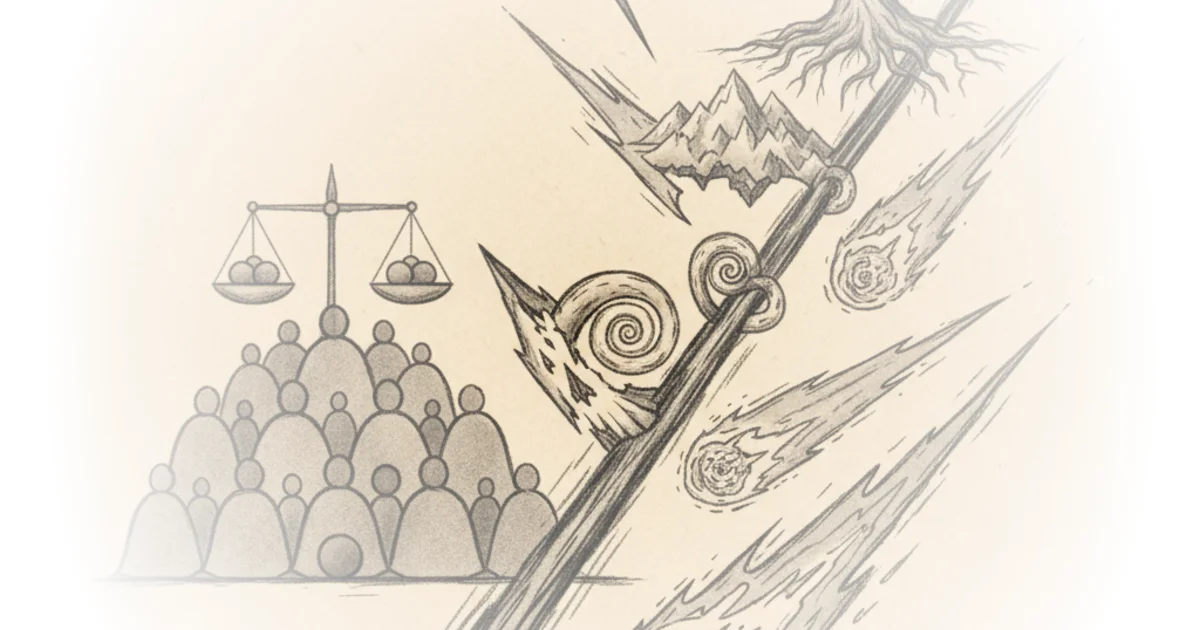
The Normal Mistake
When you measure things in the natural world — human height, IQ, or apple sizes on a tree — most data clusters around some average value. This happens so consistently that mathematicians call it the normal distribution.
But here's what's strange: many systems in life don't follow this pattern at all.
Consider wars and their death tolls. If you measure how many people died in conflicts, from small battles to world wars, the numbers span an extraordinary range — from ten million to a hundred million casualties. The outcomes vary so wildly that they completely skew any average. There's no inherent scale telling you what to expect next. The more you measure, the bigger the average becomes.
This is counter-intuitive. It sounds impossible. But it's exactly how power laws work.
The Discovery That Changed Economics
In the late 1800s, Italian engineer Vilfredo Pareto stumbled onto something no one had seen before.
He suspected income might follow a hidden pattern. So he gathered tax records from Italy, France, England, and other European countries. For each country, he plotted how many people earned above certain incomes.
What he found shocked him: the distribution wasn't normal at all.
In a normal distribution like height, there's a clearly defined average. Extreme outliers are practically impossible — you'd never find someone five times the average height. That would be physically absurd.
But income was different. The curve showed most people earning relatively little, but then it stretched across several orders of magnitude. Some people earned five times, ten times, even a hundred times more than others. That kind of spread wouldn't happen if income followed a normal distribution.
When Pareto shrunk the data by calculating logarithms — plotting log against log instead of linear values — the broad curve transformed into a straight line. The gradient was around negative 1.5. Each time you doubled your income, from £200 to £400, the number of people earning at least that much dropped by a factor of roughly 2.8.
This pattern held for every country he studied. He could describe income distribution with one simple equation: the number of people earning above a certain income equals one divided by that income raised to the power of 1.5.
"When you move from the world of normal distributions to the world of power laws, things change dramatically."
This relationship is called a power law. And it reveals something profound about how inequality actually works.
The Casino Analogy
To understand why this matters, Muller takes us through three different casino games.
At the first table, you get 100 coin flips. Each heads wins you $1. The expected payout is $50 — straightforward. You should pay anything less than $50 to play. Over hundreds of plays, small variations cancel out and you turn a profit.
This represents normal distributions: when many random effects add up, you expect this bell-curve pattern. Like height — it depends on nutrition, genetics, and all kinds of random factors that are additive.
At the second table, things change. You still get 100 flips, but instead of winning $1 each time, your winnings multiply. You start with $1. Each heads multiplies by 1.1; each tails multiplies by 0.9. After 100 flips, you take home your starting dollar multiplied by the string of factors.
The expected factor per flip is exactly one — so your expected payout stays $1. But look at the distribution: if you flipped 100 heads, you'd win almost $14,000. The chance of that happening is roughly one in a googol — astronomically unlikely.
However, the median payout is around 61. So if you're playing once and want even odds of profit, pay less than $61.
Now watch what happens when Muller switches from a linear axis to a logarithmic scale. The curve transforms into a normal distribution. That's why this is called a lognormal distribution: when random effects multiply rather than add, you get this pattern. And it produces massive inequality — far more likelihood of enormous wealth than a normal distribution would allow.
The downside is capped at zero. You can only lose your initial dollar. But the upside keeps growing to nearly $14,000.
At the third table, everything breaks. You start with one dollar and double it every time you flip tails until you get heads. If you get heads on the first toss, you win $2. If it takes two flips, you get $4. After three flips, $8 — doubling each time.
The expected value calculation gets strange: each possible outcome adds another $1 to the total expected value. Even if it's extremely unlikely to flip 100 times without hitting heads, that outcome still adds enough money to keep the expected value climbing. Theoretically, the total expected value becomes infinite.
This is the St. Petersburg paradox — a power law with no measurable width. The standard deviation doesn't exist because it spans all orders of magnitude. You could win $1,000, $100,000, or even a million. And while a million-dollar payout is unlikely, it's not that unlikely — roughly one in a million.
"It's much more likelihood of really big events than you would expect from a normal distribution."
When you transform both axes to a log scale, you see a straight line with a gradient of negative 1. The probability equals one divided by X — exactly the power law pattern.
Why Power Laws Appear Everywhere
So why do you get a power law from this simple setup?
The payout grows exponentially: X equals 2 raised to N. But the probability shrinks exponentially: it's one-half raised to N. These two exponentials cancel each other out, leaving just that constant gradient of negative 1.
Two exponentials conspiring create a power law. And that's common in nature — many times when we see power laws, there are two underlying exponentials dancing together.
Earthquakes show this pattern perfectly. Small earthquakes are very common. But larger earthquakes become exponentially rarer. Yet the destruction they cause is proportional to energy released, which grows exponentially with magnitude. When you combine those two exponentials to eliminate the magnitude, what emerges is a power law.
And that reveals something deeper about systems themselves: draw all outcomes as a tree diagram where each branch's length equals its probability. When you zoom in, you keep seeing the same structure repeating at smaller and smaller scales — it's self-similar like a fractal.
Critics might note that applying mathematical models to human behavior involves significant abstraction. The St. Petersburg paradox assumes infinite money and perfect rationality. In reality, people don't behave this way.
But here's what's remarkable: we see this fractal-like pattern everywhere in nature. The veins on a leaf, the structure of financial markets, the spread of internet traffic through data centers — all follow these same mathematical principles.
Bottom Line
Muller's strongest insight is that power laws aren't just mathematical curiosities — they explain why inequality is baked into systems ranging from income to earthquake damage. His casino analogy makes this concrete and intuitive.
The biggest vulnerability is one of implication: if power laws govern so much of life, the game isn't just about skill or effort. It's about which side of the exponential curve you're on. That's a unsettling realization worth sitting with.