Dylan Patel doesn't just predict a robot revolution; he provides a ruthless, data-driven map of exactly where we are in the transition from rigid automation to genuine autonomy. While the industry buzzes with hype about humanoid robots, Patel's "Robotics Levels of Autonomy" framework cuts through the noise by anchoring progress in commercial viability rather than technical possibility. For the busy executive, this is the missing barometer: it clarifies why your warehouse isn't fully automated yet and why the next decade will see labor displacement happen in distinct, economically justified waves.
The Illusion of the Dark Factory
Patel begins by dismantling the common misconception that current industrial automation equals intelligence. He describes the decades-old standard in automotive and electronics manufacturing as "Level 0: Scripted Motion," where robots operate with incredible speed but zero adaptability. "The robots performing these tasks have incredible power, speed, and precision, but they operate with no intelligence, only via strict programming and perfect tasks/environments," Patel writes. This distinction is critical because it highlights that the current "Dark Factory" model—facilities running entirely without humans—is actually a triumph of industrial engineering, not artificial intelligence.
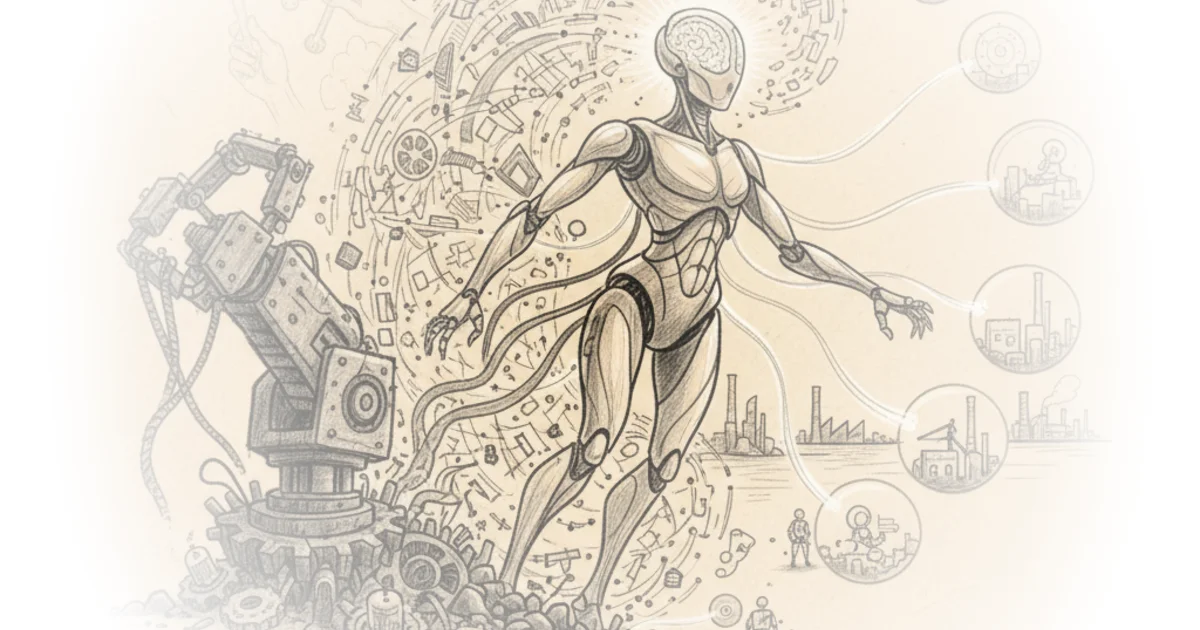
The economic reality of this rigidity is staggering. Patel notes that for a new assembly line, "Integration: 4x to 6x The Cost of The Robots Themselves." This massive upfront capital expenditure creates a barrier to entry that excludes all but the largest players. The argument here is that we have been building monuments to capital expenditure rather than flexible labor solutions. "A small error in programming, poor integration, or failure of two systems to sync can render an entire multi-million dollar factory non-functional," he warns. This fragility explains why automation has historically been confined to high-volume, low-mix industries like car manufacturing, leaving the vast majority of the economy untouched.
The environment must be perfectly engineered for them. Everything is done on the robot's terms, and everything and everyone else must comply.
Critics might argue that the push for "Level 0" efficiency has already delivered immense value, and that the focus on flexibility is a distraction from proven productivity gains. However, Patel's framing suggests that without autonomy, these systems remain brittle assets that cannot adapt to the dynamic, non-engineered environments where most human labor actually occurs.
The Shift to Perception and Dexterity
The core of Patel's thesis lies in the transition to "Level 1: Intelligent Pick and Place," a shift driven not by better hardware, but by the injection of data and perception. He traces this evolution to the period between 2015 and 2022, noting that "Large-scale datasets, and smaller but vital grasping datasets, powered this attempt into Level 1 autonomy by unlocking a piece of Dexterity: Generalization, especially in perception." This is the moment robots stopped being blind machines and started being able to see and adapt to changing object positions.
Patel's analysis is particularly sharp in how he defines the axes of progress: Agency and Dexterity. He argues that "Robot autonomy is inherently linked to applications: creating value only through actions often irrecoverable." In other words, a robot that can see but cannot reliably grasp an item is economically useless. The framework posits that "Once reliability is proven, the robot must deliver sufficient throughput to justify its cost as well." This commercial grounding is what separates this piece from typical tech speculation; it demands that every new capability prove its economic worth before being counted as a success.
The progression is additive. As Patel explains, "General-purpose robots that can accurately perform any task in any domain is now an inevitability, and mass labor replacement is on the horizon." However, he tempers this inevitability with a crucial timeline: "these robots will arrive in levels, slowly adding more capabilities until all tasks are feasible." This sequential approach suggests that the labor market disruption will not be a sudden cliff but a gradual slope, starting with low-skill manipulation and moving toward complex, force-dependent tasks.
The Road to Full Autonomy
Looking ahead, Patel outlines a trajectory where robots move from simple navigation to delicate manipulation. "Level 3: Low-skill Manipulation" sees robots performing basic, noncritical tasks in kitchens and laundromats, while "Level 4: Force-dependent Tasks" remains in the research phase, tackling delicate actions like finding a phone in a pocket or driving a screw on the correct threads. The distinction is vital: the ability to navigate a room (Level 2) is fundamentally different from the ability to interact with the physical world with the nuance of a human hand (Level 4).
The author's confidence in this roadmap is bolstered by the assertion that "modern AI paradigms convert most robot roadblocks into data problems." This reframing is the piece's most optimistic yet realistic claim. It suggests that the bottlenecks of the past were not insurmountable physical limits, but rather a lack of sufficient data to train the models. "As these models absorb real-world experience, robots will sharpen current skills, gain new ones, and deploy faster, absorbing ever-increasing shares of labor," Patel writes. This implies that the pace of adoption will accelerate as the data flywheel turns, potentially faster than most realize.
However, a counterargument worth considering is the sheer complexity of the "unstructured" world. While data solves many perception issues, the physical variability of real-world environments—changing lighting, unpredictable human behavior, and novel object combinations—may present challenges that pure data scaling cannot easily solve. Patel acknowledges this by emphasizing that "capabilities are derived from reliability and capability," suggesting that the industry is still in the early stages of proving these systems in the wild.
General-purpose robots that can accurately perform any task in any domain is now an inevitability, and mass labor replacement is on the horizon.
Bottom Line
Patel's "Robotics Levels of Autonomy" is the definitive framework for understanding the near future of work, successfully shifting the conversation from sci-fi speculation to economic reality. Its greatest strength is the rigorous distinction between what is technically possible and what is commercially viable, grounding the promise of AI in the hard math of integration costs and throughput. The biggest vulnerability remains the timeline; while the trajectory is clear, the speed at which Level 3 and 4 capabilities will achieve mass adoption depends on breakthroughs in reliability that are difficult to predict. Watch for the next wave of pilot programs in logistics and light manufacturing, as these will be the first true indicators of the shift from scripted motion to genuine autonomy.