N.S. Lyons delivers a provocative thesis that reframes the current political turbulence in the West not as a simple policy dispute, but as a form of self-inflicted colonization. By applying the historical mechanics of empire to the domestic policies of modern liberal democracies, the author argues that the West is actively dismantling its own national identities through a specific ideological engine. This is not a standard commentary on migration; it is a structural critique of how "liquid liberal-modernity" operates as a colonial force, a perspective that demands attention from anyone trying to understand the depth of the current populist backlash.
The Mechanics of Self-Colonization
Lyons begins by borrowing the concept of "counter-colonization" from French thinker Renaud Camus, but immediately expands it beyond simple demographics. The author writes, "Colonialism is something waged by empires – supranational political entities that control many different nations, or peoples, under one imperial umbrella." This framing is crucial because it shifts the blame from external invaders to the internal structures of power. Lyons argues that the primary tool of this modern empire is "de-nationalization," the systematic erasure of a people's conception of themselves as a coherent group with a distinct history.
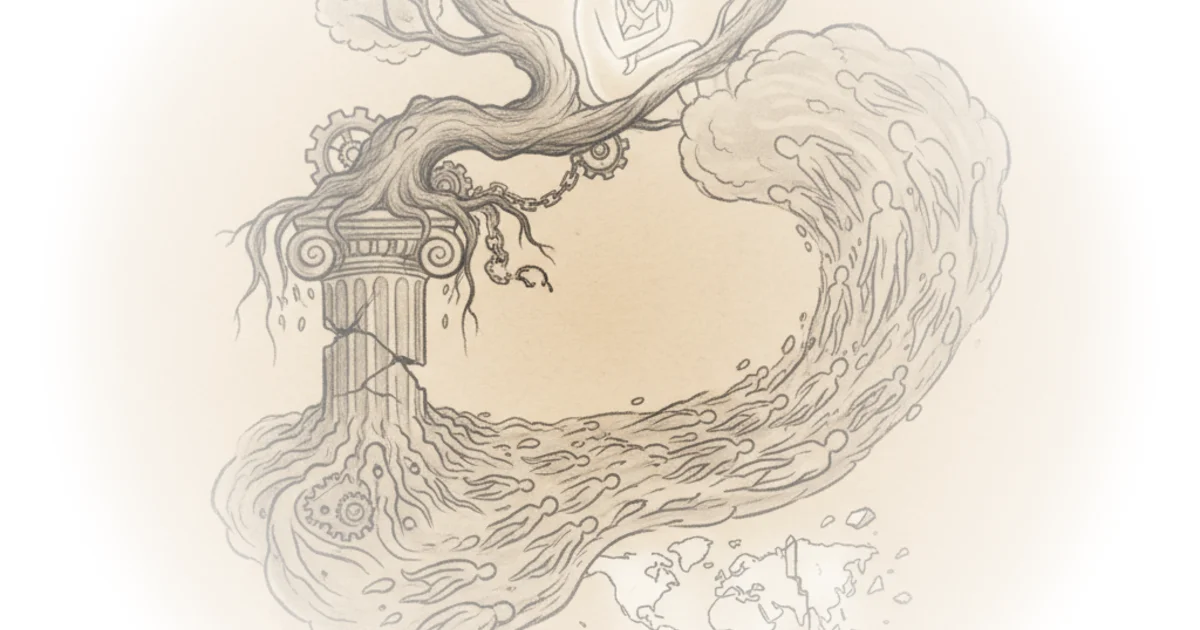
The piece then details a second imperative: "deculturalization." Lyons describes this as a deliberate severing of historical roots, often targeting children for reeducation to strip them of their traditional values. The author notes that this is frequently sold as a "benevolent civilizing process," a familiar trope in colonial history that is now being repurposed to justify the replacement of traditional culture with a universalized, cosmopolitan set of values. This argument is compelling in its historical parallel, yet critics might note that equating multicultural policy with the violent erasure of indigenous cultures risks oversimplifying the complex, often well-intentioned debates surrounding integration and diversity.
The West seems to be the first civilization in history that is in the process of colonizing itself.
The Strategy of Divide and Rule
A central pillar of Lyons' analysis is the economic and political strategy of "divide and rule." The author posits that the colonial power establishes a hierarchy that privileges specific minority groups to ensure their loyalty to the empire rather than the native majority. Lyons writes, "The empire does so because it knows that minority groups in such a multi-cultural administrative system are likely to remain far more loyal to the empire than to their nation." This creates a scenario where racial and sectarian tensions are not accidental byproducts but functional tools of control.
The commentary extends this to economic dispossession, suggesting that native populations are gradually stripped of their land and businesses through regulatory capture and debt. Lyons argues that the ultimate expression of this strategy is the "mass inward migration" of outside groups, which dilutes the native political voice until they become "strangers in their own land." The author draws a stark comparison to the People's Republic of China's policies in Tibet and Xinjiang to illustrate the severity of this demographic shift. While the historical parallels are vivid, the application of the term "genocide" to Western migration policies remains a highly contentious legal and moral claim that the piece asserts without engaging with the rigorous definitions required by international law.
The Engine of Replacism
Perhaps the most distinctive part of Lyons' argument is the identification of the colonizing force. It is not a foreign army, but an internal ideology the author calls "replacism." Lyons describes this as the "marriage of convenience" between post-war antiracist moralism and global managerial capitalism. The goal, according to the text, is a world where "any inefficient and dangerously prickly particularities and differences between peoples... have been sanded away." The author quotes Camus to describe the desired outcome: a world of "Nutella Man," a homogenized "paste without lumps or clots" where humans are reduced to "undifferentiated human matter."
This conceptualization of a "global managerial machine" that seeks to erase the very idea of a nation is the piece's intellectual core. Lyons argues that this system relies on a "total absence of genuine love," because love requires cherishing unique particularity. The author asserts that the rising nationalist movements are not born of hatred, but of a "love of one's own." This reframing of populism as an "anti-colonial struggle" is a powerful rhetorical move, offering a moral justification for the backlash that avoids the usual accusations of bigotry. However, it risks ignoring the genuine grievances and xenophobic rhetoric that often accompany such movements, presenting a sanitized version of the reaction.
The animating force of nationalism... is not hatred of otherness but the love of one's own.
Bottom Line
Lyons' strongest contribution is the structural analogy of self-colonization, which provides a coherent narrative for the disorientation felt by many in the West regarding rapid demographic and cultural change. The argument's greatest vulnerability lies in its tendency to conflate distinct political phenomena—migration, global capitalism, and identity politics—into a single, monolithic conspiracy of "replacism," potentially obscuring the nuanced realities of governance and human rights. Readers should watch for how this "anti-colonial" framing evolves in future political discourse, as it offers a potent new vocabulary for the populist right.