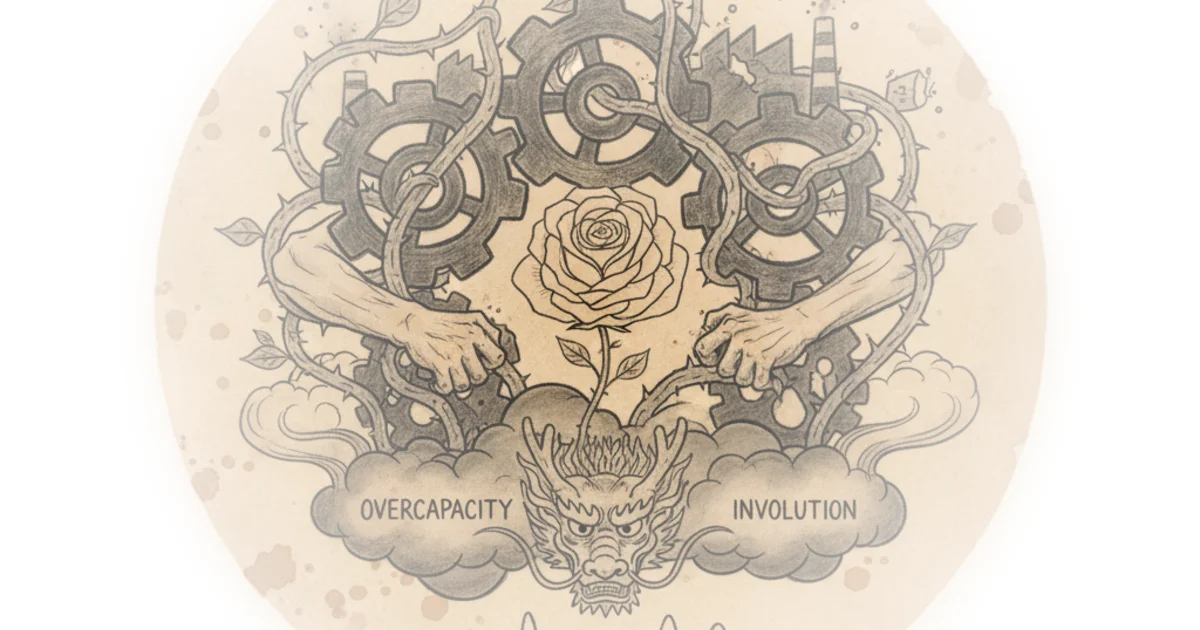
In mid-2024, Beijing executed a subtle but critical semantic pivot, rebranding its industrial surplus not as "overcapacity" but as "involution." This isn't merely a linguistic game; it signals a fundamental shift in how the Chinese state perceives its own economic mechanics and rejects the Western premise that global supply must be capped. Kaiser Kuo, analyzing the latest Trivium China podcast, reveals that this terminological shift is a strategic defense mechanism designed to reframe the problem from a global imbalance to an internal efficiency crisis.
The Semantic Shield
Kuo highlights how the Chinese leadership initially acknowledged "overcapacity" during the 2023 Central Economic Work Conference, only to retreat from the term once Western powers seized upon it as a justification for tariffs. The pivot to "involution" is deliberate. As Kuo notes, the concept of involution describes "a situation in which additional inputs don't yield a proportional increase in outputs." This distinction is vital because it shifts the blame away from the sheer volume of production and onto the nature of domestic competition.
The argument rests on a provocative economic theory: that in a truly free market, overcapacity is a temporary illusion. Kuo explains that Beijing's logic dictates that "in a global free market economy, overcapacity cannot exist" because demand will eventually adjust to prices, and future demand is inherently unpredictable. This framing allows the state to argue that current gluts in electric vehicles or solar panels are merely investments in future growth, not market distortions. Kuo points out that the Development Research Commission of the State Council explicitly argued that investment in sectors like EVs is "mostly about matching expected future demand."
This reasoning is intellectually consistent but politically convenient. By defining overcapacity out of existence, the administration avoids the admission that its subsidy-heavy industrial policy has created a supply shock that the global market cannot immediately absorb. Critics might note that this theory ignores the reality of state-subsidized pricing, which allows Chinese firms to undercut competitors regardless of actual market demand, effectively forcing higher-cost producers out of business before demand can naturally rise.
"The real issue here is they want to stop Chinese firms from eating each other's lunch."
The Internal Battle
The most striking insight Kuo draws from the podcast is that the Chinese state's primary concern is not global equilibrium, but domestic profitability. The term "involution" captures the self-destructive nature of cutthroat competition among Chinese firms, where price wars erode margins to the point where no one makes a profit. Kuo writes, "The goal here isn't to bring about a global equilibrium that will reestablish a more equitable playing field for foreign competitors. The real issue here is they want to stop Chinese firms from eating each other's lunch."
This reframing changes the policy response. Instead of closing factories to reduce global supply, the state seeks to consolidate the industry, ensuring that the surviving giants can eventually service the world without destroying their own balance sheets. Kuo observes that the state's investment strategy was never intended to result in a scenario where "no one's earning any profits, where employees are struggling under a constant state of uncertainty about their job prospects." The shift to addressing "involution" is essentially an attempt to stabilize the domestic economy by curbing the very competition the state previously encouraged.
This perspective offers a crucial nuance often missing from Western trade war rhetoric. While the West sees a threat to its own industries, Beijing sees a threat to its own tax base and social stability. The policy implication is that future Chinese actions will likely focus on mergers, acquisitions, and export discipline rather than simple production cuts. However, this approach assumes that the state can successfully manage a transition from chaotic competition to coordinated oligopoly without triggering a deeper economic slowdown.
Bottom Line
Kuo's analysis effectively exposes "involution" as a strategic rebranding that allows Beijing to reject the premise of overcapacity while addressing the real economic pain of margin erosion. The strongest part of this argument is the distinction between a global supply problem and an internal efficiency crisis, but its biggest vulnerability lies in the assumption that future global demand will inevitably catch up to current Chinese production capacity. Readers should watch for whether Beijing's new anti-involution policies result in actual supply consolidation or merely a temporary pause in the price wars that have defined recent years.