This piece cuts through the glossy narrative of China's economic miracle to expose a rotting foundation in its northeast, arguing that the region's decline isn't just an economic statistic but a ticking political time bomb. Asianometry doesn't just recount the history of coal; they reveal how the very institutions designed to stabilize the Communist Party are now the primary drivers of local resentment and social fragility. For a busy listener, this is essential context for understanding why Beijing is suddenly desperate to break its own taboos to save a region that once built the nation.
The Eldest Son's Burden
Asianometry frames the story through a historical lens that is often overlooked in Western analysis: the Northeast provinces of Liaoning, Jilin, and Heilongjiang were not merely industrial hubs, but the "country's eldest son," a term used by Chairman Mao to acknowledge their foundational role in the revolution and early industrialization. The author notes that while coastal cities like Shanghai and Shenzhen surged ahead during the economic opening, these rust belt cities were left behind as the centrally planned model faded. "Many of these government-owned companies found themselves financially burdened by the load of having to pay fat salaries and give out free Social Welfare perks to its workers," Asianometry writes, highlighting the unsustainable social contract that once guaranteed lifetime employment. The commentary here is sharp because it connects the abstract concept of "state-owned enterprise reform" to the visceral reality of a worker losing their home, their child's education, and their healthcare all at once. This framing effectively humanizes the macro-economic shift, showing that the transition from a planned to a market economy was not a clean break but a traumatic severing of the social safety net.
"The city story is not unique in the Heilongjiang province... left behind cities like Fushun incubate political threats to the Communist Party's role."
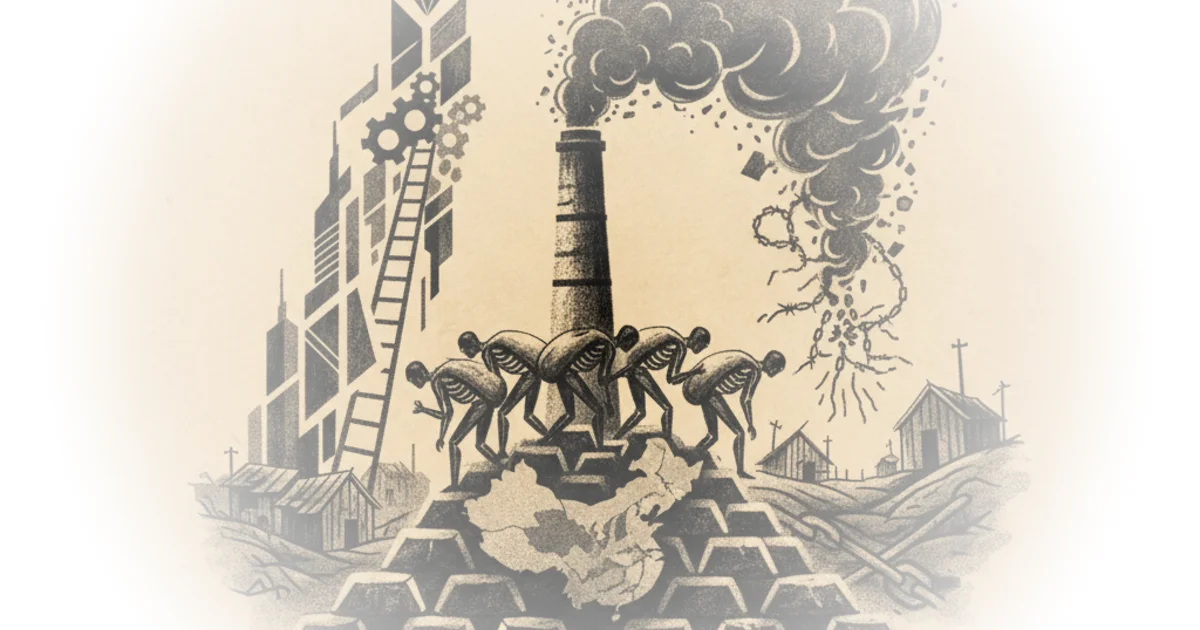
The author's choice to focus on Fushun as a case study is particularly effective. Asianometry details how the city, once a model of socialist economy, watched its coal reserves dry up in the early 1990s, leading to a catastrophic reckoning in 1998 when 200,000 workers were laid off. "Protests exploded across the city," the author notes, illustrating the immediate volatility that accompanies such economic shocks. The analysis suggests that the local government's response—selling rural land to developers to plug financial deficits—only deepened the crisis, creating ghost cities and shanty towns side-by-side. This evidence holds up well against the broader narrative of China's urbanization, but it also points to a critical flaw in the central government's approach: treating symptoms rather than the disease. Critics might argue that the environmental benefits of closing these mines outweigh the social costs, but Asianometry rightly points out that "joblessness is a serious problem especially for a developing government that is not a democracy," where the lack of political outlets for frustration can lead to radicalization.
The Zombie Economy and Failed Revival
The piece then pivots to the central government's attempts to revive the region, describing a cycle of well-intentioned but ultimately futile interventions. Asianometry describes how Beijing directed massive investments into agriculture and wind power, hoping to replicate the success of the coastal provinces. "The companies being controlled by the government had no choice but to comply," the author writes, explaining how these directives led to the creation of "zombie companies" that survived only on subsidies without generating real profit. This is a crucial insight: the problem isn't a lack of investment, but a lack of market logic. The author argues that these projects were "vastly unprofitable with just too much competition," serving more as political photo-ops than economic engines. The commentary here is compelling because it exposes the rigidity of the system; even when the central government recognizes a failure, the mechanism to correct it is slow and often counterproductive. The attempt to turn Fushun into a wind power hub, for instance, resulted in heavy industrial products that "were not able to do it more efficiently than the market," leaving the region with debt and no jobs.
"You can't just repurpose trains and hardware for coal overnight; it takes time and investment and government support."
Asianometry also tackles the popular counter-argument that these cities should pivot to light industry, such as textiles and electronics. The author dismantles this idea by pointing out the demographic reality: "The young and educated have already left... only the old, middle-aged and uneducated who remain." This observation is a stark reminder that economic policy cannot simply wish away human capital flight. The argument that local governments should attract investment in electronics is logically sound in a vacuum, but Asianometry correctly identifies the structural barriers: the labor force is not suited for intricate work, and the infrastructure is geared toward heavy industry, not export logistics. The author suggests that the real solution lies in administrative reform, noting that "core issues remain like unending useless regulations and a myopic focus on land sales that chokes off any potential economic growth." This is the piece's most provocative claim: that the solution requires the government to "bring on fresh blood and drive with a goal towards refocusing its priorities," a move that would challenge the very bureaucracy that created the problem in the first place.
Bottom Line
Asianometry's strongest contribution is the reframing of China's rust belt not as a forgotten economic backwater, but as a direct threat to the legitimacy of the Communist Party, forcing the regime to confront its own policy failures. The argument's biggest vulnerability is its reliance on the assumption that administrative reform is politically feasible in a system that prioritizes stability over efficiency, a tension the author acknowledges but cannot fully resolve. Readers should watch for how Beijing navigates this dilemma in the coming years, as the pressure to save the "eldest son" grows alongside the risk of social unrest. The piece leaves us with a sobering truth: in a non-democratic system, economic stagnation is not just a numbers game; it is a precursor to revolution.