In an era where digital tools aggressively streamline and sanitize our writing, Justin E. H. Smith argues that the very act of preserving the messy, specific details of language—down to the space before a semicolon—is an act of resistance against a homogenizing technological force. This is not merely a pedantic complaint about style guides; it is a profound meditation on how the automation of language erases history, culture, and the human labor of thought itself. Smith suggests that when we let algorithms decide how a book title is capitalized or a city name is transliterated, we are not just saving time; we are actively participating in the "systematic effort... to efface all written traces" of the traditions that shaped our intellectual world.
The Violence of Autocorrect
Smith begins by dismantling the assumption that language rules are arbitrary. While we accept that the word "dog" is just a sound we agree upon, Smith points out that the convergence of the English "dog" and the extinct Aboriginal Mbabaram language's "dog" hints at something deeper, a "true Adamic dog-nature." Yet, he argues, the real arbitrariness lies in punctuation. He spends years forcing himself to insert a space before a semicolon when writing in French, a habit that feels "unnatural" in English but is mandatory in French. He illustrates the rigidity of these rules with a graffiti quote he once saw: "La France, c'est comme ta mère : pas de règles !" (France is like your mother: no rules!), noting the irony that the author broke the very rule of spacing he was mocking.
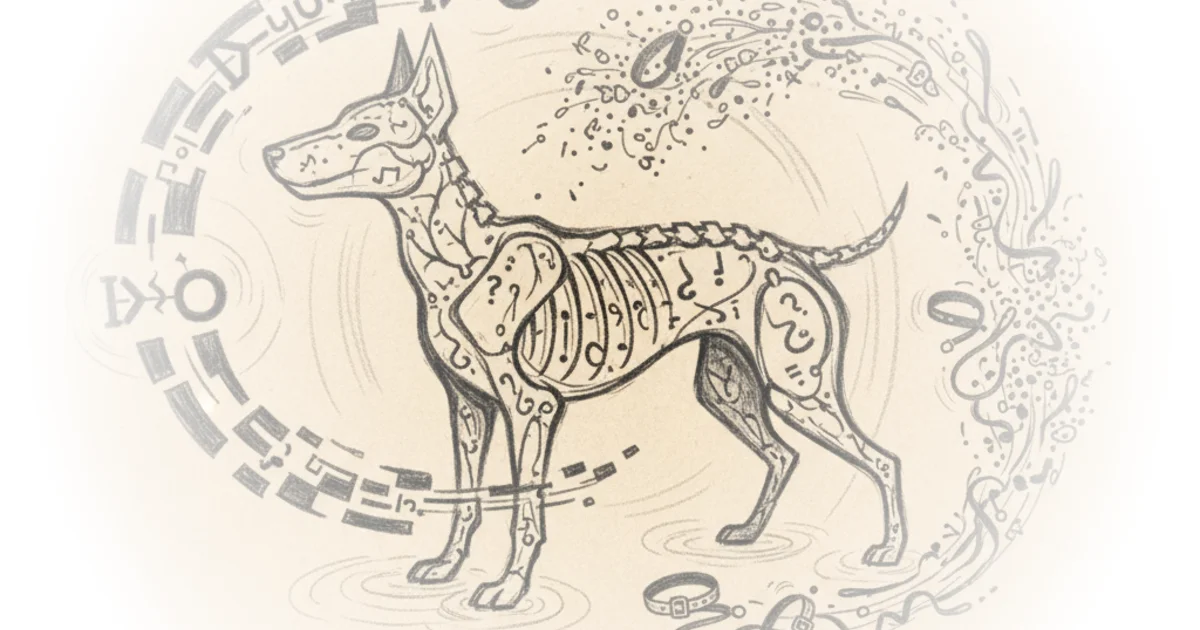
The core of Smith's argument is that these micro-decisions in bibliography are not trivial. They are the gatekeepers of cultural context. When citing a French work in an English publication, the writer faces a "grotesque hybrid" of systems. Should one use English quotation marks with French spacing, or French guillemets with English spacing? Smith notes that guillemets (the « » marks) "simply do not exist in English, strictly speaking," yet to remove them is to strip the text of its original texture. He draws a parallel to the Mbabaram language, where a single word for "dog" emerged independently, suggesting that while words can be accidental, the systems we build around them are deliberate acts of preservation.
"I do not experience this as mere automated correction, but as true violence."
Smith's most striking claim is that modern word processors are not neutral tools but active agents of destruction. He describes his computer's relentless attempt to delete the final 'e' from the Latin title De Interpretatione as a "tradition-hating work" performed by a "Perecian evil demon." This is not just a glitch; it is a reflection of a broader cultural shift where the "fundamental hostility to tradition" of our technological reality seeks to flatten all linguistic nuance. He contrasts this with the hypothetical word processors of 400 years ago, which he imagines would have been "engines for the preservation of good Latinitas," equipped with a "spring-driven hammer to pop out and rap your knuckles" for grammatical errors.
Critics might argue that Smith's romanticization of pre-digital precision ignores the accessibility gains of modern standardization. If every scholar had to manually type out archaic Cyrillic hard signs or preserve the plural forms of ancient city names, the barrier to entry for academic work would skyrocket, potentially silencing voices that don't have the luxury of artisanal labor. However, Smith counters that this efficiency comes at the cost of depth, turning the "city of publication" from a historical marker into a generic data point.
The Art of the Footnote
Smith positions himself as an "organic" and "artisanal" footnoter, refusing to use citation management software. He types every one of the 628 footnotes in his current 103,000-word manuscript by hand, letter by letter. He views these footnotes not as administrative burdens but as the "roots and leaves" of the text, anchoring it to the world while ornamenting it. This manual process, he argues, forces the writer to engage with the material in a way that automation prevents.
He illustrates the complexity of this engagement with a hypothetical citation of a 17th-century Dutch scholar, Christiaan Huygens, whose name might be transliterated from Cyrillic as "Giuŭgens" in a pre-Soviet context. Smith asks whether we should translate the city name "Saint Petersburg" or preserve the archaic "Sankt-Peterburg," complete with the hard sign that looks like a misplaced quotation mark. He concludes that any attempt to standardize these entries results in a "monstrosity"—a "hybridization of two systems" that is inevitably "wrong."
"The footnotes are the roots and leaves at once of the text, which both anchor it to the world and ornament it."
This section highlights the tension between legibility and fidelity. Smith admits that his hybrid citations are "wrong" by any single standard, but he insists that this "intractable problem" is the price of doing serious work. He contrasts the modern tendency to strip away the "vestigial pluralizations" of city names (like the plural "Athens" or the lost "Lions" of Lyon) with the richness of the Latin genitive, which preserves strata of meaning that national languages have lost. For Smith, the city name "Ratisbonae" tells a different story than "Regensburg," and to lose the former is to lose a piece of history.
The End of Pure Poiesis
The piece culminates in a broader critique of artificial intelligence and the outsourcing of language. Smith suggests that the anxiety surrounding large language models (LLMs) is misplaced because the process of automating language has been underway for decades. "Many of you have in any case already been letting the machines make your language for you for some time now," he writes, noting that the arrival of AI is merely "the end of a process, not the beginning of it."
He argues that the "writerly care" required for a footnote has fallen beneath the "seuil de perception" (threshold of perception) for many because they have already outsourced their linguistic power to word-processing prostheses. The fear of AI-generated text, he implies, is a delayed reaction to the loss of agency that began with the first spell-checker. Smith concludes by reflecting on his own recent work with the Sakha language, where he marvels at how "subtleties of meaning can get packed, morpheme by morpheme, into agglutinative chains." This richness, he suggests, is what is at stake when we allow machines to dictate the structure of our writing.
"If full-blown solicitous writerly care for the footnote falls beneath your seuil de perception, this is only because you are unaware of how much of your own linguistic power you have already outsourced to word-processing prostheses."
A counterargument worth considering is that Smith's ideal of "pure poiesis" (pure creation) is perhaps a nostalgic illusion. The history of writing is one of constant adaptation to new tools, from the quill to the printing press to the typewriter. Each tool changed the nature of the text, yet none eliminated the human capacity for creativity. Smith's resistance to automation might be less about preserving beauty and more about resisting the inevitable evolution of how knowledge is produced and shared.
Bottom Line
Justin E. H. Smith delivers a powerful, if somewhat melancholic, defense of the messy, labor-intensive details of scholarly writing. His strongest argument is that the standardization of language through digital tools is not a neutral efficiency but an active erasure of historical and cultural nuance. While his refusal to compromise on citation styles may seem impractical to the busy modern reader, his warning that we are losing the ability to perceive the depth of our own language is a crucial intervention. The piece serves as a reminder that in a world of automated convenience, the most radical act may be to insist on the difficult, the specific, and the historically grounded.
"It's been a technology all along, I mean, and you're going to have to go pretty far back in time, likely back to the age of oral composition techniques, if what you're looking for is pure poiesis."
The biggest vulnerability in Smith's argument is its potential elitism; the "artisanal" approach he champions is a luxury that not all writers can afford, and the resulting "monstrosities" of hybrid citation may indeed confuse rather than enlighten the general reader. However, as a critique of the invisible hand of algorithmic standardization, his work is essential reading for anyone concerned with the future of human thought in the age of artificial intelligence.