More Perfect Union exposes a brutal reality that often gets lost in political rhetoric: the machinery of American manufacturing is being dismantled not by market forces alone, but by a deliberate, decades-long strategy of corporate coercion. While politicians promise to save jobs, the article reveals how companies like John Deere and Case New Holland have weaponized the threat of offshoring to suppress wages, fracture unions, and ultimately move production to Mexico and Italy anyway. This is not just a story about trade deficits; it is a forensic look at how the promise of "Made in the USA" has become a marketing label for a globalized supply chain that leaves American workers holding the bag.
The Architecture of Fear
The piece opens by dismantling the patriotic branding of these industrial giants. More Perfect Union writes, "the truth is the biggest companies that make farm equipment and construction equipment... have been moving their jobs overseas." They argue that the corporate narrative is not about efficiency, but about power. The author details how John Deere, after posting $10 billion in profits and spending $8 billion on stock buybacks in 2023, still chose to cut its workforce in Atuma, Iowa, by a third.
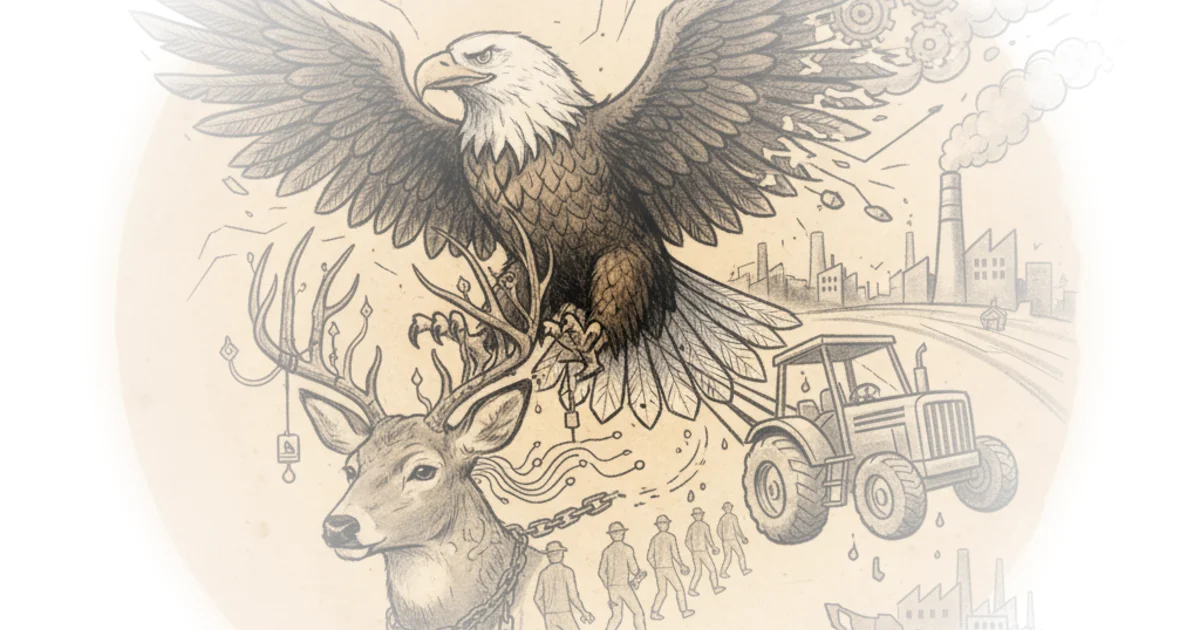
The core of the argument rests on the idea that these corporations have perfected a "divide and conquer" strategy. As More Perfect Union puts it, "The company wants us to live in that constant state of fear... they had the gun in our head, they had it cocked as well." This framing is effective because it shifts the blame from abstract economic trends to specific, calculated management decisions. The evidence presented—layoffs following wage gains, and the implementation of two-tier wage systems—suggests that the goal was never to keep production in the US, but to extract maximum concessions before moving the line.
"The company wants us to live in that constant state of fear. They had the gun in our head, they had it cocked as well."
The Legacy of Trade Deals
The commentary traces the roots of this displacement back to the North American Free Trade Agreement (NAFTA), arguing that the agreement was a bipartisan failure that prioritized corporate mobility over worker stability. More Perfect Union notes that since NAFTA, union membership in Iowa and surrounding states has been cut nearly in half. The article highlights how the threat of moving to Mexico was used to force a two-tier system, where new hires earned significantly less than veterans for the same work.
Nick Gery, a union president interviewed in the piece, explains the human cost: "It creates issues in the workplace... we had members that would work 40 plus hours a week in that plan still qualify for state aid, food assistance." This detail is crucial; it illustrates that even full-time employment at a billion-dollar corporation was insufficient to live on. The argument here is that the "race to the bottom" was institutionalized through trade policy, creating a permanent underclass of workers who are desperate to keep their jobs, no matter the cost.
Critics might note that trade deals also lowered consumer prices and allowed for the export of high-value services, but the article effectively counters this by showing that the gains were overwhelmingly captured by shareholders via buybacks, while the losses were concentrated on the factory floor. The narrative suggests that the "efficiency" gained was actually just a transfer of wealth from labor to capital.
The Limits of Enforcement and the Tariff Gamble
The piece then pivots to the modern era, examining the United States-Mexico-Canada Agreement (USMCA) and the Biden Administration's attempts to enforce labor standards. While the administration did use the agreement to reinstate a fired union organizer at a Caterpillar plant in Mexico, the article points out a glaring failure: the administration refused to sanction the company for blacklisting strikers, a tactic that effectively ended the organizer's career.
More Perfect Union writes, "Victor and his colleagues have now been on strike for over a year... resenting those workers isn't going to change a damn thing." This highlights a critical vulnerability in the current approach: without the threat of severe economic consequences, international labor enforcement is toothless. The article then addresses the incoming administration's proposed solution: massive tariffs. While the author acknowledges that a 200% tariff could theoretically make offshoring too expensive, they warn that tariffs alone are not a silver bullet.
The argument suggests that without parallel government investment in domestic high-wage industries, tariffs could simply lead to higher prices for consumers without bringing jobs back. As More Perfect Union notes, "if tariffs are not combined with government support for high wage industries, they can only help workers so much." This is a nuanced take that avoids the trap of simple protectionism, recognizing that capital will find a way to move unless the cost of staying in the US is actively subsidized.
"We made great gains but at the end of the day when you punch a bully in the mouth, sometimes the bully brings friends."
Bottom Line
More Perfect Union delivers a searing indictment of the gap between political promises and corporate reality, proving that the threat of offshoring has been a deliberate tool of labor suppression for decades. The piece's greatest strength is its refusal to let politicians off the hook, showing that both the trade deals of the past and the tariff threats of the present have failed to stop the exodus of American manufacturing jobs. The biggest vulnerability of the current strategy is the lack of a comprehensive industrial policy that makes staying in the US more profitable than leaving; until that equation changes, the "gun in the head" of the American worker will remain cocked.