In a digital landscape saturated with alarmist headlines about artificial intelligence devouring the planet's resources, Andy Masley offers a rare, data-driven pause button. Rather than adding to the noise, he argues that the public conversation has finally matured enough to move beyond debunking basic myths and toward more nuanced, high-impact policy debates.
The Shift from Exploration to Exploitation
Masley begins by reflecting on a six-month deep dive into the intersection of AI and environmental impact, a project born from frustration with the "wildly inaccurate confident beliefs" circulating among the public. He notes that early coverage often relied on absurd comparisons, such as claims that a single chatbot session consumes more energy than a human lifetime, without providing necessary context. "Every piece of news coverage I was reading had ridiculous comparisons... and no one doing the simple David MacKay move of actually putting the numbers in context," Masley writes. His approach was to apply fundamental physics and high school-level math to strip away the hysteria, a method that resonated with 230,000 readers and earned him the moniker of the "AI water guy."
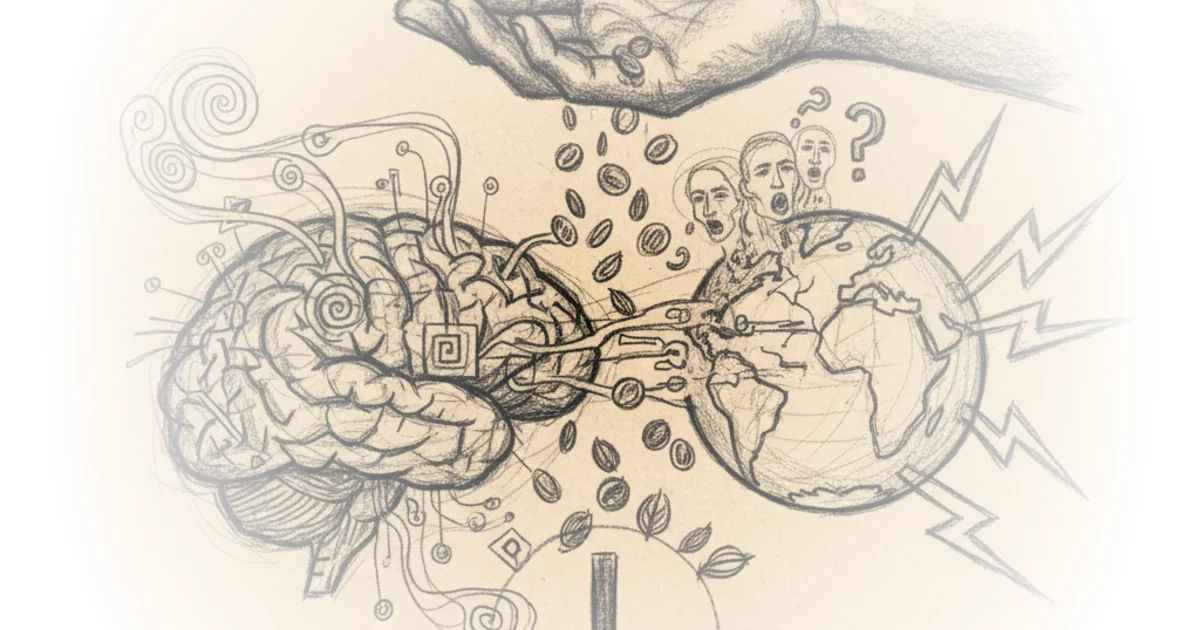
The core of Masley's current argument is that the public discourse has reached a tipping point. He observes that everyday people are now converging on the correct objections: while personal prompt costs are negligible, the aggregate strain of data centers on the electrical grid is a genuine concern for the green energy transition. "Everyday people are converging on the correct objections," he notes, suggesting that his role as a primary debunker is no longer as critical. This shift allows him to reframe the issue not as a battle against misinformation, but as a strategic pivot to more complex problems like land use and local electricity pricing.
"I've gotten most of the 'explore' out of the way, what's left to do is 'exploit.'"
Masley invokes the "explore-exploit trade-off" to justify stepping back. He argues that he has mapped the contours of the debate and now faces a choice: continue repeating the same few facts about water usage or redirect his energy toward more impactful areas. He admits that while a YouTube overview might maximize audience reach, he currently lacks the capacity for it. Instead, he is choosing to prioritize other high-leverage topics, including misuse risks from advanced AI systems, animal welfare ethics, and the geopolitical dynamics of AI development between the US and China.
Critics might note that stepping away from the water debate just as it enters the policy phase could leave a vacuum for bad actors to fill with new misinformation. However, Masley counters this by suggesting that the foundational facts are now stable enough for others to pick up the baton, urging the community to "start doing these deep dives yourself" using the same accessible math and physics he employed.
A Bounty for Accuracy
Perhaps the most distinctive element of Masley's commentary is his offer of a financial bounty to challenge his own work. In an era where fact-checking is often reactive and partisan, he proactively stakes his reputation—and $50—on the integrity of his data. He outlines specific criteria for a successful challenge: finding a legitimate source that proves he lied about a statistic, cited an illegitimate source, or made a calculation error that invalidates a core argument.
"I will send you $50 if you can find: A legitimate source for a statistic I cite where I lie about the number it's giving or I get it wrong, which invalidates a core argument I'm making," Masley writes. He carefully distinguishes between minor rounding errors and fundamental flaws, noting that if a median chatbot prompt actually uses 300 watt-hours instead of 0.3, he would happily pay up. This transparency is a powerful tool for building trust, especially given the complexity of the data involved.
Masley also addresses the nuances of water accounting, acknowledging that definitions of "water use" vary wildly depending on whether one counts rainfall on crops or water in hydroelectric dams. He admits to taking a "middle ground" on these issues to avoid getting bogged down in semantic arguments that could lead to oscillating conclusions. "I'm vetoing very specific disagreements of what counts as 'using' water," he states, prioritizing the spirit of the data over technicalities that obscure the bigger picture.
"If I did a calculation wrong and 0.0000102% should actually be 0.0000103%, I'm not going to consider that to be invalidating. But if I say the median chatbot prompt uses 0.3 Wh, and it actually uses 300 Wh, that does invalidate a core claim I make."
This section of the piece serves as both a challenge to skeptics and a manifesto for rigorous, open-source journalism. By inviting public scrutiny and offering a reward for errors, Masley transforms the typical adversarial relationship between writer and critic into a collaborative pursuit of truth. He even offers a "wall of shame" for those who successfully prove him wrong, demonstrating a level of intellectual humility that is increasingly rare in the tech commentary space.
Bottom Line
Masley's decision to pause his AI-environment series is a strategic retreat from a battle he has largely won, allowing him to focus on the more complex, high-stakes policy questions that lie ahead. While the risk of leaving the water debate to others is real, his offer of a bounty for factual errors and his call for more voices to join the analysis provide a robust safety net for the ongoing conversation. The strongest part of his argument is the recognition that effective altruism requires knowing when to stop optimizing a local maximum and move toward a greater global good.