This piece doesn't just recount the history of timekeeping; it exposes a profound market failure where the most precise instrument in history nearly killed the industry that built it. Works in Progress argues that the survival of Swiss watchmaking wasn't a triumph of engineering, but a radical pivot to selling human imperfection in an age of digital perfection. For busy leaders watching how legacy industries adapt to disruption, the story of how a brand was saved by refusing to be the best at its original job is a masterclass in strategic repositioning.
The Great Disruption
The narrative begins not with a victory, but with a near-death experience. The piece sets the scene in April 1984, describing two men sleeping in a car park in Basel, pitching a brand that had all but vanished. "The Swiss watch industry is in a tailspin, disrupted by a new technology, the quartz wristwatch, that has left Switzerland's traditional watchmakers obsolete." This framing is crucial because it strips away the romanticism of the industry to reveal a brutal economic reality: Japanese factories were producing watches that were faster, cheaper, and more precise. The data is stark. "Over half of Switzerland's watch companies collapse. Two thirds of its watchmaking jobs disappear."
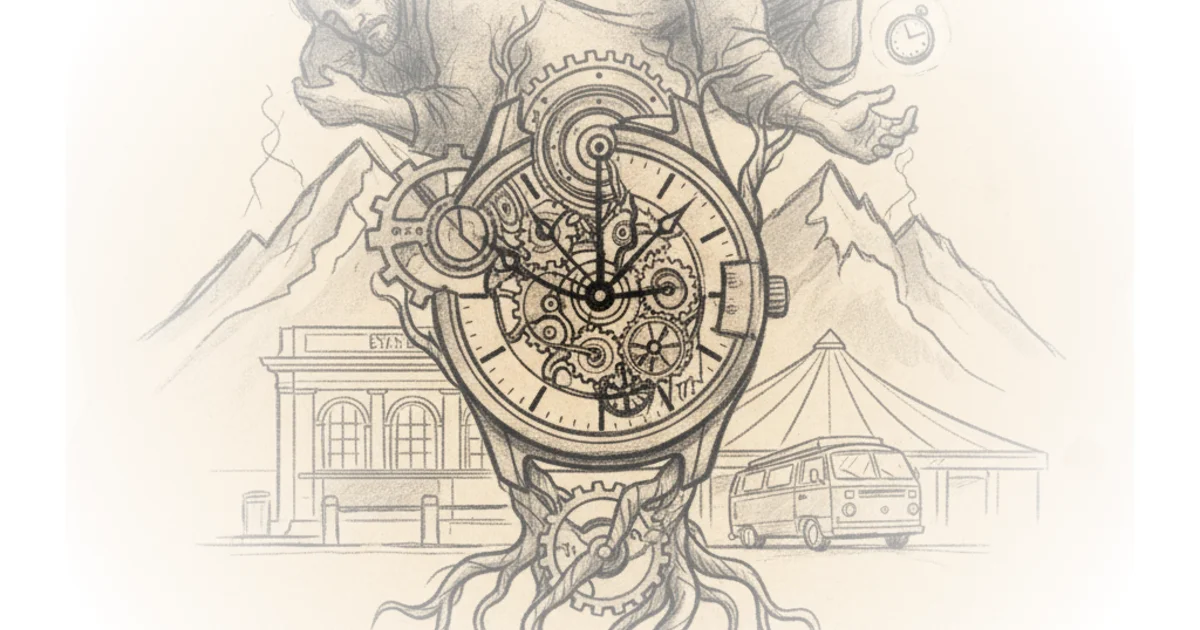
The article effectively uses the history of the "Quartz crisis" to illustrate how a superior technology can destroy a market leader. It notes that while the Swiss had dominated the market for centuries, winning every chronometry competition from 1907 onwards, they failed to see the threat until it was too late. The piece highlights a critical strategic error: the Swiss had set up an industrial laboratory to study quartz but "did not pursue it as doggedly as Seiko." This oversight allowed a competitor to leverage the piezoelectric effect—where crystals vibrate at a precise frequency when charged—to create a movement that was mathematically superior to the mechanical escapement.
"The quartz timekeeper is a superior instrument in terms of both precision and price, and is bound to win out."
This quote, attributed to historian David Landes, captures the prevailing wisdom of the era. It was a rational conclusion based on the metrics of the time: accuracy and cost. Critics might note that Landes' prediction seemed inevitable because the industry was measuring success by the wrong variables. By focusing solely on functional precision, the Swiss missed the emerging value of emotional resonance. The piece suggests that the industry's survival depended on realizing that a watch was no longer just a tool for measuring time, but a vessel for human identity.
The Pivot to Artistry
The turning point arrives with the acquisition of Blancpain by Jean-Claude Biver and Jacques Piguet. The article details their audacious strategy: to reject the very technology that was destroying them. "Biver developed a theory: Swiss watchmaking could survive only by rejecting quartz and doubling down on high-end, handmade mechanical watches." This was a counter-intuitive move in a market that was racing toward efficiency. While Seiko was slashing power consumption and adding calculators, Biver was positioning his brand as the antithesis of the machine.
The piece brilliantly contrasts the utilitarian origins of the wristwatch with this new philosophy. Historically, watches were tools for war and industry; the Rolex Submariner was "standard military issue for Royal Navy divers." But Biver saw that in a world where machines were taking over, the premium would shift to the work of human hands. The slogan they devised was a direct challenge to the era's logic: "Since 1735, there has never been a quartz Blancpain watch. And there never will be."
This argument lands because it reframes the product entirely. Instead of competing on accuracy, they competed on the narrative of craftsmanship. The article notes that "Biver's philosophy was that watches are not just functional tools but artistic objects, designed not merely to tell the time, but to convey something about the wearer." This shift from utility to artistry is the core of the modern luxury watch market. It is a lesson in how to survive a technological singularity: do not try to out-engineer the machine; become the human alternative.
"That famous quartz precision became the enemy, and the mechanical imperfection became the selling point."
While the piece makes a compelling case for this pivot, it glosses over the immense risk involved. Betting the entire industry on the idea that consumers would pay thousands for a device that loses seconds per day, when a dollar battery could keep perfect time, was a gamble on human psychology that could have easily failed. The success of this strategy relied on a cultural shift that wasn't guaranteed. Yet, as the article shows, the gamble paid off, transforming the Swiss watch industry from a manufacturing sector into a luxury powerhouse.
Bottom Line
The strongest part of this argument is its clear demonstration that technological superiority does not guarantee market dominance when the definition of value changes. The piece's biggest vulnerability is its focus on the success of the pivot without deeply exploring the thousands of workers and smaller firms that were left behind in the transition. For the reader, the takeaway is clear: in the face of disruptive innovation, the most powerful strategy may be to stop trying to be the best at the old game and start defining a new one where your unique strengths are the only metrics that matter.