Here is my adapted article:
The System That Silences Serious Journalism
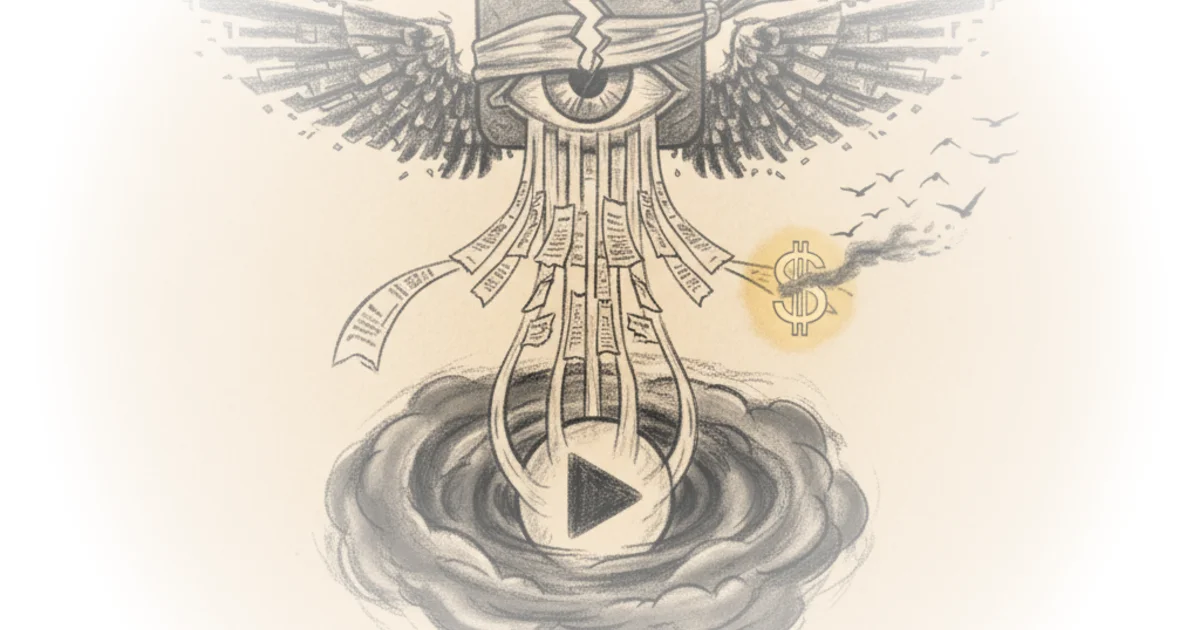
A video examining Jeffrey Epstein's files was on track to become Patrick Boyle's most successful upload—gaining one million views in just 24 hours. Then YouTube's dashboard showed a yellow dollar sign. The video had been demonetized, and with it went the platform's recommendation engine support. View counts flatlined immediately.
The content was a 37-minute analysis of inconsistencies in Epstein's files, specifically regarding FBI redactions that appeared to violate transparency laws passed by Congress. No profanity. No violence. No inappropriate imagery. The audience metrics told a different story: 90,000 likes with a 98.9% like-to-dislike ratio—unusually high approval suggesting viewers found the content valuable.
How YouTube's System Works
To understand why this happens, one must look back to the YouTube ad apocalypse. After Logan Paul's infamous vlog in a Japanese forest triggered massive advertiser exodus, big brands paused their YouTube campaigns. YouTube responded by drastically tightening creator guidelines. If creators wanted advertising money, they couldn't behave like Logan Paul.
The problem is that this mechanism has evolved into a blunt instrument. Advertisers routinely buy slots on mainstream cable news programs discussing war, crime, and political corruption. Yet when independent creators examine these same topics with equal rigor, the algorithm flags them as inappropriate.
One creator's experience suggests YouTube operates an arbitrary system where demonetization depends less on subject matter and possibly more on the algorithmic status of the uploader.
The Research on Censorship by Proxy
Researchers have termed this problem "censorship by proxy." A 2022 study found that demonetization effectively acts as a censor because it creates financial disincentives for creators to cover risky topics. The algorithm favors safe metrics like channel size and video duration over specific content details. Creators build trust with the algorithm, and once trusted, they're less likely to be demonetized.
The study also shows that when the algorithm decides a topic is unsafe, it restricts distribution—making content almost invisible to all but the most dedicated subscribers. This safety filter notoriously fails to grasp context. One creator documented that educational videos on World War II were demonetized simply for displaying a clip of a flag from that period or discussing the September 11th attacks.
This has given rise to what's known as "algo speak"—a surreal new online dialect where creators replace clinical terms with nonsense words, hoping to slip past automated filters. Serious discourse becomes a childish code, degrading information quality in exchange for algorithmic safety.
Why This Format Matters
The format of online video offers something traditional media often can't: depth. A cable news segment lasts four minutes. A newspaper article runs around 700 words. The video was 37 minutes long and attempted to give a balanced view of what government documents revealed and why it matters.
This long-form format allows detailed examination of complex timelines—like the fact that Epstein was first reported to the FBI in 1996 or that his financial crimes date back to the 1970s. It permits exploration of systemic failures spanning multiple administrations rather than reducing stories to partisan soundbites.
When algorithms penalize this type of depth, they don't just hurt creators—they harm public understanding of complex topics.
The Broader Implications for Press Freedom
The United States has recently fallen to 57th out of 180 countries ranked for press freedom. It's seemingly easier for politicians to coerce the few remaining broadcast giants than to go after millions of independent bloggers and YouTubers.
Yet if the primary platform for independent video journalism effectively taxes serious reporting by removing its revenue and reach, that ranking will likely slide even lower.
YouTube is not merely an American platform—it has global reach. In countries with strict state censorship, citizens often rely on VPNs to access YouTube as one of the few windows into the unfiltered world. If the platform itself begins to sanitize content to appease Western politicians or advertisers, it inadvertently aligns with the goals of restrictive regimes.
By disincentivizing coverage of serious topics, YouTube shuts off the escape valve for global information, homogenizing the internet into a safe, corporate-friendly feed that challenges no one.
There's a distinct irony to digital censorship: attempts to suppress information often make it more popular. After a community update explaining the video had been demonetized, thousands of viewers watched it specifically because it was flagged. The like-to-dislike ratio went even higher and many new viewers subscribed.
Counterarguments Worth Considering
Critics might note that this analysis risks overstating YouTube's role in suppressing information. The platform remains one of the few spaces where independent voices can publish without gatekeepers, and demonetization affects only a fraction of content creators. Additionally, YouTube's recommendation algorithm has also helped expose stories that traditional outlets ignored—suggesting the system isn't purely suppressive.
A counterargument worth considering is that the Epstein story itself remains deeply contested. The author frames it as a moral scandal about a two-tier justice system, but many reasonable people view the coverage differently—some see conspiracy theories, others see legitimate accountability journalism. The piece doesn't fully acknowledge this divide.
When algorithms penalize depth and discussion, they don't just hurt creators—they harm public understanding of complex topics.
Bottom Line
Boyle's strongest argument is the empirical one: demonetization data shows the algorithm suppresses serious coverage regardless of audience reception. His biggest vulnerability is strategic—he frames this as a press freedom issue but offers no concrete solution beyond raising awareness. The system he documents is real, but whether it's truly censorship or market dynamics remains contested. What comes next will likely depend on what creators do with their growing awareness of these invisible constraints.