Derek Muller's Veritasium piece makes a startling claim: the universe is hostile to computers. Not through malware or hackers, but through cosmic rays — high-energy particles raining down from exploding stars that can flip bits inside machines we trust to be reliable. The evidence he marshals is extraordinary: in 2003, Belgian voter Maria Vindevogel received exactly 4,096 extra votes — a number so precise it points directly to a single bit flip. "The 13th bit had to flip from a zero to a one," Muller writes, explaining how binary computers store numbers as powers of two.
The Mystery of the 4,096 Votes
What makes this story compelling is how thoroughly investigators ruled out every other explanation. Belgian election officials re-ran the magnetic cards multiple times and got identical results — except for Vindevogel, whose tally remained inflated by exactly 4,096 votes. Computer experts combed through software, tested hardware repeatedly, found no bugs. The only remaining explanation was seriously weird: a cosmic ray had struck a transistor inside the counting machine and flipped one bit from zero to one.
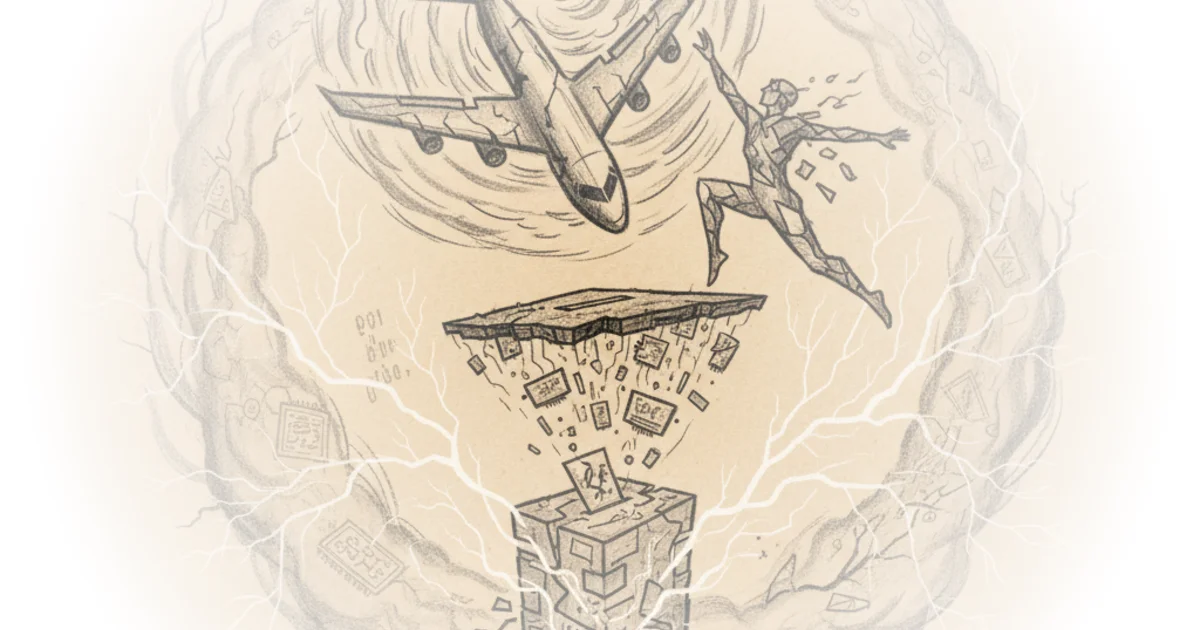
Muller traces this phenomenon back to the 1970s, when Intel discovered similar errors in their memory chips. "The problem turned out to be the ceramic packaging the chip was encased in," he writes, with uranium and thorium contaminating materials downstream of an old Colorado uranium mill. Alpha particles emitted by these radioactive elements could create enough charge to flip a one to a zero — this is known as a single event upset.
The Discovery of Cosmic Rays
The piece pivots to the early 20th century, telling how Victor Hess discovered cosmic rays through balloon experiments up the Eiffel Tower and beyond. Muller writes that "the radiation appeared to be coming not from the Earth but from the sky" — and it wasn't from the Sun during solar eclipses. These are particles from exploding stars and black holes, traveling at nearly the speed of light.
The most dramatic illustration is the OMG particle detected in 1991: a single subatomic particle with the energy of a baseball moving 100 kilometers per hour. From one primary cosmic ray comes an entire shower of particles — protons, neutrons, muons, electrons — colliding with air molecules at about 25 kilometers above ground.
Speedrunners and Glitches
Muller applies this physics to something unexpected: video game speedruns. In 2013, a user named DOTAsomething was speedrunning Super Mario 64 when the character suddenly warped onto a higher platform — an impossible move that could only be explained by a glitch. "It's been shown that a single bit flip in the first byte of Mario's height coordinate could have caused the effect," Muller writes. The bounty for replicating this glitch went unclaimed for six years.
This is particularly visible but cosmic rays are triggering bit flips all the time, Muller argues. A single event upset can alter function, hang processes, cause blue screens of death — what we think are software failures might actually be neutrons striking transistors.
The Airbus A330
The most alarming example involves an Airbus A330 that suddenly dove 200 meters in 20 seconds, subjecting passengers to negative eight Gs. "Inside the cockpit alarms went on for overspeed and stall simultaneously — something that should be impossible," Muller writes. Investigators found a bit flip in the first eight bits meant altitude information was mislabeled as angle of attack information. The cause appeared to be "a single event effect resulting from a high energy atmospheric particle striking one of the integrated circuits within the CPU module."
At cruising altitudes, radiation increases dramatically: .5 microSieverts per hour at 18,000 feet, over two at 33,000 feet, and toward the poles this increases the chance of a single event upset by ten to thirty times. The irony is striking — we trust fly-by-wire systems more than ever, but invisible particles from space are increasingly likely to disrupt them.
Counterpoints
Critics might note that while cosmic ray-induced bit flips are scientifically verified, attributing specific historical incidents like the Belgian election or Toyota recalls requires stronger evidence. NASA investigated the Toyota case and identified conventional causes: sticky accelerator pedals, poorly fitted floor mats, and driver error — cosmic rays were probably not the culprit. The Airbus A330 investigation found multiple potential causes beyond single event upsets.
The universe is hostile to computers — but we've built our entire digital infrastructure assuming they work reliably.
Bottom Line
Muller's strongest move is making invisible physics feel urgent through vivid, specific examples: elections, video games, planes. His biggest vulnerability is that most incidents he describes are hypotheses, not proven causes — the Belgian vote count was never definitively linked to cosmic rays, and Toyota's problems had mundane explanations. The piece succeeds wildly in making readers care about particle physics; it should be more careful about what it's claiming.
What stays with you is the scale: a single subatomic particle can alter an election, warp a video game character, or crash a passenger jet. We built our modern world on bits that we assume stay stable — but they're being flipped by ancient explosions in distant galaxies.