Devin Stone doesn't just report on a leaked document; he exposes a potential constitutional collapse where the executive branch declares the Fourth Amendment optional. In a piece that feels less like legal analysis and more like a warning siren, Stone argues that Immigration and Customs Enforcement (ICE) is operating under a secret directive that treats judicial warrants as mere suggestions. This isn't about rogue agents acting alone; it is about a top-down policy that claims the Constitution can be bypassed by an internal agency memo. For anyone who believes the rule of law still holds, Stone's breakdown of this 2025 directive is a terrifying must-read.
The Administrative Warrant Fallacy
Stone anchors his argument in a fundamental distinction that the government appears to be deliberately blurring: the difference between a warrant signed by a neutral judge and one signed by an agency official. He writes, "While they share parts of the same name, they're about as similar as a French horn and a shoe horn." This analogy is strikingly effective because it strips away the legal jargon to reveal the absurdity of the government's position. An administrative warrant, Stone explains, is merely an internal document authorizing an arrest on public property, yet the leaked memo claims it grants the power to forcibly enter a private residence.
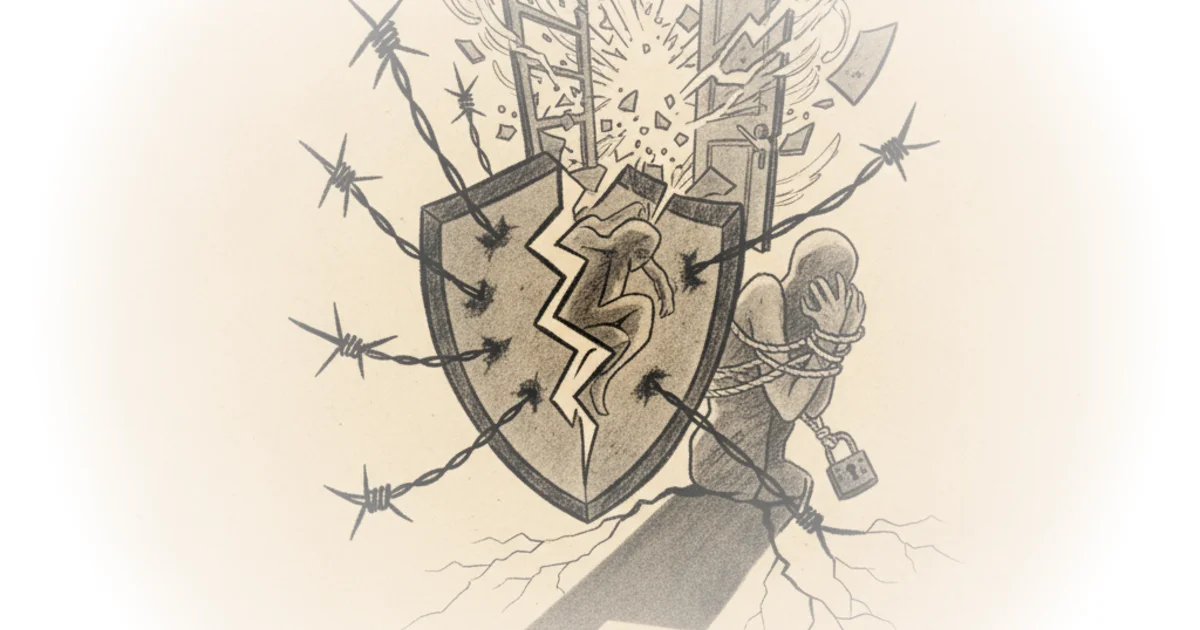
The author highlights the gravity of this overreach by noting that the memo was kept so secret that one whistleblower could only view it under supervision and was forbidden from taking notes. "A totally legal thing when you're trying to train people on what is and is not constitutionally permissible," Stone notes with biting sarcasm. The implication is clear: the government knows this policy is legally precarious, which is why they hid it. This secrecy undermines any claim that the policy is a standard, well-vetted legal interpretation.
Critics might argue that immigration enforcement requires flexibility and that administrative efficiency is a valid government interest. However, Stone dismantles this by pointing out that the Supreme Court has long established that the home is the "chief evil" the Fourth Amendment was designed to protect. He writes, "The entire point of the warrant requirement is that a neutral judge decides when the government can cross that threshold." By replacing a judge with an agency employee, the administration is effectively removing the check and balance that defines American liberty.
A Policy Built on a Fiction
The core of Stone's critique focuses on the legal theory underpinning the memo, which relies on a the president-era executive order rather than established statute or case law. He points out the circular logic of the directive: "Essential to the removal of removal is the ability to locate and arrest them. So, you're telling me that in order to deport someone, you have to find them. Wow, these guys are real geniuses." This moment of dry humor underscores the desperation of the legal argument. The memo attempts to elevate an internal form (Form I-205) to the status of a judicial warrant, a move Stone describes as a "monstrosity."
Stone draws a sharp line between the executive and judicial branches, noting that the memo admits it cannot apply in Los Angeles due to a specific court ruling, yet proceeds to ignore that precedent elsewhere. "The government settled the Kid case in 2025 and they agreed not to enter a home without a warrant or consent... but the lines memo makes it clear that they did not accept the judge's constitutional analysis," he observes. This selective adherence to the law suggests a strategy of enforcement through intimidation, betting that citizens will not challenge the agents at their door.
The Fourth Amendment was written to make sure that no government could ever do that again. So, naturally, in the year of our Lord 2026, we decided to do exactly that again.
The human cost of this legal fiction is vividly illustrated through the case of Chong Lee Scott Tao, an American citizen handcuffed in his underwear in freezing temperatures while agents searched for someone else. Stone uses this anecdote to demonstrate that the policy is not theoretical; it is already causing real harm to innocent people. The argument that administrative warrants provide "probable cause" is, as Stone puts it, "not a golden ticket to give probable cause under all circumstances."
The Erosion of Judicial Authority
Stone's most damning point is that this memo attempts to redefine the very nature of a judge. The directive suggests that an immigration officer, an employee of the executive branch, can function as a neutral magistrate. "They are an employee of the executive branch is enough to supplant the need for a judicial warrant based on probable cause," Stone writes, highlighting the constitutional impossibility of this claim. He references the 1960 case Able v. United States, which the government might be misusing, but clarifies that modern doctrine, specifically Payton v. New York, explicitly rejects warrantless home entries for arrests.
The author warns that this is not just a policy dispute but a fundamental shift in how the government views its power over the individual. "It asserts exactly what Payton and related cases reject," Stone states. The memo's footnote, which suggests these powers might extend even without a final removal order, indicates a potential slide toward warrantless arrests for anyone suspected of immigration violations, regardless of their legal status or the existence of a court order.
Bottom Line
Devin Stone's commentary is a masterclass in cutting through bureaucratic obfuscation to reveal a constitutional crisis in the making. His strongest asset is the ability to translate complex legal distinctions into stark, undeniable realities: an administrative form is not a judicial warrant, and the executive branch cannot unilaterally rewrite the Fourth Amendment. The argument's greatest vulnerability lies in its reliance on the assumption that the courts will continue to enforce these boundaries, a hope that seems increasingly fragile given the administration's willingness to ignore settled law. Readers should watch closely to see if the judiciary steps in to stop this policy or if the "secret memo" becomes the new normal.