Udith Dematagoda delivers a visceral, unfiltered portrait of artistic burnout and the crushing weight of unrequited genius, stripping away the romantic veneer of the music scene to reveal a landscape of chemical dependency and profound isolation. This is not a story about the glory of performance, but rather a raw examination of the moment an artist realizes their "prophetic" vision is merely a delusion shared by no one else. Dematagoda's narrator, Vincent, navigates a Glasgow night defined by stale cider, electric shocks, and the sudden, terrifying clarity that his life's work has reached its terminus.
The Architecture of Disillusionment
The piece opens with a declaration of surrender that feels less like a choice and more like a collapse. Udith Dematagoda writes, "I decided to pack it in that night…being in a band. I'd probably stick to the music all the same. Didn't need any of these other cunts holding me back!" This immediate pivot from collective creation to solitary obsession sets the tone for a narrative that rejects the very idea of community. The narrator's plan to sell his guitar for a "big Soviet fucker…Polyvox or something" to play "drones and harsh noise" signals a retreat into the abstract, a move that mirrors the historical shift in avant-garde art where the artist's internal chaos supersedes audience comprehension. It is a lonely path, one that Dematagoda frames not as a rebellion, but as a retreat from a world that refuses to listen.
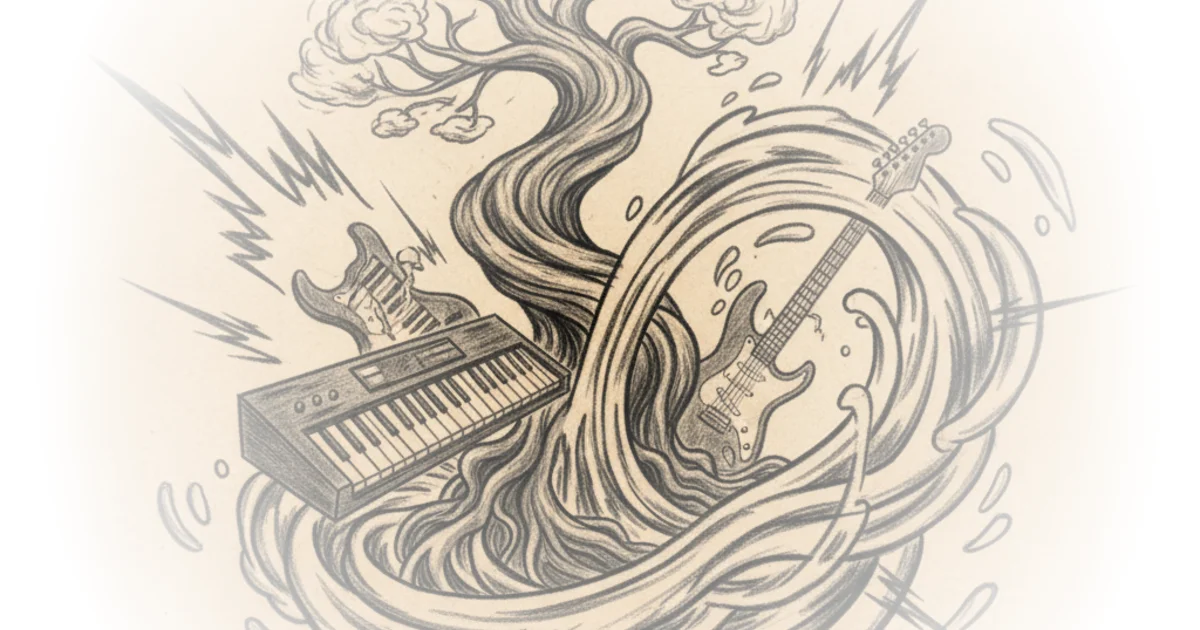
The setting is as toxic as the narrator's mindset. The story unfolds in the shadow of expired Strongbow and the regular application of electric shocks, a detail that grounds the abstract pain in physical reality. As Udith Dematagoda puts it, "By this point the electric shocks had become pretty regular, cutting through every one of my thoughts every couple of minutes…drank more to dampen the effects…didn't seem to be working." This cycle of self-medication and sensory overload creates a claustrophobic atmosphere where the narrator's perception of reality is constantly fractured. The inclusion of ketamine, laid out on a CD case of The Texas-Jerusalem Crossroads, adds a layer of chemical dissociation that blurs the line between the narrator's internal monologue and the external world. Critics might argue that this reliance on substance abuse as a narrative device risks romanticizing addiction, but Dematagoda avoids glorification by showing the immediate, ugly consequences: the "disgusting" taste of the cider and the inability to form coherent thoughts.
"There's nae point hoping for universal salvation when cunts don't even appreciate what they're being given…don't they know that I'm some sort of prophet?…I'm not though…not even close."
The Ghost of Byzantium and the Weight of History
The narrative takes a sharp turn when the narrator encounters a woman at a club, a figure who triggers a cascade of historical and literary associations. She is described with the specific, almost academic detail of a character from a history module: "I knew her from the honors module on the history of Byzantium a couple of years back." This reference is not merely decorative; it anchors the narrator's fleeting romanticism in a specific intellectual context, suggesting that his perception of the world is filtered through the lens of dead empires and forgotten scholars. The woman's appearance—"diminutive and pale, big light brown eyes, pink lips, black hair always tied with a red ribbon"—evokes the aesthetic of the Pre-Raphaelites, a connection the narrator explicitly makes later when he compares her to the women in Virginia Woolf's circle.
The encounter is brief, intense, and ultimately tragic. The narrator, high on ketamine and drunk, is drawn to her, only to be met with a sudden, devastating emotional collapse. "Her pain seemed, at that moment, to be larger than her delicate frame could contain…the sorrow of the nightingale," Dematagoda writes, capturing the narrator's inability to bridge the gap between his desire and her reality. The scene is a microcosm of the narrator's broader failure: he can observe the beauty, he can even feel the sorrow, but he cannot participate in it. He leaves her to weep, a "dejected mist," and walks home with a "pang of regret." This moment underscores the central theme of the piece: the artist is a spectator in his own life, unable to connect with the very humanity he claims to understand.
The Performance of Genius
The climax of the piece occurs during the band's final performance, a moment where the narrator's internal certainty clashes with the external indifference of the audience. "We played all of those eight songs more perfectly than they had ever been played, not a single slippage or off-note," Dematagoda writes, highlighting the technical perfection that the narrator believes should have secured his legacy. Yet, the reception is "pitiful silence," a "funereal dimness" that confirms his worst fears. The narrator's realization that "the problem with being a misunderstood genius seems to mostly be that nae cunt actually understands you" is a brutal deconstruction of the artist's ego. He admits, "Everycunt thinks they're a genius! Come on! As if everyone can be. And as if it really mattered whether you are or not."
The interaction with Vivi, the sculptress, further complicates this dynamic. She is introduced as a counterpoint to the narrator's cynicism, a woman who is "possessed of an unmistakable physical grandeur and elegance" yet chooses to present herself as "slightly unattractive." Her work, sculptures of "body parts…and some bodies…but never faces," mirrors the narrator's own inability to see people as whole entities. When she reveals she is writing a PhD on Franz Fanon, the narrator's dismissal—"Ok, sounds cool," half-heartedly—reveals his own intellectual limitations. He is trapped in his own narrative, unable to engage with the world beyond his own grievances. The narrator's thought process, which drifts to Nancy Cunard and the idea that "maybe only the diddled become geniuses," exposes a deep-seated resentment toward the very women who might offer him connection. He views them as obstacles or muses, never as equals.
"The name Vincent? Yeah, I mean… whatever, but like not many people have that name? Many people that look like me? Not what I meant. Saint Vincent De Paul…the charitable. Are you religious? Obviously not, no."
Bottom Line
Udith Dematagoda's piece is a masterclass in capturing the specific, suffocating loneliness of the artist who has outgrown their own myth. The strongest element is the unflinching honesty with which the narrator confronts his own mediocrity, stripping away the pretense of genius to reveal a man who is simply lost. The piece's vulnerability lies in its relentless negativity; the narrator's worldview is so closed off that it risks alienating the reader, making it difficult to find a foothold for empathy. However, this is precisely the point: the narrator has built a cage of his own making, and the story is the sound of him rattling the bars. Readers should watch for how this narrative of isolation resonates in a culture that increasingly celebrates individualism while eroding the communal structures that make art meaningful.