Asianometry delivers a masterclass in industrial history by revealing that the semiconductor industry's greatest near-miss wasn't a lack of ambition, but a collision of physics, economics, and timing. While most narratives focus on the triumph of current technology, this piece dissects the specific, high-stakes gamble on 157-nanometer lithography—a technology that was technically viable but commercially doomed. For leaders navigating rapid technological shifts, the story of why a billion-dollar roadmap was scrapped offers a rare blueprint on how to recognize when a "bridge" technology has become a dead end.
The Physics of a Dead End
The core of the argument rests on the relentless pressure of Moore's Law, which forced the industry to shrink chip features faster than optical physics could naturally accommodate. Asianometry writes, "in 1999 it became the case that the leading edge process node had a minimum feature size smaller than the most advanced lithographic wavelength and from then on it became much harder to push the limit on semiconductor manufacturing." This sets the stage for the 157-nanometer project, which was intended as a crucial bridge between the established 193-nanometer lasers and the futuristic, but immature, Extreme Ultraviolet (EUV) technology.
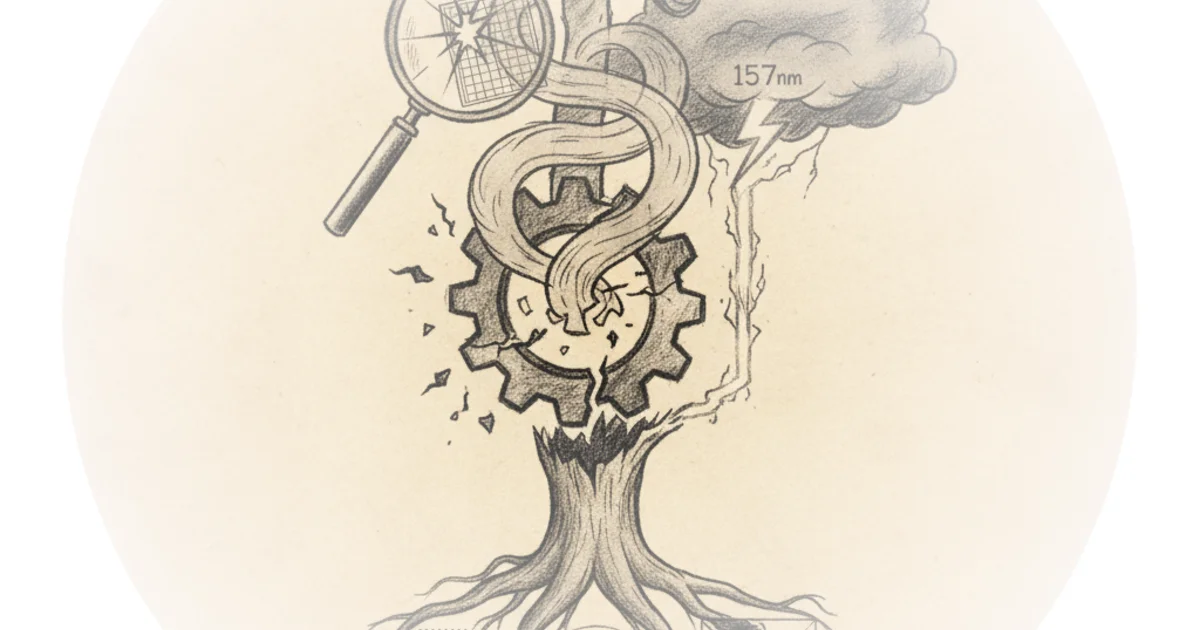
The author meticulously details the engineering hurdles, noting that the transition required a complete overhaul of the optical system. "Ordinary air easily absorbs 157 nanometer light the entire light pathway has to be purged of air and replaced with inert nitrogen this added substantial cost to the whole system." This requirement alone illustrates the fragility of the approach; it wasn't just an upgrade, but a fundamental re-engineering of the manufacturing environment. The commentary is particularly effective in explaining the material science challenges, such as the struggle to find lens materials that wouldn't distort the light. Asianometry notes that while engineers managed to solve the issue of "intrinsic birefringence"—where light splits into two when entering a crystal—by creating complex "crystal orientation pairs," the solution was elegant but expensive.
157 is the last feasible optical lithography technology period.
This assertion is the piece's most striking claim. It reframes 157-nanometer lithography not as a failed experiment, but as the absolute ceiling of what was physically possible with traditional optical methods. The author argues that the industry hit a hard wall where the materials required to make the masks and lenses transparent to this specific wavelength simply did not exist at a commercial scale.
The Economics of Abandonment
The narrative shifts from physics to economics, revealing that the technology was technically salvageable but financially unsustainable. The author points out that the industry was suddenly faced with three competing paths: 157-nanometer, 193-nanometer immersion, and EUV. Asianometry writes, "157 emerged as the weakest link it was conservative but not as conservative as 193i which didn't require as much new technology and crucially a commercially suitable 157 immersion fluid had not yet been found."
This comparison is the crux of the failure. While 157 required purging air and growing rare crystals, the alternative—193-nanometer immersion—could use simple ultra-pure water to boost resolution. The author highlights the decisive moment when Intel, a primary champion, pulled the plug. "In may 2003 intel one of the technologies original champions announced that they were dropping 157 out of the road map they cited technical factors for their decision not economic ones." However, the commentary suggests this distinction was thin; the technical factors were inextricably linked to cost and yield. With yields for the necessary calcium fluoride crystals hovering at a mere one percent, the economic reality was undeniable.
Critics might argue that the industry's pivot to 193-nanometer immersion was a lucky break rather than a strategic masterstroke, as it merely delayed the inevitable need for EUV by a decade. Yet, the author's analysis suggests that without this detour, the industry might have rushed into EUV before the supply chain was ready, potentially causing a far greater disruption. The failure of 157-nanometer lithography was not a lack of innovation, but a rational calculation that the cost of the bridge exceeded the toll.
The Cost of Progress
The final section of the piece drives home the sheer scale of the financial loss. The author notes that lithography machines represent over half of the total capital costs of a fab, and "157 nanometer machines were estimated to cost twice as much as their 193 nanometer counterparts a really hard pill to swallow." This economic reality, combined with the technical fragility, sealed the technology's fate. The industry collectively invested hundreds of millions of dollars, only to flush it down the toilet as the roadmap pivoted.
Asianometry concludes with a poignant observation on the lifecycle of industrial technology: "optical lithography gave the semiconductor industry its golden years and the industry tried to give the technology its one last ride with 157 but in the end the train had reached its final destination and it was time to move on." This framing elevates the story from a technical post-mortem to a lesson in strategic timing. The industry didn't fail to innovate; it succeeded in recognizing when to stop.
The lithography industry would from then on focus solely on bringing euv to market and the foundries would try to tread water until it arrived.
Bottom Line
Asianometry's analysis is strongest in its ability to disentangle technical feasibility from commercial viability, showing that a technology can be scientifically sound yet strategically wrong. The piece's biggest vulnerability is a slight underestimation of the political friction required to get the entire global supply chain to agree on abandoning a technology they had already invested in, but the evidence of Intel's decisive move largely covers this. For any leader facing a similar crossroads, the lesson is clear: when the cost of the bridge exceeds the value of the destination, the only rational move is to stop building.