Rohit Krishnan transforms a mundane family outing into a piercing critique of modern capitalism, arguing that the county fair is not merely entertainment but the "final boss" of a system designed to extract value through calculated confusion. He doesn't just describe the heat and the noise; he dissects the architecture of consent that keeps visitors trapped in a cycle of mediocre consumption and complex math. This is a rare piece of cultural criticism that finds the profound in the banal, revealing how we willingly surrender our autonomy to a system that offers us nothing but the "existence of beer" and the illusion of choice.
The Mathematics of Captivity
Krishnan immediately establishes the fair as a controlled environment where standard economic rules are suspended. He writes, "The core fact that one notices about fairs is that they are the final boss of capitalism. Once you enter you enter into a captive world." This framing is powerful because it shifts the reader's perspective from a leisure activity to a strategic encounter. The author observes that the fair is designed so that "money ceases to have any meaning," replaced by a convoluted ticket system that forces parents to perform "differential equations with plugged in utility numbers" just to decide how many rides their children should enjoy.
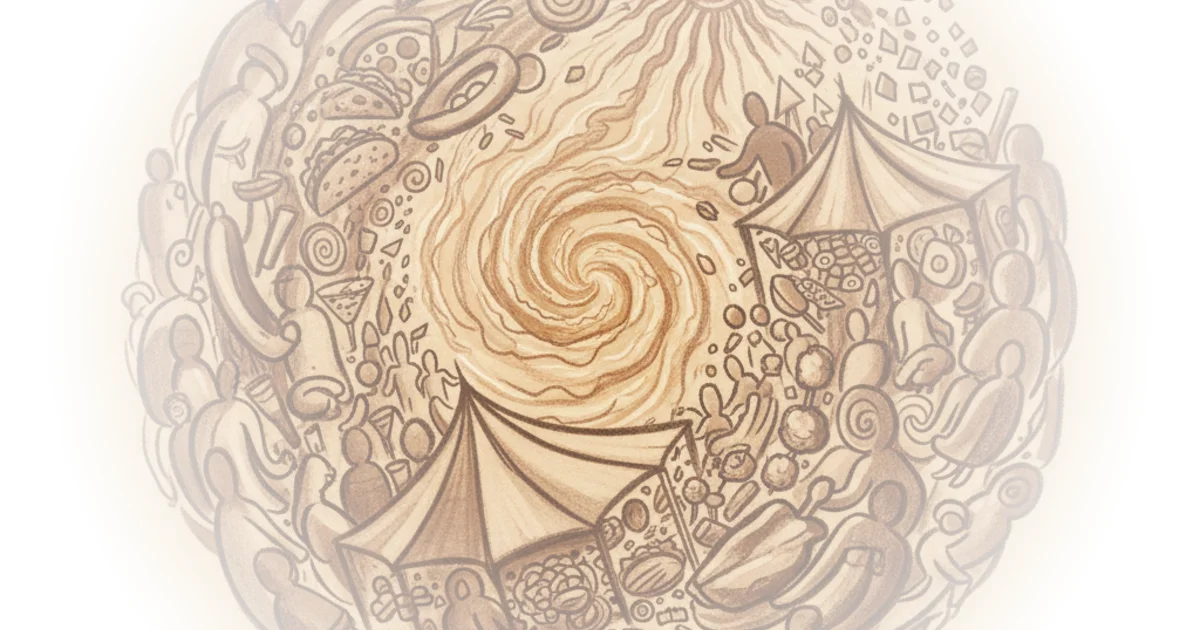
This analysis of the pricing structure is the piece's intellectual anchor. Krishnan notes that the system is engineered to make you "convert money into tickets, and then do the maths on those tickets, so you have to do rather complex maths if you want to figure out how to maximise your 'fun'." The commentary here is sharp: the confusion is not a bug, it is a feature. It distracts the consumer from the actual cost while engaging their brain in a futile optimization problem. A counterargument might suggest that such complexity is simply poor design rather than malicious intent, but Krishnan's observation of the ubiquitous "small purple cartoon-emblazoned ATMs" suggests a deliberate strategy to ensure no one ever runs out of tickets, removing the only true exit strategy.
Sells you 'id', attracts you with colours and lights. It's a place where money ceases to have any meaning.
The Industrialization of Joy
Moving beyond the economics, Krishnan turns his gaze to the physical experience, describing the food and rides as "mediocre imitations" of the real thing. He describes the pizza as having a "crust thick enough to fill any stomach" but lacking the "succour a pizza slice demands," noting that the price reflects the "portability premium" rather than quality. This critique extends to the rides themselves, which he argues are the result of "convergent evolution" among a tiny oligopoly of manufacturers. He points out that there are only a few major suppliers, such as Chance Rides and Wisdom Rides, meaning that "they look the same because they literally are the same, just new coats of paint to trick the eyes."
The author's description of the rides as machines that "sound like a washing machine ready for repair but the groans are ignored in a form of consensual hallucination" is a brilliant metaphor for our trust in modern infrastructure. We accept the noise and the mediocrity because the system is safe, regulated, and predictable. Krishnan highlights the rigorous safety standards, mentioning "NAARSO and AIMS for ride inspectors" and "Title 8" compliance, to show that the only thing the industry has perfected is the ability to pass inspection while delivering a standardized, low-effort product. The result is a "beautifully stylized supply chain" where the only innovation is adding more LEDs to the same spinning drum.
Critics might argue that the standardization ensures safety and affordability for families, but Krishnan's point is that this safety comes at the cost of genuine novelty or quality. The fair becomes a place where "the distinction between the rides are blurred," leading to a homogenized experience where a child cannot tell the difference between a boat ride and rotating bears, both simply registering as "fun."
The Human Cost of Convenience
The most poignant section of the commentary focuses on the workers and the emotional toll of the environment. Krishnan imagines the workers whose "neurons get numb at the sight of fried cheese and mozzarella balls," contrasting their exhaustion with the forced happiness of the visitors. He draws a parallel to a day cruise in Scandinavia, describing it as "the most extraordinarily boring day I've spent anywhere, despite being tailor made to satisfy human desire." This comparison underscores the central thesis: when convenience is maximized and variety is minimized, the result is not satisfaction, but ennui.
He writes, "Something about the extreme convenience and mediocre imitations of everything you might like, together in a shopping mall, seemed to be a mockery of our existence." This is a heavy claim, but the evidence of the "Professor Science" show supports it. The show is described as anodyne, with jokes that land flat and props destined for the bottom of a toybox. Even the educational moments are fleeting; when a child asks about the telescope, the answer "Hubble" is given, but the moment is quickly swallowed by the surrounding chaos. Krishnan suggests that the fair is a place where we are "hedonically adjusted all the way up," yet left with a sense of emptiness.
The existence of a form of entertainment has transformed into a beautifully stylized supply chain, a few suppliers who build a few machines that pass inspection, and seemingly a caste of people who think of this as their whole way of life.
Bottom Line
Rohit Krishnan's piece succeeds by refusing to treat the fair as a simple backdrop for family memories, instead exposing it as a highly efficient, albeit soul-crushing, machine for capital extraction. His strongest argument lies in the connection between the physical monotony of the rides and the psychological manipulation of the pricing structure. The piece's vulnerability is its somewhat fatalistic tone, suggesting that the system is so entrenched that the only response is to "find a quiet place in the shade and to have a beer," but this resignation is precisely the point: the fair is designed to make us feel that way. Readers should watch for how these dynamics of captive consumption and standardized experience are scaling into other sectors of daily life, from theme parks to digital entertainment platforms.