Forget the flashy rockets and political posturing; the real bottleneck for becoming a multi-planetary species isn't engineering, it's biology. Rohin Francis, writing for Medlife Crisis, dismantles the romanticized vision of interstellar colonization by exposing the brutal physiological reality: our bodies are not built for the void. Using the science fiction universe of The Expanse as a rigorous thought experiment, Francis argues that the human organism is so finely tuned to Earth's specific gravity and biosphere that a simple trip to Mars could leave us anemic, blind, and riddled with clots before we even land.
The Gravity Trap
Francis begins by tackling the most immediate threat to any long-term mission: the transition between gravity wells. He notes that while the Expanse depicts characters struggling to adapt to higher gravity on alien worlds, the reality for astronauts traveling from the microgravity of deep space to the partial gravity of Mars is equally treacherous. "A lack of gravity causes loss of bone density and strength reduced muscle mass and function and a smaller weaker heart," Francis writes. This isn't just about feeling weak; it's a systemic failure of the cardiovascular system. In microgravity, blood pools in the upper body, tricking the kidneys into thinking the body is flooded, leading them to excrete fluid and shrink the blood volume.
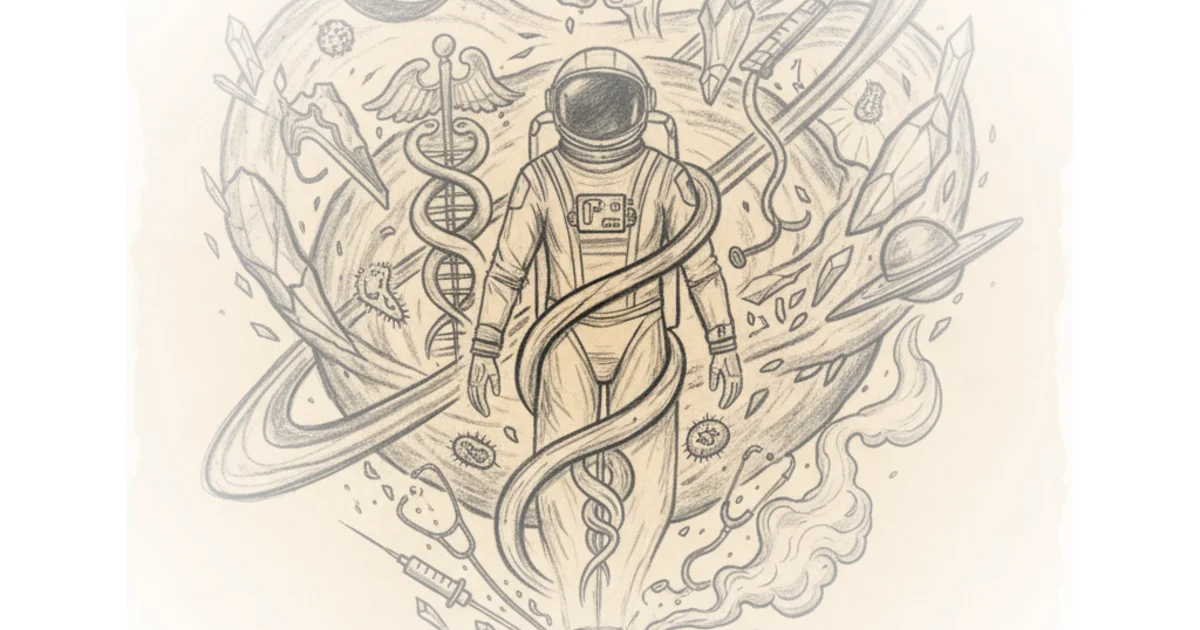
The author highlights a particularly insidious consequence of this fluid shift: deep vein thrombosis. Recent data from the International Space Station has revealed astronauts developing clots in major veins, a danger Francis describes as potentially fatal if the clot travels to the lungs. "Astronauts refer to this volume redistribution as the puffy face bird leg syndrome which sounds kind of silly and harmless but the dangers were of this were brought home very recently," he explains. The solution proposed is grimly mundane: two hours of grueling exercise every single day. "There's no shortcut," Francis insists. "I don't foresee any drugs being developed that will replace exercise if they were that surely make their inventor the richest person alive." This framing strips away the sci-fi fantasy of a "magic pill" for space travel, grounding the discussion in the unyielding laws of physiology.
Critics might argue that Francis underestimates the potential for future pharmaceutical breakthroughs or artificial gravity solutions, but his reliance on current data from the ISS provides a necessary reality check against the optimism of private space ventures.
There's no shortcut. I don't foresee any drugs being developed that will replace exercise if they were that surely make their inventor the richest person alive.
The Surgical Nightmare
Moving beyond chronic adaptation, Francis turns to the acute horrors of emergency medicine in space. The visual of blood floating in zero gravity is a staple of sci-fi, but the medical implications are far more chaotic than the movies suggest. "Arterial bleeding which this appears to be is more likely to break the surface tension and cause all kinds of mess by forming free-floating droplets that will go all over the place," he notes. In a sealed spacecraft, a floating droplet of blood isn't just a mess; it's a biohazard that could clog air filters or short-circuit sensitive equipment.
The environmental control of a spacecraft also complicates infection control. Without gravity to drive convection currents, hot air doesn't rise, and bacteria don't settle. "Airborne microbes have been recorded in the International Space Station at ten times the level you would find in an operating theater," Francis points out. This creates a paradox where the very technology meant to sustain life becomes a vector for infection. The proposed solution—a sealed glovebox for surgery—highlights the extreme isolation required to perform even basic procedures. The argument here is compelling because it shifts the focus from the surgeon's skill to the environment's hostility, suggesting that the greatest risk to a colonist might not be the alien terrain, but the air they breathe inside their own ship.
The Alien Biosphere
Perhaps the most chilling section of Francis's analysis concerns the unknown biological threats of an alien world. He uses the concept of "convergent evolution" to explain why alien pathogens might still be dangerous to humans, even if they evolved on a different planet. "Humans are still warm walking reservoirs of fluid and nutrients so we might still be victim to microorganisms just looking for somewhere nice to live," he argues. This challenges the common trope that alien life would be too chemically distinct to infect us.
Francis draws a fascinating parallel to Earth's own parasitic diseases, noting that organisms like Toxoplasmosis or River Blindness already demonstrate how parasites can exploit human biology. He speculates that on an alien world, the local flora and fauna might share chemical pathways with Earth life due to convergent evolution, making them viable hosts for human pathogens or vice versa. "The very concept of how we might interact with alien life is fascinating all life on Earth evolved from the same origin so every life form on earth shares at least some features," he writes. However, he also introduces the terrifying possibility of "mirror life"—organisms built from molecules with opposite chirality (handedness) to ours. If such life exists, our immune systems would be completely blind to it, and we would be unable to digest it, rendering the planet effectively uninhabitable despite its apparent resources.
A counterargument worth considering is that Francis's reliance on Earth-based parasitology might limit his vision of truly alien biology. It is possible that extraterrestrial life operates on principles so foreign that the concept of "infection" itself doesn't apply, though this remains speculative.
Bottom Line
Francis's commentary succeeds by replacing the glamour of space exploration with the gritty, unglamorous constraints of human biology. The strongest part of his argument is the insistence that exercise and fluid management are non-negotiable, not optional, for survival. The biggest vulnerability lies in the speculative nature of alien biology, where the lack of data forces reliance on Earth analogues that may not hold up. As the executive branch and private entities race toward Mars, the reader must watch for whether mission planners are prioritizing these biological countermeasures with the same fervor as their rocket engines.
Humans are still warm walking reservoirs of fluid and nutrients so we might still be victim to microorganisms just looking for somewhere nice to live.