In a world obsessed with the immediate, this piece delivers a stunning reminder: the most profound insights into human conflict often arrive quietly, buried in the biology of our genes rather than the headlines of the day. Yascha Mounk argues that the chaotic, often painful dynamics of our daily lives—from family feuds to marital betrayals—are not random failures of character, but predictable outcomes of an ancient evolutionary logic. This is not just a eulogy for a forgotten scientist; it is a map for understanding why we love, fight, and deceive ourselves.
The Forgotten Architect
Mounk opens with a jarring observation about the hierarchy of public attention. He notes that while the deaths of prominent environmentalists and philosophers were met with immediate fanfare, the passing of Robert Trivers, a titan of evolutionary biology, went unnoticed by major news outlets for two weeks. "Trivers was no ordinary academic," Mounk writes, describing him as "otherworldly brilliant but forehead-slappingly foolish." This framing is crucial; it sets the stage for a theory that is as messy and contradictory as the man who proposed it.
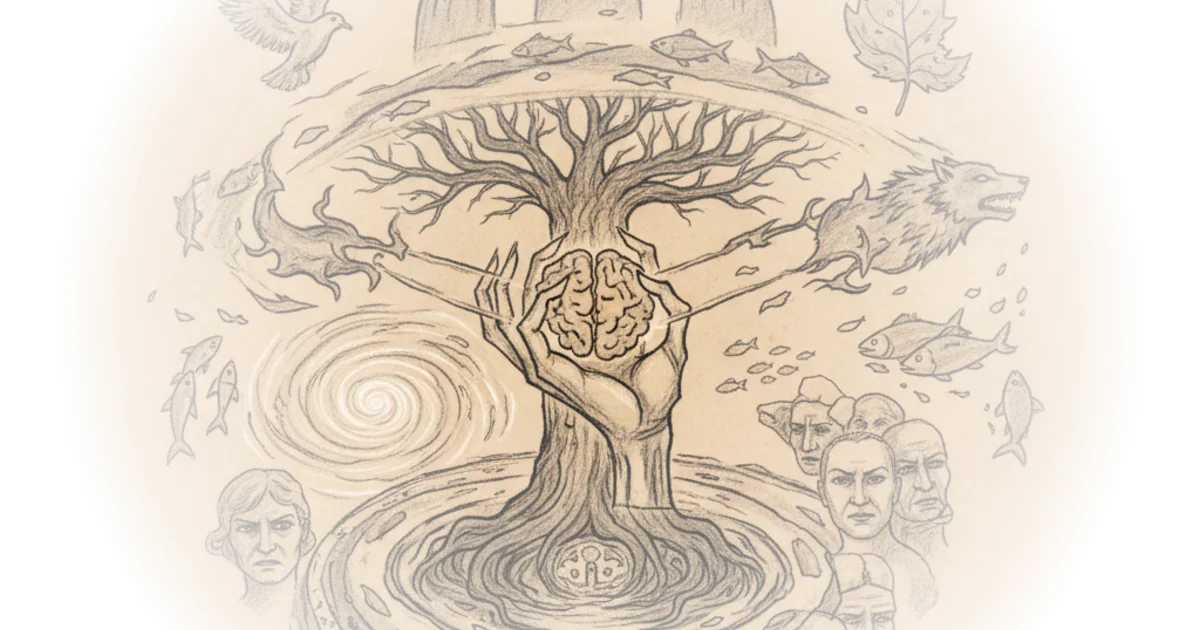
The core of Mounk's argument rests on Trivers' revolutionary insight from the early 1970s: that human relationships are defined not by harmony, but by a "partial conflict of psychological interest" rooted in genetics. Mounk explains that while parents and children share half their genes, the child's interest in its own survival is absolute, whereas the parent must balance that child against siblings. "The parent tacitly wants—half for Jack, half for Jill—is not what Jack and Jill each want," Mounk paraphrases Trivers. This biological reality, Mounk suggests, explains the universal friction of family life, from weaning tantrums to inheritance disputes.
Darwinian social theory gives us a glimpse of an underlying symmetry and logic in social relationships which, when more fully comprehended by ourselves, should revitalize our political understanding.
This connection between biological imperatives and political psychology is the piece's most ambitious leap. Mounk argues that understanding these genetic conflicts should help us build a "science and medicine of psychology" that addresses the roots of human suffering. Critics might note that reducing complex social pathologies to genetic calculus risks oversimplifying the role of culture and environment, yet Mounk's framing remains compelling because it offers a unifying theory for behaviors that often seem irrational.
The Shadow of Reciprocity
Moving beyond the family, Mounk explores how Trivers explained altruism among non-relatives. The author dismantles the romantic notion that humans are naturally communal, arguing instead that cooperation is a strategic game. "In evolution as in baseball, nice guys finish last," Mounk writes, highlighting Trivers' concept of reciprocal altruism. This system works only because we possess the cognitive machinery to remember favors and punish cheaters. Mounk points out that this evolutionary pressure likely drove the expansion of human intelligence: "human intelligence evolved to deal with people, not just predators and tools."
The author draws a fascinating parallel to the work of W.D. Hamilton, who in the 1960s established that natural selection acts on genes, not groups. Mounk uses this historical context to show how Trivers built upon Hamilton's foundation to explain why we feel moral emotions like guilt, shame, and anger. These are not abstract virtues but functional tools for maintaining the delicate balance of cooperation. "Sympathy and trust prompt people to extend the first favor," Mounk notes, while "anger and contempt prompt them to avoid or punish cheaters."
This analysis reframes our moral life as a series of calculated exchanges. Mounk writes, "Reciprocity hangs, like a sword of Damocles, over every human head," citing Matt Ridley to illustrate how our language is permeated with concepts of debt and obligation. The argument is effective because it demystifies the feeling of betrayal; it is not a personal failure but a violation of an evolutionary contract.
The Art of Self-Deception
Perhaps the most provocative section of the piece is Mounk's exploration of Trivers' theory of self-deception. The author argues that we lie to ourselves not out of weakness, but to become better liars to others. "If deceit is fundamental to animal communication, then there must be strong selection to spot deception and this ought, in turn, to select for a degree of self-deception," Mounk quotes from Trivers' foreword to The Selfish Gene. This flips the conventional wisdom that evolution favors an accurate view of reality.
Mounk illustrates this with the example of a marital argument where both spouses genuinely believe they are the victim and the other is the aggressor. "Both parties believe that one is an altruist of long standing... while the other is characterized by a pattern of selfishness," he writes. This self-serving bias, Mounk suggests, is a feature, not a bug, of the human mind. It allows us to maintain the confidence necessary to deceive others without the tell-tale signs of guilt.
We lie to ourselves the better to lie to others, protecting compromising private knowledge from emotional tells or factual contradictions.
This section connects Trivers' biological theories to the psychological defenses described by Freud and the cognitive dissonance studied by modern psychologists. Mounk's commentary here is particularly sharp, suggesting that the "divided self" is a survival mechanism. However, a counterargument worth considering is whether this theory fully accounts for the genuine pursuit of truth that also characterizes human history, or if it risks painting all self-reflection as a form of strategic deception.
Bottom Line
Yascha Mounk's tribute to Robert Trivers succeeds in transforming a niche academic biography into a powerful lens for viewing the human condition. The strongest part of the argument is its ability to link disparate phenomena—family bickering, marital infidelity, and political polarization—under a single, logical framework of genetic conflict. The piece's biggest vulnerability lies in its potential to feel deterministic, offering a biological explanation that might seem to excuse harmful behavior rather than illuminate it. Readers should watch for how these evolutionary insights are applied to modern policy; if we truly understand the "roots of our suffering," the next challenge is deciding how to mitigate them without ignoring the very human capacity for transcendence.