Heather Cox Richardson delivers a chilling diagnosis of an administration that has abandoned strategy for spectacle, revealing how a war of choice has spiraled into a global energy crisis and a constitutional emergency. What makes this piece urgent is not just the reporting of military escalations, but the explicit linkage between the executive's erratic impulses and the erosion of international law, specifically the threat to destroy civilian water infrastructure.
The Architecture of Chaos
Richardson opens by exposing the disconnect between the administration's grandiose self-image and the grim reality of its foreign policy. She notes that while the President was "Showing reporters on Air Force One a series of posterboard images of his new ballroom," he simultaneously posted threats to "obliterate all of their Electric Generating Plants, Oil Wells and Kharg Island." This juxtaposition is not merely ironic; it is indicative of a leadership style where personal vanity and geopolitical strategy are indistinguishable. The author argues that the administration entered this conflict with a fantasy of a quick regime change, similar to the failed Venezuelan intervention, but found themselves unable to control the aftermath.
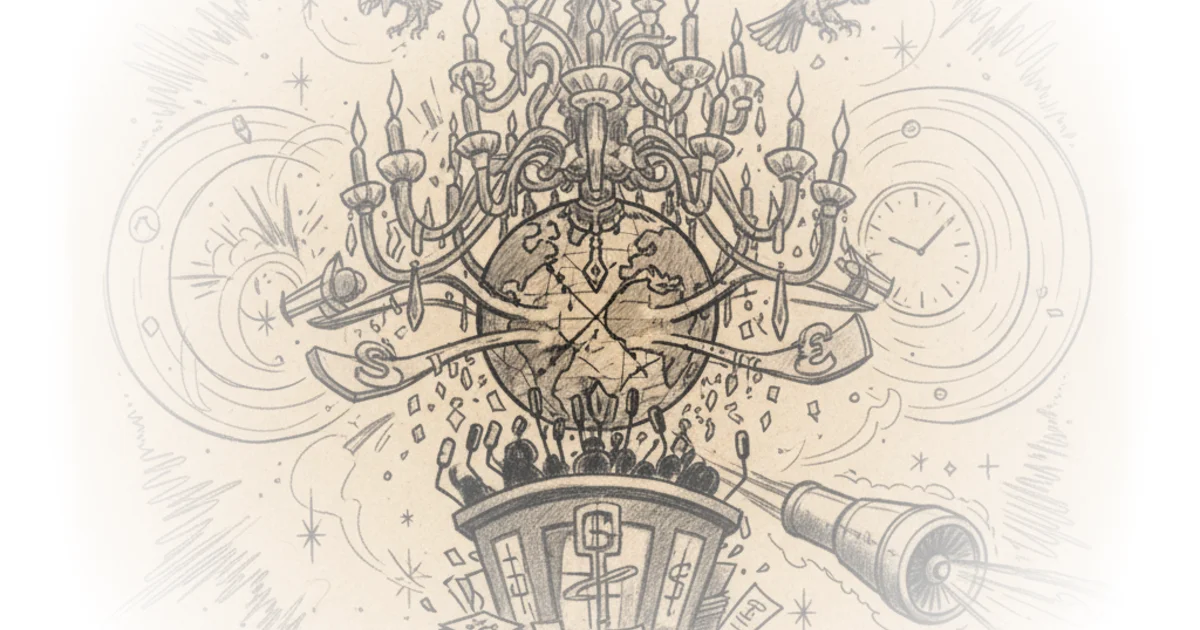
The core of Richardson's argument rests on the legal and moral implications of the administration's stated goals. She highlights the administration's threat to target desalination plants, noting that "International law recognizes attacks on civilian infrastructure... as war crimes." This is a critical pivot point in the coverage. By focusing on the specific threat to water sources, Richardson moves the conversation from political posturing to potential criminal liability. As she puts it, the threat to attack desalination plants is "not only stupid because Iran could do the same to other Gulf states, but 'also, quite obviously,...very illegal.'"
The Geneva Convention specifically prohibits attacks on drinking water, so the administration's threat to attack the desalination plants that make seawater drinkable is, as Shashank Joshi of The Economist notes, not only stupid but also, quite obviously, very illegal.
Critics might argue that in the fog of war, such rhetoric is merely bluster intended to force negotiations. However, Richardson counters this by pointing to the administration's massing of troops and the lack of a coherent "plan B," suggesting that the threats are not just words but a reflection of a genuine intent to escalate regardless of the legal consequences. The administration's claim that they are fighting a 47-year war is described as "imaginary," yet the actions taken to enforce this fiction are very real.
The Hollowing of Institutions
The commentary then shifts to the domestic cost of this foreign policy failure, tracing a direct line from the radicalization of the conservative movement to the current abdication of congressional oversight. Richardson writes that "Movement Conservatives... became increasingly radical over time" and focused on "taking power away from Congress... and centering power in the president." This historical context is essential for understanding why the legislative branch has failed to check the executive's escalation. The author observes that "Republicans in Congress have abdicated their authority to oversee the war or other government agencies," leaving the administration to operate in a vacuum of accountability.
This concentration of power has led to bizarre and dangerous developments, such as the inclusion of billionaire Elon Musk in diplomatic calls with foreign leaders like Prime Minister Narendra Modi, a detail Richardson highlights as evidence of the administration turning to "his usual cadre of billionaires" rather than the State Department. The result is a foreign policy that lacks expertise and is beholden to the whims of a single man. Richardson notes that the administration has "embroiled the U.S. in a war of choice that has created an extraordinary global energy crisis," with oil prices spiking and inflation rising as a direct consequence.
The erosion of norms extends to the military itself. Richardson details the concerns raised by veterans and experts regarding Defense Secretary Pete Hegseth's framing of the conflict as a "Christian holy war." She quotes Hegseth's prayer for "overwhelming violence of action against those who deserve no mercy," using this to illustrate how the administration is injecting extremist religious ideology into the chain of command. This is not just a matter of personal belief; it represents a fundamental shift in the military's mission and identity.
After a year in power, the administration has embroiled the U.S. in a war of choice that has created an extraordinary global energy crisis, inflation is rising, job growth is down, and Republicans in Congress have abdicated their authority to oversee the war.
A counterargument worth considering is whether the administration's actions are a calculated strategy to force a deal, as the President claims "great progress has been made." Richardson dismisses this by pointing out that Iran insists it is not engaged in talks, and the administration's goals have collapsed from "regime change" to simply reopening the Strait of Hormuz, a condition that existed before the war began. The administration appears to be fighting a war to achieve the status quo ante, a strategic failure that Richardson describes as "flailing."
The Cost of Imperial Ambition
The final section of the piece connects the foreign policy disaster to domestic political survival. Richardson notes that the administration is considering cuts to federal health care to fund the war and Immigration and Customs Enforcement (ICE), framing this as a choice between war and the well-being of American citizens. She writes that House Majority Leader Steve Scalise told reporters they were looking at areas of "waste and fraud and abuse," a euphemism for slashing essential programs.
The author also highlights the administration's obsession with prosecuting political enemies, such as New York Attorney General Letitia James, even as the country faces a global crisis. This distraction, Richardson argues, is a deliberate tactic to "save face, create the mirage of victory, and extricate himself from the box canyon into which he so triumphantly galloped." The piece concludes with a stark assessment of the administration's approval ratings and the growing isolation of the United States on the world stage, as allies like Spain close their airspace to U.S. planes.
Trump is extraordinarily unlikely ever to do anything that will conflict with the wishes of Russia's president Vladimir Putin, even as he strangles the energy sector of Cuba and permits Russian tankers to bypass his own blockades.
This observation about the administration's relationship with Russia adds a layer of geopolitical complexity that is often overlooked. By allowing Russian oil tankers to reach Cuba while threatening other nations, the administration reveals a transactional approach to foreign policy that undermines its own stated principles and alliances.
Bottom Line
Richardson's strongest argument is the synthesis of legal, historical, and political analysis to show that the administration's actions are not just erratic but systematically destructive to the rule of law and democratic institutions. The piece's greatest vulnerability is its reliance on the assumption that the administration will continue to escalate rather than retreat, a gamble that could have catastrophic consequences. Readers should watch for the next moves in the Strait of Hormuz and the potential for further congressional inaction as the crisis deepens.