Good Times Bad Times doesn't just predict a war; they construct a terrifyingly plausible timeline where the world's most critical semiconductor supply chain is extinguished in a single autumn week. While most analysts debate the possibility of a Chinese invasion, this piece forces the reader to confront the mechanics of a 2027 conflict, arguing that the convergence of political desperation in Beijing and American isolationism has created a perfect storm. The author's most startling claim isn't that the invasion will happen, but that the United States has already decided to fight a defensive war from the rear, sacrificing its forward bases to survive a longer attrition battle.
The Calculus of Desperation
The narrative begins by grounding the conflict in the internal politics of the Communist Party of China, a perspective often missing from Western military wargames. Good Times Bad Times writes, "Since 2021, China's economy has slowed and the Communist Party's legitimacy depends increasingly on nationalism rather than growth." This is a crucial pivot; the author suggests that the invasion is not merely a strategic expansion but a survival mechanism for the regime itself. By linking the 2027 centennial of the People's Liberation Army to Xi Jinping's need for a legacy-defining victory, the piece transforms a geopolitical standoff into a domestic necessity.
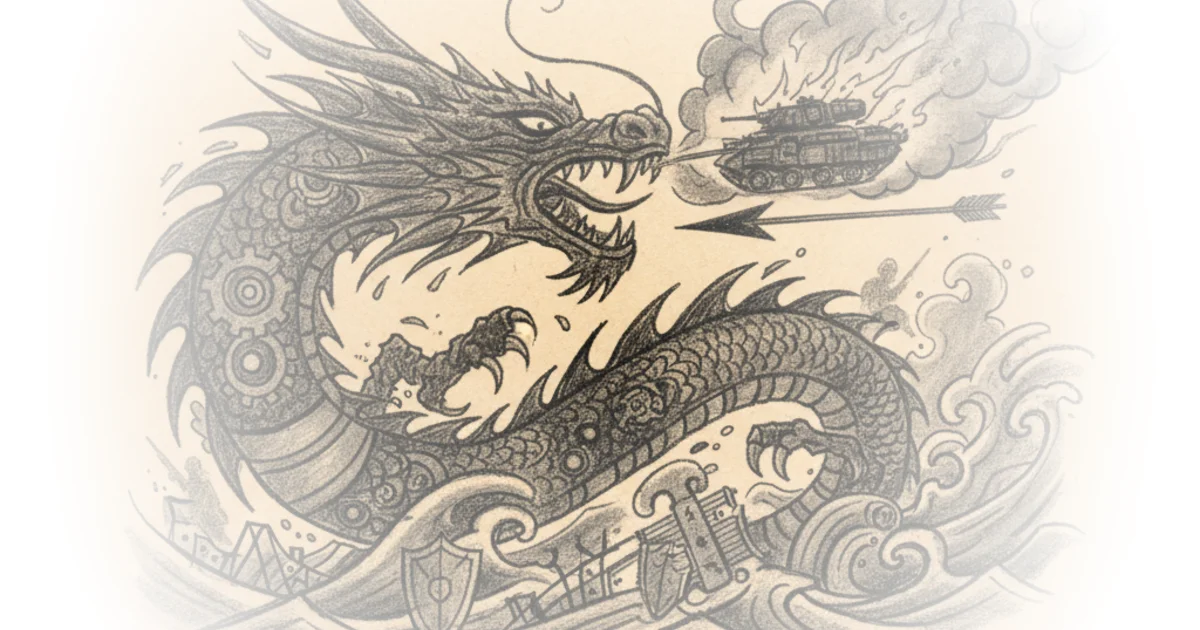
The author leans heavily on the concept of the "Davidson window," the theory that after 2027, the military balance will tilt so decisively toward China that intervention becomes impossible. As Good Times Bad Times puts it, "PLA commanders believe they finally reached the level of capability required to take the enormous risk of invading Taiwan." This framing is effective because it explains the timing of the aggression. Critics might note that this assumes China's military modernization will proceed without significant hiccups and that the United States will not accelerate its own counter-measures in the interim. However, the logic holds: if Beijing believes the window is closing, the pressure to act becomes overwhelming.
The year 2027 carries powerful symbolism, marking the centennial of the People's Liberation Army, PLA, and a key milestone in its modernization.
The Trap of Secrecy and the Civilian Shield
Perhaps the most chilling detail in the scenario is how Beijing plans to hide a massive invasion force in plain sight. The author describes a strategy of "military-civil fusion" that relies on the sheer scale of China's commercial fleet to mask the buildup. Good Times Bad Times notes, "Beijing's main challenge is to assemble invasion forces without alerting Taiwan or its allies," and details how the People's Liberation Army disguises the mobilization as routine drills or disaster relief.
The reliance on civilian ferries is a double-edged sword that the author highlights with precision. "These ships provide enormous lift capacity, roughly 2.4 million tons compared to the PLA Navy's 370,000, but are unarmored and easy targets." This creates a fascinating tactical dilemma: the invasion force is massive but fragile. The author argues that this forces a "72-hour" mobilization window, a frantic rush that leaves little room for error. This section is particularly strong because it moves beyond abstract troop numbers to the logistical reality of moving millions of tons of equipment across a typhoon-prone strait. It suggests that the invasion's success hinges entirely on the element of surprise, which, once lost, could be fatal.
The American Dilemma: Isolationism Meets Hawkishness
The scenario places a fictionalized, isolationist Donald Trump in the White House, creating a paradox where a leader who wants to disengage from the world is forced to fight the most consequential war of the century. Good Times Bad Times writes, "Despite his isolationist posture, Trump adopts a hawkish stance, seeing the war over Taiwan as a struggle for the future of American power." The author argues that the stakes are too high to ignore, specifically citing the semiconductor industry: "If it falls, China gains control over the industry, a tool of economic coercion on a global scale."
The author's depiction of US strategy is where the piece becomes most controversial and insightful. Rather than rushing carrier groups to the front lines, the US is portrayed as retreating to the Philippine Sea to preserve its assets. "War games run by CSIS and others consistently show that carriers operating too near the Chinese coast are destroyed within the first days of the conflict." This leads to a grim conclusion: the US will not lead the opening blows but will instead act as a reserve force, waiting for submarines and bombers to erode China's defenses first. This is a stark departure from traditional doctrine, and the author justifies it by noting that losing a carrier group would be politically and militarily catastrophic.
Losing the island would shatter the first island chain... giving Beijing direct access to the Pacific and threatening US territories like Guam and allies including Japan and the Philippines.
Critics might argue that this passive strategy invites China to seize the initiative and that a delayed US entry could demoralize Taiwan to the point of surrender before American forces even engage. The author acknowledges this risk but suggests that the alternative—suicidal carrier losses—leaves the US with no power to fight a long war.
The First Strike: Blinding the Enemy
The climax of the scenario is the opening hour of the war, which the author describes not as a gradual escalation but as a "rapid paralyzing blow." Good Times Bad Times writes, "The aim is not gradual escalation, but a rapid paralyzing blow designed to break Taiwan's defenders and deter their allies." The strategy involves swarms of cheap drones to confuse air defenses, followed by massive missile strikes on runways and underground hangars.
The author emphasizes that the goal is not to destroy every fighter jet but to make them unusable. "Neutralizing the opponent therefore requires taking away his ability to fight, not annihilating each asset outright." This distinction is vital. By cratering runways and destroying fuel depots, the People's Liberation Army traps Taiwan's surviving air force in their own shelters. The piece also notes the critical role of the Japanese alliance, where Prime Minister Takahichi grants permission for US bases to be used without committing Japanese troops directly. "Tokyo therefore chooses option B, cooperation without direct engagement," a nuanced diplomatic maneuver that allows the US to operate from Okinawa while avoiding a full-scale war with China on Japanese soil.
The scenario concludes with a brutal assessment of the opening phase: "War games by CSIS suggest Taiwan loses the bulk of its air force and surface fleet in the opening phase." The author argues that this is inevitable due to the sheer scale of the Chinese missile arsenal and the limited number of hardened shelters in Taiwan. This is the piece's most sobering takeaway: even with perfect intelligence and preparation, the defensive side may simply be overwhelmed by the volume of fire in the first 48 hours.
War games highlight the stakes. Roughly 90% of all US aircraft losses in simulated conflicts with China occur on the ground destroyed before takeoff.
Bottom Line
Good Times Bad Times has constructed a compelling, if terrifying, case that the next war in the Pacific will be decided in the first week, not by the size of the armies, but by the ability to strike first and the willingness of allies to host the fight. The strongest part of the argument is the detailed logistical breakdown of how a civilian fleet could mask an invasion, turning a theoretical threat into a tangible operational reality. However, the piece's biggest vulnerability is its reliance on a specific, isolationist US political scenario; a different administration might choose a more aggressive forward posture, fundamentally altering the calculus. Readers should watch for how real-world military exercises in the coming years begin to mirror these specific logistical and strategic assumptions. The window is closing, and the author makes it clear that when it shuts, the cost will be measured in more than just lives.