A federal law from 1868 criminalizes the act of making whiskey in your own kitchen, yet two federal appeals courts recently issued diametrically opposed rulings on whether that ban is constitutional. This piece from Reason highlights a rare and urgent circuit split that forces the Supreme Court to decide if Congress can use its power to tax as a pretext to ban peaceful, private conduct inside the home. For busy readers, the stakes extend far beyond a hobbyist's still; this is a defining moment for the limits of federal authority over the American household.
The Taxing Power Paradox
Reason reports that the core of the conflict lies in the 5th Circuit's rejection of the government's primary defense: that banning home distilling is a valid revenue measure. The court found that a law which prevents a product from existing cannot possibly be a tax on that product. As Judge Edith Jones wrote in the majority opinion, "Neither provision raises revenue... The provisions operate to reduce revenue instead of raising it." This logic is compelling because it exposes a fundamental flaw in the government's argument: you cannot tax what you have legislatively erased.
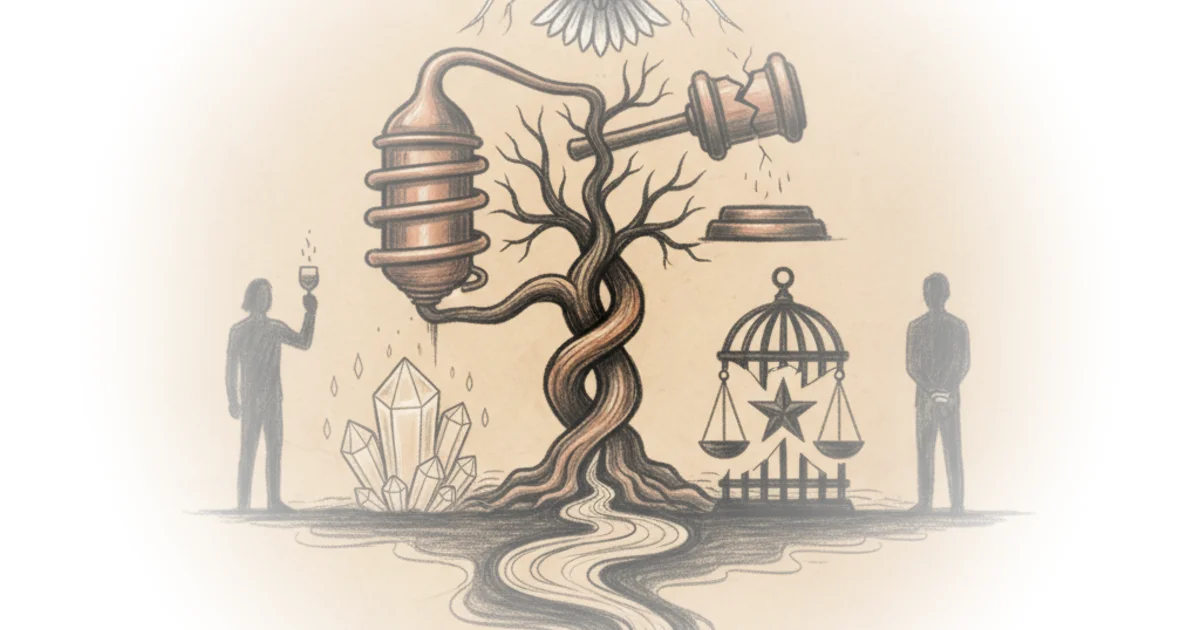
The piece notes that the government tried to pivot, arguing that the ban is "necessary and proper" to prevent tax evasion, since home stills are harder to track than commercial distilleries. However, the 5th Circuit dismantled this by pointing out that if the government could ban an activity simply because it is hard to tax, the limits on federal power would vanish. Jones warned that under the government's logic, "Congress may criminalize nearly any at-home conduct only because it has the possibility of concealing taxable activity." This is a powerful check on executive overreach, suggesting that the "Necessary and Proper" clause cannot be used to expand the taxing power into a general police power.
"The government's theory had no limiting principle. It would allow federal authority to extend into virtually any aspect of private life—particularly activities occurring in the home—so long as some connection to revenue could be asserted."
Critics might argue that the 1868 ban was a pragmatic response to "stupendous frauds" in tax collection, as the 6th Circuit noted, and that some regulation is necessary to ensure a fair tax base. However, the 5th Circuit's reasoning suggests that the solution to tax evasion is better enforcement, not the total prohibition of a lawful activity.
A Patchwork of Liberty
The practical result of this legal schism is a confusing patchwork where your rights depend entirely on your zip code. Reason details how the 5th Circuit's ruling protects distillers in Louisiana, Mississippi, and Texas, while the 6th Circuit's decision leaves those in Kentucky, Michigan, Ohio, and Tennessee exposed to federal felony charges. The piece highlights the absurdity of this situation, noting that the Alcohol and Tobacco Tax and Trade Bureau (TTB) still sends threatening letters to hobbyists even as courts question the law's validity.
The article points out that even where the ban has been struck down, the path to legality is not clear. The injunction in the 5th Circuit case does not mean home distilling is legal; it merely means the government cannot deny a permit application solely because the applicant lives at home. As Aaron Hyde, an author on distilling, told The Spill, "we're making steps forward... it's not legalized yet." This bureaucratic limbo underscores the piece's argument that the current system is "antiquated, widely flouted, and haphazardly enforced."
The editors draw a parallel to the 1978 legalization of home brewing, which sparked a massive craft beer revolution. They suggest that following the same path for spirits could yield similar cultural and economic benefits. "Take note of what legalizing homebrewing in 1978 did for craft brewing and what craft brewing did for beer culture here in the United States," Hyde is quoted as saying. This historical context adds weight to the argument that the ban is not just a legal overreach, but a policy failure that stifles innovation.
The Constitutional Stakes
Ultimately, the piece frames this not as a debate about alcohol, but as a test of the Constitution's enumerated powers. The Competitive Enterprise Institute, which supported the plaintiffs, argues that the 5th Circuit's decision addresses "a much broader question central to our constitutional structure." If the Supreme Court allows the government to prohibit private conduct to simplify tax collection, the door opens for federal interference in countless other areas of domestic life.
The dissent in the 6th Circuit case, written by Judge Andre Mathis, focused on procedural standing rather than the merits, noting that plaintiffs often struggle to prove a "certainly impending threat of prosecution" in an era of sporadic enforcement. Yet, the reality of the TTB's aggressive warning letters suggests that the threat is real enough to warrant judicial intervention. The piece effectively argues that waiting for a criminal prosecution to challenge a law that has been on the books for 150 years is a recipe for injustice.
Bottom Line
Reason's analysis offers a robust defense of individual liberty against a bureaucratic overreach that has long been ignored. The strongest part of the argument is the 5th Circuit's refusal to accept that the power to tax includes the power to ban, a distinction that protects the home from becoming a zone of unlimited federal scrutiny. The biggest vulnerability remains the Supreme Court's current composition and its willingness to revisit the scope of the Necessary and Proper Clause, but the legal logic presented here is difficult to refute. Readers should watch closely as this case moves toward the high court, as the outcome will define the boundary between federal taxation and personal freedom for decades to come.