Most history textbooks treat 476 AD as the definitive moment the Roman Empire collapsed, a binary switch flipped from 'empire' to 'dark ages.' Kings and Generals challenges this certainty, arguing that for the people actually living through the transition, the end of the Western Roman Empire was not a cataclysmic event but a bureaucratic footnote.
The Illusion of the Fall
The core of the argument rests on a simple, yet profound, observation: "Roman citizens were much less knowledgeable and informed than the people of the modern age currently are." Kings and Generals posits that modern historians have projected a sense of finality onto a year that contemporaries barely noticed. The narrative shifts from a sudden death to a slow, agonizing decline that had been underway for decades. The video notes that "the western half slowly began to fracture first losing britannia in 410 and then being reduced piece by piece," suggesting that by the time Romulus Augustulus was deposed, the political reality had already shifted.
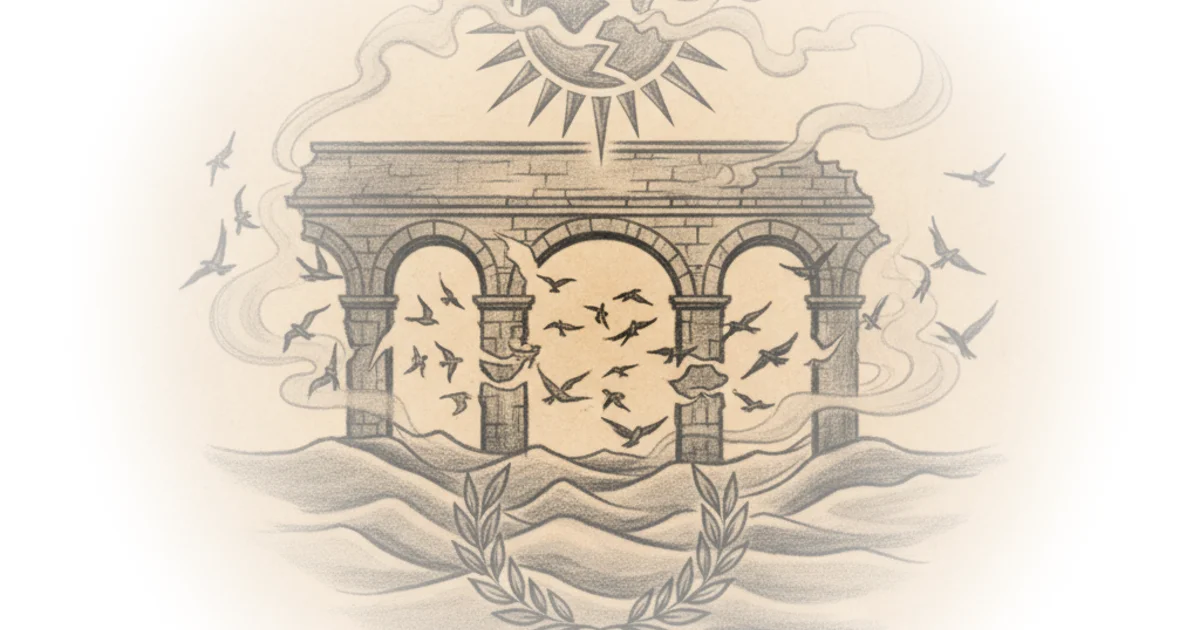
This reframing is crucial because it moves the discussion away from the personality of the last emperor to the structural inertia of the state. The authors highlight that the deposition of Romulus was handled with surprising casualness by the sources available to us. "The event is not described with any hint of importance as he certainly does not talk about the end of an empire or of the roman world," Kings and Generals writes regarding the anonymous Felicianus. This lack of contemporary alarm suggests that the "fall" was a retrospective construction, not a lived experience.
The situation of the roman government had been in a constant state of flux for decades and the arrival of a barbarian king who nominally reigned under the name of the empire was not a reason to believe that the roman i
Critics might argue that this perspective downplays the genuine trauma of the era, particularly for those in regions like Gaul where the transition was violent. However, the evidence from ecclesiastical writers suggests a complex reality where daily life often continued uninterrupted. As Kings and Generals notes, while some authors like Sidonius Apollinaris saw a "polarized" world of barbaric invaders and dying culture, others like Constantius of Lyon described a society where "germanic and atlantic peoples are participating in daily life and are not the cause of all evils."
The Politics of Memory
The commentary then delves into why later historians insisted on the significance of 476. The authors identify a clear political agenda in the writings of figures like Marcellinus Comes and Jordanes, who wrote decades later under the influence of the Eastern Roman Empire. Kings and Generals explains that "it was important for the emperor to paint the occupation of italy by the goths as illegitimate both to justify the heavy costs of the war and to bring onto his side the local italian population."
This is a sophisticated reading of historiography. The authors point out that the famous declaration that "the western roman empire of which title was first taken by august octavian in the year 709 from the founding of rome died with this augustulus" likely originated from a specific political faction that opposed the new Gothic rulers. The narrative of total collapse was a tool used by the Eastern administration to delegitimize the Germanic kings in Italy. As Kings and Generals puts it, "once they had the stability and the resources emperor justinian began the reconquest of those regions... it was important for the emperor to paint the occupation of italy by the goths as illegitimate."
The piece effectively contrasts this with the views of contemporaries like Ennodius and Cassiodorus, who served the Gothic kings. They viewed the deposition not as an end, but as a substitution of one weak ruler for another. Cassiodorus, for instance, described the transfer of imperial regalia to Constantinople as "strange" but did not interpret it as the end of institutions. The authors argue that for the Italian aristocracy, "the empire as a political institution continues to exist" even without a resident emperor in Rome.
The Verdict on 476
The final synthesis of the piece is a powerful rejection of the traditional narrative. Kings and Generals concludes that the idea of a sudden fall is a myth perpetuated by later political needs rather than historical reality. The authors state, "while a usurper in the eyes of many he was still the head of what remained of the empire of italy and that idea had not died." The transition was a slow integration, not a sharp break.
This analysis holds up well against the available primary sources, which often show a continuity of Roman law and administration under Gothic rule. The only potential weakness is the reliance on elite sources; we have almost no testimony from the peasantry, whose lives might have been more drastically altered by the changing of the guard. Yet, even acknowledging this gap, the argument that 476 was not a singular moment of collapse is compelling.
The deposition of romulus was just a substitution of one weak ruler for another in a state that had been long declining but it was not the culmination of this decline.
Bottom Line
Kings and Generals delivers a necessary corrective to the popular understanding of the Roman fall, proving that 476 was a political technicality rather than a historical apocalypse. The strongest part of this argument is its exposure of how later Eastern Roman propaganda cemented the date as a symbol of illegitimacy to justify military reconquest. The biggest vulnerability remains the silence of the lower classes, but the evidence from the aristocracy and clergy strongly supports the view that the empire's end was a slow fade, not a sudden death.