Smrithi Sunil reframes the history of biological discovery not as a sudden leap of genius, but as a century-long engineering struggle to see the invisible. While many science histories focus on the biological breakthroughs themselves, Sunil's piece is notable for its meticulous tracing of the instrumental limitations that held back medicine for decades. The argument lands hard because it reveals that the tools we take for granted today—like the imaging that guided vaccine development—were once theoretical impossibilities, constrained by the very physics of light.
The Wall of Light
Sunil begins by establishing the fundamental barrier that defined biology for centuries: the wavelength of light itself. She writes, "Until Abbe, microscope design had been more of an art than an art, with innovators building optical instruments through trial and error." This distinction is crucial; it highlights that without the mathematical rigor introduced by Ernst Abbe, scientists were essentially guessing their way toward better vision. Abbe's discovery that resolution is mathematically capped by the wavelength of light meant that no amount of polishing glass could ever reveal the inner workings of a virus or a protein.
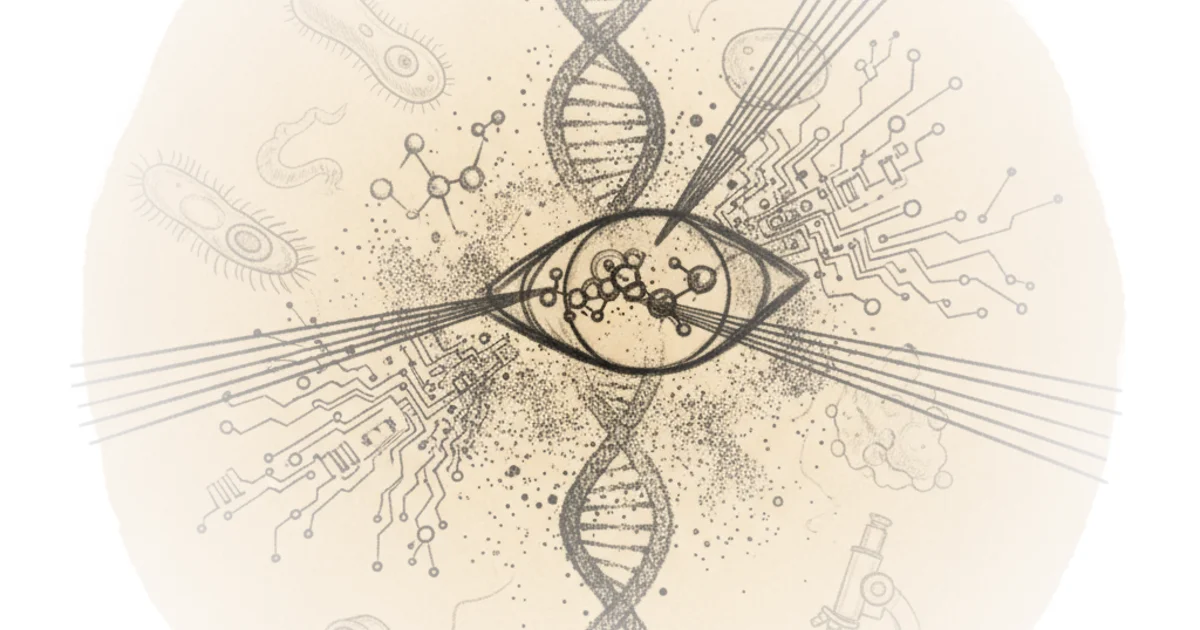
The author notes that even with the best lenses, "the limit of resolution was 200 nanometers — larger than most viruses, intracellular structures, and protein complexes." This creates a stark narrative tension: biologists knew the answers existed, but the universe's physics had locked the door. Sunil effectively uses the history of X-ray crystallography as a partial solution, yet she points out its fatal flaw for dynamic biology. "Biomolecules, however, are not naturally crystalline," she explains, noting that the process of forcing them into crystals often destroyed their natural context. This framing is effective because it sets the stage for the electron microscope not just as a better tool, but as the only tool capable of bridging the gap between static atomic models and living cells.
Critics might argue that X-ray crystallography deserves more credit for solving the structures of DNA and hemoglobin, which Sunil acknowledges, but her focus remains rightly on the limitations of that method for observing cellular machinery in action.
"The ability to explore and map such minute mechanisms eluded scientists until the invention of the electron microscope."
The Spark of Electron Optics
The narrative shifts from biological frustration to physical possibility with the work of Hans Busch. Sunil captures the moment of theoretical breakthrough beautifully: "Busch's paper was more than an eye-opener; it was almost like a spark in an explosive mixture." She attributes this quote to Denis Gabor, a Nobel laureate, which lends immediate weight to the claim that Busch's math was the catalyst for everything that followed. The core of Sunil's argument here is that the electron microscope was born from an analogy: treating electrons like light rays.
She details how Busch demonstrated that "a magnetic coil could focus an electron beam in the same manner that a glass lens focuses light." This is the piece's most technical yet accessible pivot. Sunil explains that once this analogy was accepted, the entire field of optics could be imported to electron physics. This reframing is vital; it suggests that the invention was not a magic trick, but a logical application of existing principles to a new medium. The author then introduces Ernst Ruska, a young engineer whose background was less in pure science and more in "tinkering with electrical switchboards." This characterization humanizes the inventor, suggesting that practical engineering intuition was just as necessary as theoretical physics.
From Oscilloscope to Virus
Sunil weaves the origin story of the first prototype into a tale of solving a mundane industrial problem: electrical surges from thunderstorms. The High Tension Laboratory needed to visualize fleeting voltage spikes, leading Ruska to build a high-speed oscilloscope. In doing so, he inadvertently created the first electron microscope. "By 1929, his Master's thesis contained 'numerous sharp images with different magnifications of an electron-irradiated anode aperture … the first recorded electron-optical images,'" Sunil writes, quoting Ruska's own Nobel lecture.
This section is compelling because it demystifies the "Eureka" moment. The breakthrough wasn't a deliberate quest to see viruses; it was a byproduct of trying to measure electricity. Sunil traces the rapid evolution from this prototype to the 1938 photograph of the mouse ectromelia virus, the first time a virus was ever seen. The stakes of this progression are made clear when she connects the technology to modern crises: "During the COVID-19 pandemic, cryo-electron microscopy revealed the spike protein in the SARS-CoV-2 virus, which directly influenced the development of COVID vaccines."
"Resolving fine structures... provides the bridge between atomic detail and whole-organism physiology, taking us from form to function."
The Cost of Clarity
Despite the triumphs, Sunil refuses to paint a utopian picture. She dedicates significant space to the enduring limitations of the technology. The images are "limited to static snapshots," and the requirement for a vacuum makes it "impossible to directly observe the dynamism of live cells." Furthermore, the equipment is prohibitively expensive and complex. "Electron microscopes are physically large, can cost millions of dollars, and demand specialized facilities, training, and expertise to operate," she notes.
This balance is the piece's greatest strength. It acknowledges that while we can now see individual atoms, we still cannot easily watch them move in real-time within a living organism. Sunil argues that "despite these limitations, electron microscopy remains a powerful tool in biology, bridging the scales between molecular structure and living function." This conclusion feels earned because she has spent the entire piece detailing the immense effort required to build that bridge. The story is not just about seeing smaller things; it is about the persistent ingenuity required to overcome the physical constraints of our universe.
Bottom Line
Sunil's piece succeeds by shifting the focus from the biological discovery to the engineering triumph that made it possible, offering a nuanced look at how tool-making drives scientific progress. The argument's strongest element is its historical grounding, showing that today's life-saving vaccines rest on a century of incremental, often accidental, engineering breakthroughs. The only vulnerability is the brief treatment of modern computational advances that are beginning to overcome the "static snapshot" limitation, a frontier that deserves equal attention as the field moves forward.