Devin Stone delivers a blistering legal indictment of a presidential pardon spree, arguing that the executive branch has weaponized clemency not to correct injustice, but to shield a network of co-conspirators from accountability. The piece stands out by moving beyond partisan outrage to dissect a terrifying legal precedent: the transformation of the pardon power into a tool for incentivizing criminality in service of a sitting president. For the busy listener, Stone's analysis cuts through the noise to ask a fundamental question about the rule of law: what happens when the ultimate check on executive power becomes the mechanism for its corruption?
The Architecture of Impunity
Stone opens with raw frustration, framing the pardons not as acts of mercy but as a calculated dismantling of justice. He describes the recipients as "actual war criminals who were responsible for killing innocent iraqi citizens" and "ridiculously corrupt politicians," noting that the list includes those who refused to cooperate with federal investigations. The core of his argument is that this is not a standard political maneuver but a systemic threat. As Stone puts it, "this is not a close case this is not an issue of red versus blue this is just pure flat out corruption."
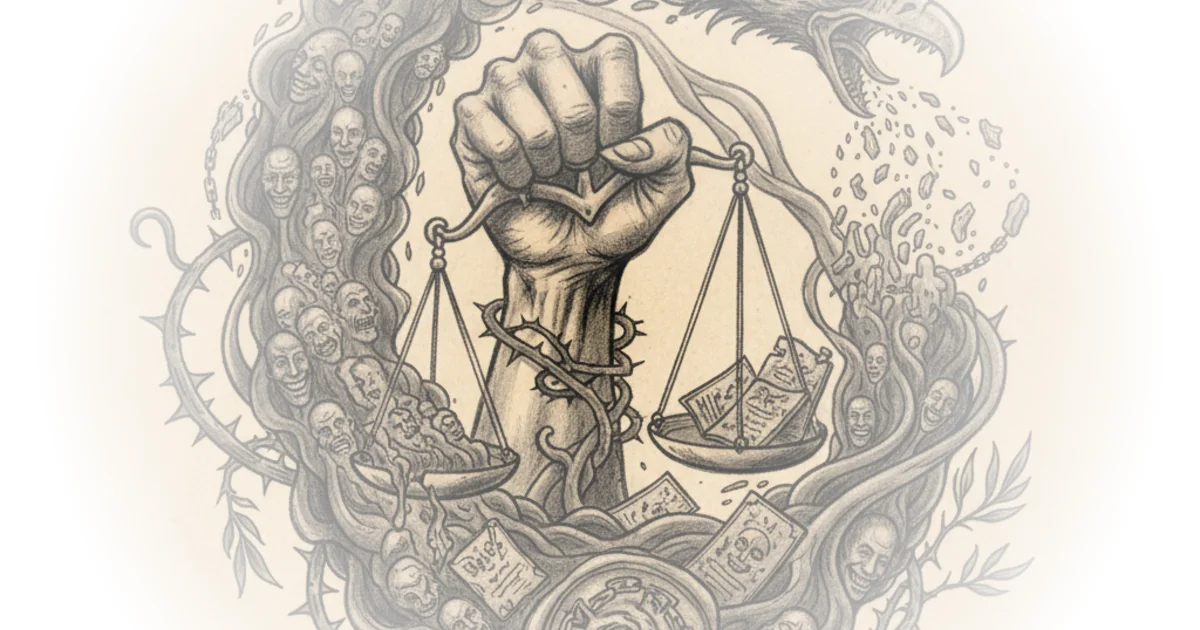
The author's framing is effective because it strips away the usual political defenses, forcing the reader to confront the mechanics of the abuse. Stone argues that the administration has created a perverse incentive structure where silence is rewarded with freedom. He warns that "if the president is allowed to pardon and absolve guilt after the fact there's a million ways for a sitting president to grift that." This logic suggests a future where a president could theoretically hire hitmen or orchestrate financial crimes, safe in the knowledge that their accomplices will be immunized from federal prosecution. Critics might argue that Stone's extreme hypotheticals—such as a president ordering a political assassination—distract from the more mundane reality of campaign finance violations. However, Stone uses these scenarios to illustrate the logical endpoint of unchecked pardon power, a point that holds significant weight in legal theory.
This is not a close case this is not an issue of red versus blue this is just pure flat out corruption.
The Silence of the Guardrails
A significant portion of Stone's commentary focuses on the institutional failure to check this behavior. He notes the silence of prominent conservative voices, stating that figures who typically defend executive authority have remained mute. He singles out Senator Ben Sasse as the sole critic, yet notes that "backing those words up with absolutely no action whatsoever" renders the criticism impotent. Stone emphasizes the futility of impeachment in a lame-duck period, describing it as "no real guard rail whatsoever."
This section highlights a critical vulnerability in the American system: the reliance on norms rather than hard legal constraints. Stone argues that the "guard rail is impeachment," but when the political will to impeach evaporates, the system has no other fail-safe. He suggests that the administration's actions are so brazen that they have effectively removed the fear of consequence. "President Trump doesn't have those lines he doesn't feel shame and he doesn't give a damn about political norms," Stone writes. This characterization of the executive's psychology is less a legal analysis and more a political observation, yet it serves to explain why traditional checks have failed. The argument is compelling because it acknowledges that legal theories often crumble when faced with an actor who refuses to play by the rules.
The Limits of Legal Recourse
Stone then pivots to the grim reality of what can actually be done. He manages expectations by stating that "absent actual evidence that there was a an explicit quid pro quo... there's not going to be criminal repercussions." He explains that while the pardons themselves are likely legal, the underlying agreements might not be. He points to the possibility of a "pardon for purchase scheme," suggesting that if there is proof of bribery, the crime-fraud exception could pierce attorney-client privilege. "It's possible that people did attempt or were successful at buying a pardon," he notes, offering a slim but non-zero chance of future accountability.
He also addresses the potential for state-level prosecutions, particularly in New York, where legislators have closed loopholes that previously protected pardoned individuals from state charges. Stone advises listeners not to "hero worship the investigators," acknowledging that state prosecutors have faced setbacks, but he maintains that the legal landscape has shifted. "The new york legislature closed a pardoned loophole that would have prevented prosecution of someone who receives a pardon when there is an ancillary new york state law to prosecute them under," he explains. This nuance is crucial; it prevents the commentary from becoming purely despairing while remaining realistic about the hurdles. The argument here is that while federal justice may be stalled, the door is not entirely closed at the state level.
The message has been sent that if you uphold your silence against who is effectively a mafia don you're going to get a pardon.
A Call for Structural Reform
In his conclusion, Stone argues that the only true remedy lies in a structural reimagining of the pardon power. He suggests that the current crisis must force Congress and the public to demand limits on executive authority. "We must demand of the future administrations that they not let these pardons go unchecked," he urges. He frames the situation as a "political rubicon" that has been crossed, warning that without intervention, future administrations will follow suit. Stone posits that the Supreme Court has never had to rule on the limits of a pardon in such a context, leaving a dangerous legal vacuum. "We don't know what the supreme court would have said if the forward pardon of nixon had been challenged," he writes, highlighting the unprecedented nature of the current legal landscape.
Critics might note that Stone's call for congressional action assumes a level of political unity that seems unlikely given the current polarization. However, his broader point—that the norm has been broken and must be replaced by law—is a necessary starting point for any future reform. The piece ends on a note of cautious urgency, reminding listeners that while the current administration is leaving, the precedent set remains.
Bottom Line
Stone's strongest contribution is his clear articulation of how the pardon power, traditionally a tool for mercy, has been inverted into a shield for criminal enterprise. His argument's greatest vulnerability lies in its reliance on future political will to correct a legal precedent that the Supreme Court has yet to define. Readers should watch for whether state-level prosecutions in New York can successfully bypass the federal pardons, as this may be the only immediate avenue for accountability.