This piece from Reason delivers a rare judicial takedown of a legal maneuver that reads less like a lawsuit and more like a rigged transaction. The central claim is startling: a federal judge didn't just dismiss a case; she declared the entire proceeding a fraudulent charade designed to launder a settlement that grants the executive branch immunity and funnels billions to allies. For busy readers tracking the erosion of institutional norms, this isn't just procedural drama—it's a forensic map of how the rule of law can be hollowed out from the inside.
The Illusion of Adversaries
The article's strongest move is its reliance on the judge's own scathing language to dismantle the administration's narrative. Reason reports that U.S. District Judge Kathleen Williams found the plaintiffs and defendants "worked in tandem and were never actually adverse." This isn't a minor procedural hiccup; it strikes at the very heart of the American legal system, which requires a genuine conflict between opposing sides to function. The piece argues that the lawsuit was brought "for an improper purpose—to gain the imprimatur of judicial legitimacy for a 'settlement' that had no viable basis in law or fact."
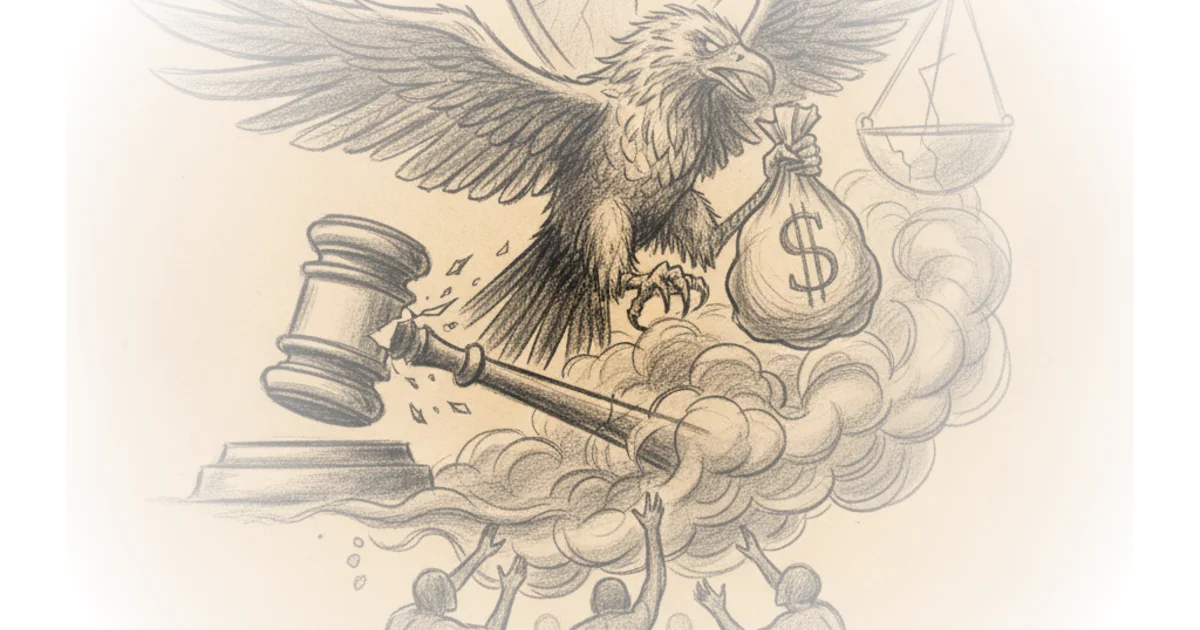
The commentary here is vital because it exposes the mechanics of the fraud. The administration sued itself, represented by lawyers who answer to the same boss as the agencies being sued. As the article notes, the executive branch's own lawyers did not "endeavor to defend" the IRS or "safeguard taxpayer monies." Instead, they executed a deal before the court could even review the jurisdiction. This failure to contest the claims highlights a blatant conflict of interest that usually results in immediate dismissal, yet here it was weaponized to create a settlement.
"The lead plaintiff and the government are one, a fully realized unitary interest."
Critics might argue that the President's control over the executive branch is a feature of the unitary executive theory, not a bug. However, the piece effectively counters this by noting that while the President controls the branch, he cannot use that control to bypass the requirement of an actual "case or controversy." The judge's observation that the parties were unable to advance any legal position contrary to the President's opinion renders the adversarial process a sham.
The Statute of Limitations and the 'Anti-Weaponization' Fund
The piece digs into the specific legal failures that make the lawsuit legally untenable, adding necessary context that goes beyond political posturing. The lawsuit was filed more than two years after the alleged leak, exceeding the statute of limitations for the specific law invoked. Reason points out that the law covers unauthorized disclosures by "any officer or employee of the United States," creating a legal hurdle for suing a private contractor that the Justice Department has disputed in other cases.
Furthermore, the article details the contents of the settlement that the judge slammed. It included a $1.8 billion "Anti-Weaponization Fund" and a provision granting immunity for federal offenses, potentially saving the President and his family over $100 million in back taxes. The piece notes that while the fund was abandoned due to bipartisan backlash, the immunity deal remained. This connects to the broader historical context of qui tam actions and collusive lawsuits, where parties manufacture legal standing to achieve private ends. The judge's finding that the case was a "pretext" for this arrangement underscores the severity of the overreach.
The article also highlights the role of a February 2025 executive order that barred government lawyers from taking positions at odds with the President. This order effectively neutered the Justice Department's ability to defend the IRS, a fact the judge seized upon. "Defendants chose not to 'advance an interpretation of the law as the position of the United States that contravenes' President Trump's opinion," Williams wrote. This demonstrates that the legal process was not just flawed; it was pre-ordained by political directive.
Sanctions and the Integrity of the Court
Perhaps the most significant takeaway is the judge's response: she didn't just walk away. She imposed sanctions, barred one lawyer from the district for a year, and referred another to the state bar. The article reports that the court found the dismissal was "premised on deception by the Parties." This is a powerful assertion of judicial independence in the face of executive overreach. The judge exercised her inherent authority to protect the integrity of judicial proceedings, ordering the reimbursement of legal expenses for parties who submitted amicus briefs, including 35 retired federal judges.
The piece argues that the settlement provisions, which bar the IRS from auditing the President, "directly contravenes" a federal statute (26 USC 7217) that makes it unlawful for an executive official to request the termination of an audit. This isn't just a policy dispute; it's a statutory violation. The judge's conclusion that the parties could not use the court to legitimize an agreement to confer immunity is a resounding defense of the separation of powers.
"This action was never about a party seeking judicial resolution of a legal issue or a factual dispute."
A counterargument worth considering is whether the executive branch's interpretation of its own authority allows for such settlements in the interest of efficiency. However, the judge's ruling suggests that efficiency cannot come at the cost of constitutional principles like the prohibition on self-dealing and the requirement for an actual case or controversy. The fact that the Supreme Court recently affirmed the President's power to remove officials does not grant him the power to sue himself and settle for billions.
Bottom Line
Reason's coverage is at its most effective when it lets the judge's words do the heavy lifting, revealing a legal strategy that was as transparent as it was corrupt. The strongest part of the argument is the demonstration that the lawsuit was a vehicle to bypass statutory limits and constitutional constraints, not a genuine attempt to resolve a dispute. The biggest vulnerability for the administration is that this ruling creates a permanent record of the transaction's illegitimacy, making it difficult to cite as precedent. Readers should watch for whether the immunity provisions survive this judicial rebuke or if the executive branch attempts to enforce them through other, less transparent channels.