Then & Now delivers a provocative diagnosis for our current global disorientation: the belief that history had ended was a dangerous illusion, and the past is now exacting its revenge on those who forgot it. This isn't a dry recitation of dates, but a urgent argument that our inability to navigate the present stems from a collective "historical blindness" that leaves us bumping into conflicts we thought we had solved.
The Illusion of Finality
The piece opens by dismantling the triumphant optimism of the 1990s, specifically targeting Francis Fukuyama's thesis that liberal democracy had become the "indisputable heavyweight champion of history." Then & Now writes, "During the '90s, there was a sense that history was over, finished, done." The author argues that this era fostered a dangerous complacency where leaders like Tony Blair believed history provided "so little instruction for our present day." This framing is effective because it connects abstract political theory to the tangible arrogance of the era—the "champagne sipping market traders" who thought borders and national identity no longer mattered.
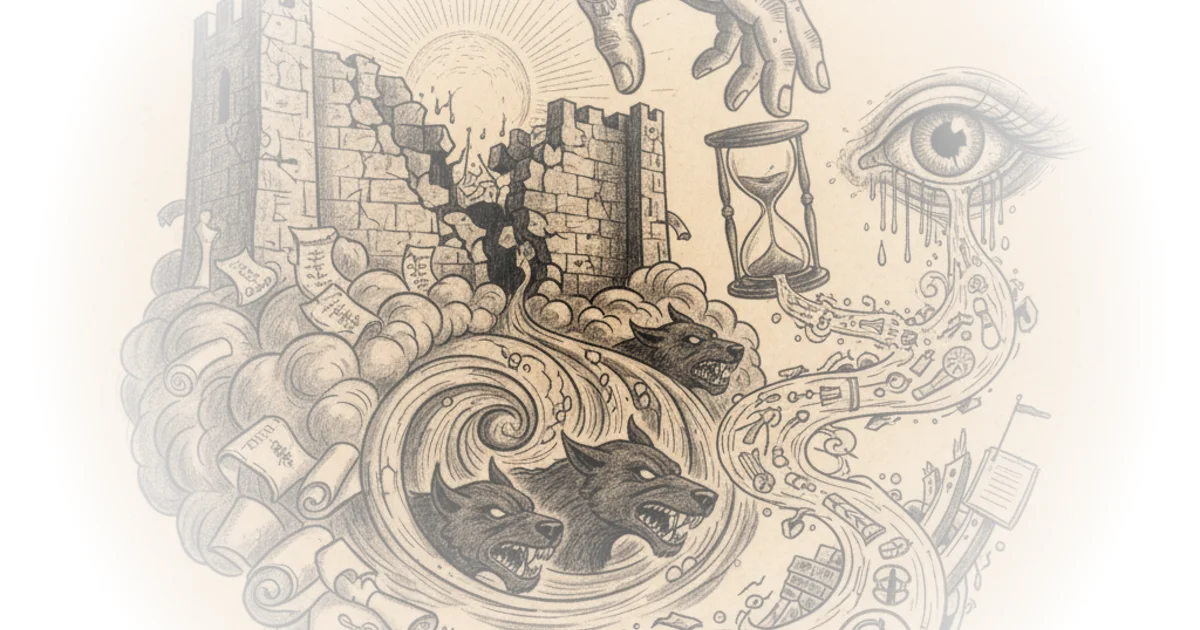
Critics might note that the 1990s were not entirely devoid of historical awareness, but the author's point holds: the dominant narrative was one of rupture, not continuity. The text suggests that by ignoring the past, the West failed to see the "frozen injustices, ethnic hatreds, [and] authoritarian desires" simmering beneath the surface of the post-Cold War order. As Then & Now puts it, "History then never ended. It was always simmering under the surface, ready to break out." This metaphor of a dormant volcano is a powerful way to explain why the return of conflict feels so sudden to some, yet so inevitable to historians.
Thinking With History, Not About It
The commentary shifts from diagnosis to methodology, introducing the concept of "thinking with history" rather than merely studying it as a detached artifact. Then & Now cites the historian Carl Shores to argue that we must use history to "orient ourselves in the living present." The author explains that our routines, movements, and even our political assumptions are "constructed by history" and "imprinted with it." This is the piece's most compelling insight: we are not free agents moving through a vacuum, but rather "archaeological sites" where the past is still active.
In each of us in varying proportions, there is part of yesterday's man. It's yesterday's man who inevitably predominates in us since the present amounts to little compared to the long past in the course of which we were formed.
By quoting sociologist Pierre Bourdieu, the author drives home the idea that the present is often "contradictory and incoherent" precisely because it is a "mixture of old and new." The text uses the example of Stalin's Russia to illustrate that even revolutions claiming to be radical breaks often inherit the structures of the regimes they replace, such as the "state repression" and "centralization of power" found in both the Tsarist and Soviet eras. This challenges the reader to look for continuity in current events, from the rise of China to the wars in the Middle East, rather than viewing them as isolated anomalies.
The Disease of Historical Blindness
The final section warns of the consequences of ignoring these lessons, coining the term "historical blindness" to describe a state where societies "fumble around, bumping into others, misunderstanding them." Then & Now writes, "If history is ignored, forgotten, incorrect, or abused, you might contract an unfortunate illness, historical blindness." The author draws on Margaret McMillan to show how we all use history to gain advantage in arguments, often spinning narratives to justify our actions while blaming others.
The piece offers a stark historical parallel: the divergent stories told after World War I. While the Allies insisted Germany was solely to blame, German historians and the public developed a narrative of being "stabbed in the back" by domestic traitors. Then & Now notes that these conflicting stories "led to German resentment and contributed to the rise of Hitler and the Nazis." This is a sobering reminder that history is not just a record of what happened, but a tool that shapes future behavior. The author argues that when we neglect the "genealogical series" that led to current worldviews, we invite conflict. As the text concludes, "History is having a bit of a moment. You might say it's having its revenge."
Bottom Line
Then & Now's strongest argument is the reframing of current global instability not as a failure of the present, but as the inevitable return of suppressed historical forces. The piece's biggest vulnerability is its tendency to treat "history" as a monolithic force that dictates outcomes, potentially underestimating human agency and the possibility of genuine novelty in political systems. The reader should watch for how this "historical revenge" manifests in the next decade, particularly in how nations navigate the tension between their inherited pasts and their desired futures.