Alaa Al-Aswany does not merely describe Cairo; he dissects its soul, arguing that the city's chaotic streets and crumbling buildings are not failures of planning but archives of human history. In an era where Egyptian leadership seeks to scrub the capital clean in favor of a sterile, Dubai-style modernity, Al-Aswany offers a defiant counter-narrative: that the true identity of Egypt lies in its layered, messy, and deeply human past. For the busy reader, this is not a travelogue but a urgent plea to understand why erasing the old city is an act of cultural suicide.
The City as a Character
Al-Aswany frames his relationship with Cairo with a tenderness rarely seen in political commentary. "When I talk about Cairo it's like talking about my mother," he tells Louisiana Channel, establishing an emotional baseline that grounds his subsequent political critiques. He argues that Cairo is not a monolith but a collection of distinct worlds, from the French-speaking elegance of his childhood in Garden City to the dense, vibrant chaos of the present. The author contends that the current government's attempt to replicate the Dubai model is a fundamental error because it ignores the unique texture of Cairo's history.
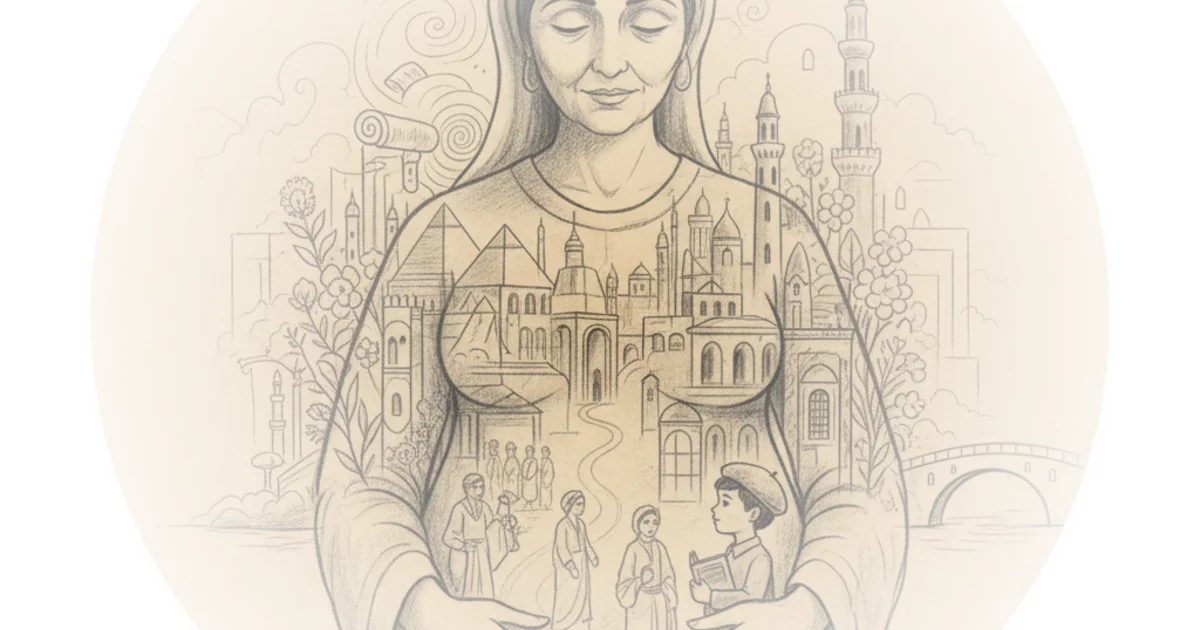
This perspective is powerful because it reframes urban decay not as a problem to be solved, but as a feature to be preserved. Al-Aswany suggests that the "deteriorating" neighborhoods hold a value that new skyscrapers cannot replicate. He notes that decision-makers in Egypt have adopted a different model, one that prioritizes the sleek aesthetics of Dubai over the preservation of "old buildings" and "old neighborhoods." This argument lands with particular force because it comes from a man who has lived inside the very structures he defends. He describes the Yakobian Building, once his father's office and now the setting of his most famous novel, as a vessel where "even the elevator... has its history."
"Every place we are using for our daily purpose is full of human history, and for the novelist to imagine or even to invent the history of the place."
Al-Aswany's method is to treat the city as a "main character," a literary device that allows him to uncover the hidden lives within the walls. He recalls a moment of inspiration when watching the American embassy demolish a building with "sophisticated" precision, cutting it like a piece of cake. Seeing the abandoned rooms filled with mundane items like newspapers and towels, he realized the space was saturated with human drama. "I can easily imagine that in this room there was a wedding night or a divorce negotiations or even somebody committed suicide," he says. This ability to see the invisible is the core of his argument: the city's value is in its stories, not its square footage.
A Heritage of Tolerance and Art
The commentary shifts from the physical city to the cultural ecosystem that once thrived there. Al-Aswany traces a lineage of Egyptian artistic innovation that predates many Western counterparts, noting that Egypt was "almost the first Arab country" to send students to the Sorbonne and to establish cinema just eleven months after the Lumière brothers' first screening in Paris. He credits a cosmopolitan past where Greek, Italian, and Jewish communities were not outsiders but integral parts of the national fabric. "We had Jews who lived for centuries in Egypt. And they were considered Egyptians in the first place," he asserts, highlighting a time when identity was not defined by religious exclusivity.
This historical overview serves as a sharp contrast to the current climate. Al-Aswany argues that this "coexistence" was a defining feature of Egyptian culture, a tolerance that allowed the country to produce a rich tapestry of art and literature. However, he acknowledges that this heritage is under threat. Critics might note that romanticizing the pre-1952 era of foreign influence can sometimes overlook the colonial inequalities that existed alongside this cultural flourishing. Yet, Al-Aswany's point remains valid: the loss of this pluralistic identity is a genuine cultural wound that the current regime has failed to heal.
The Cost of Silence
The tone darkens as Al-Aswany addresses the present political reality. He describes a society where the freedom of speech has been extinguished, replaced by a climate of fear where citizens can be imprisoned for "indefinite time" for criticizing the government. "You cannot keep the people scared forever," he warns, arguing that this fear deforms the character of the nation. He identifies himself as an opponent of the current leadership, specifically naming General Abdel Fattah el-Sisi, and details his own banishment from Egyptian media and publishing.
"If you say anything against the government or the regime... you will be arrested and you will be sent to prison for an indefinite time. Nobody knows, you know, probably you'll be released in one month or one year or five years."
Al-Aswany's decision to leave Egypt in 2018, citing the harassment of his daughters and the impossibility of writing about the revolution, is presented not as a retreat but as a strategic move to gain clarity. He draws a parallel to writers like Gabriel García Márquez, suggesting that exile can provide a "better vision" of one's homeland. "When you are no more in the city you probably have a better vision for the city and you have a strong nostalgia," he explains. This distance has allowed him to write prolifically, producing two novels in five years, a pace he attributes to the unique perspective of the exile.
The Secret of the Revolution
Despite the bleakness of the current dictatorship and the "catastrophic" economic situation, Al-Aswany finds hope in the memory of the 2011 revolution. He recounts the "unbelievable" solidarity he witnessed in Tahrir Square, where strangers shared food and huddled together in a way he had never seen before. The moment Mubarak stepped down, he describes, was the "most beautiful moment" of his life, characterized by a spontaneous, collective joy that transcended class and political divides.
He identifies the "secret" of Cairo as a deep, stratified identity that is both Arab and Egyptian, rooted in a love for the country and for strangers. "Egyptians love each other, love their country and love the strangers," he says. This love, he argues, is the antidote to the fear and division currently tearing the country apart. While he admits he does not know what the future holds, he is certain that the current unsustainable path of military dictatorship and economic mismanagement will eventually collapse.
"I believe this love is translated to many things, a very decent attitude because of the secret of love in my opinion."
Bottom Line
Al-Aswany's most compelling argument is that the physical destruction of Cairo's old neighborhoods is a direct attack on the nation's ability to remember who it is. His greatest vulnerability lies in his reliance on a romanticized version of the past that may not fully account for the deep-seated religious and political fractures that also shaped Egyptian history. However, his insistence that the city's chaos is a form of vitality, and that its people's capacity for love is its ultimate defense, offers a necessary counterweight to the sterile vision of modernization currently being imposed from above.