What if this war was never planned? What if the president of the United States launched strikes on Iran without clear objectives, no strategy for ending hostilities, and no protection for American troops deployed in the region? That is exactly what journalist E.J. Dionne observed in the New York Times: from the very beginning of this conflict, there wasn't serious thought about how it might end, what needed to be done to protect Americans in the Middle East, or what might happen to oil flows through the Strait of Hormuz.
The War Without a Plan
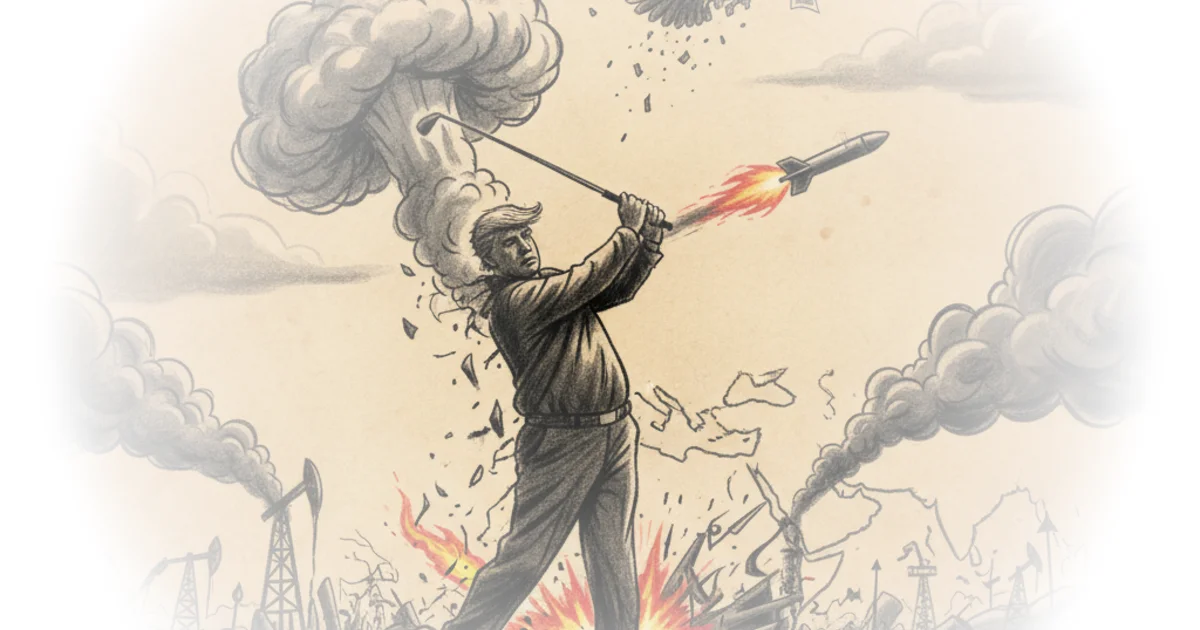
Three weeks into the conflict with Iran, President Donald J. Trump was on the golf course. The administration appears to be trying to convince Americans that destruction of the Iranian military means the United States has won. But Iranian leadership needs only to continue in power to declare victory. Blocking the 20% of the world's oil that flows through the Strait of Hormuz gives them leverage over the war's outcome.
On March 10, senior defense officials told the New York Times that the Iranian military is adjusting its tactics to strike at communications and defense systems protecting U.S. troops. Those tactics include drone strikes—the same day Axios reported that Ukrainian officials had tried months ago to sell the U.S. anti-drone technology for downing Iran-made drones as a sign of thanks for U.S. support, but the United States did not pursue the offer.
White House spokesperson Anna Kelly responded that characterization by unnamed sources was inaccurate. Defense Secretary Pete Hegseth "did an incredible job planning for all possible responses," she said. Yet the fallout from strikes on Iran by the U.S. and Israel appears to have caught the administration by surprise.
Trump told NBC News yesterday he was "surprised" that Iran attacked other countries after the U.S. and Israeli strikes. He also said strikes on Saturday on Kharg Island, about fifteen miles off the Iranian coast and home to Iran's primary oil export terminal, "totally demolished" most of the island but "we may hit it a few more times just for fun."
"We have already destroyed 100% of Iran's Military capability, but it's easy for them to send a drone or two, drop a mine, or deliver a close range missile somewhere along, or in, this Waterway, no matter how badly defeated they are."
Calling for Help After Declaring Victory
Despite claiming the utter destruction of Iran's military, Trump asked other countries to contribute to reopening the strait. He posted on social media: "Hopefully China, France, Japan, South Korea, the UK, and others, that are affected by this artificial constraint, will send Ships to the area so that the Hormuz Strait will no longer be a threat by a Nation that has been totally decapitated."
Since he took office more than a year ago, Trump has gone out of his way to antagonize allies and partners, warning them that the United States would act alone and working to undermine the international alliances the U.S. shaped since World War II. Now, having sparked a regional war in the Middle East after ignoring what virtually everyone said would be the result of attacking Iran a second time, Trump is begging other countries to come to his aid.
In yesterday's NBC News interview, Trump told reporters that several countries have committed to helping reopen the strait but he declined to name them. "They've not only committed, but they think it's a great idea," he said. He also said "Iran wants to make a deal" but he has declined because "the terms aren't good enough yet."
Today Iran's foreign minister, Abbas Araghchi, said Tehran had not even asked for negotiations, let alone a ceasefire.
The White House in Turmoil
That the White House is in turmoil showed first of all in the fact that one of the people making the administration's case on the talk shows was U.S. Ambassador to the United Nations Mike Waltz—the man who added Atlantic editor Jeffrey Goldberg to the Signal messaging app on which members of the administration were making plans to strike Houthi militants in Yemen, a chat that would hide administration discussions from the record-keeping required by public records laws.
On CNN's State of the Union, over a chyron reading "OIL PRICES SKYROCKET AS IRAN THROTTLES TRAFFIC IN STRAIT OF HORMUZ," Jake Tapper noted that while the U.S. said it would soon send naval escorts through the strait, shipping executives have told CNN "that all their requests for escorts have been rebuffed."
On Face the Nation, National Economic Council director Kevin Hassett told host Margaret Brennan that "America is not going to have its economy harmed by what the Iranians are doing." He implied that because the U.S. produces more oil now than it did in the 1970s, it doesn't really need oil from the Persian Gulf.
The U.S. does indeed produce more oil and natural gas than it consumes, but it cannot use much of what it produces. The key is prices and refineries. The U.S. tends to produce light, sweet crude—oil that flows easily and has low sulfur content. Because it is easy to refine and more valuable than heavy, sour crude, U.S. producers have an incentive to sell it on the open market. Even if they wanted to keep it at home, U.S. refineries are set up to refine the cheaper heavy crude oil, so the U.S. does not have the refining capacity to process the oil it currently produces and must buy what it needs from elsewhere.
This means the U.S. is inextricably tied to the international oil markets.
Attacking the Press
The administration appears to be taking the position that the problem is not Trump launching an ill-thought-out war, but rather the media outlets' reporting on that war. Yesterday morning he posted on social media: "The New York Times and The Wall Street Journal (in particular), and other Lowlife 'Papers' and Media actually want us to lose the War."
Hours later, Federal Communications Commission chair Brendan Carr threatened the broadcast licenses of media stations. He quoted Trump: "Broadcasters that are running hoaxes and news distortions—also known as the fake news—have a chance now to correct course before their license renewals come up." Then Carr slipped in his own fake news, suggesting Trump won "a landslide election victory" when in fact he received less than 50% of the vote.
Jim Acosta, who left CNN, noted that while the administration is attempting to establish a state media, the American people increasingly have the option of reading independent journalism. "Yes," Acosta wrote, "Trump put me on his media hit list. I regret to report to the notoriously thin-skinned, twice elected, yet soon to be thrice-impeached president that I am still here, loving the freedom of independent media."
The Framers of the U.S. Constitution understood that a free press is imperative for democracy. They established the right to a free press in the First Amendment that begins the Bill of Rights. Silencing critics is the refuge of those who know what they are doing is unpopular and unjustifiable.
In an interview with Financial Times published this evening, Trump warned that NATO would have a "very bad" future if allies don't help open the Strait of Hormuz. Tonight, on Air Force One, he told reporters: "Really, I'm demanding that these countries come in and protect their own territory, because it's their territory. It's the place from which they get their energy, and they should come and they should help us protect it. You could make the case that maybe we shouldn't even be there at all, because we don't need it. We have a lot of oil."
Critics might note that framing this conflict as "ill-thought-out" relies on assuming what the administration's actual intentions were—a difficult proposition given their consistent messaging about winning. Others might argue that Trump's appeal for international assistance could succeed where his previous isolationist approach failed, potentially creating new diplomatic openings.
Bottom Line
The strongest thread running through this piece is the consistency of contradiction: claiming total military victory while begging for help; declaring Iran "totally decapitated" while requesting naval escorts; insisting the U.S. doesn't need Middle Eastern oil while being inextricably tied to international crude markets. The administration's biggest vulnerability is that it appears to have no plan for ending this war, and now needs allies it has spent two years antagonizing. Watch for whether other countries actually commit ships to the strait—and what happens when oil prices remain elevated despite claims of energy dominance.