Ghosts, Cattle, and the Logic of Marriage
Of the 186 societies cataloged in the Standard Cross-Cultural Sample, 153 practiced polygyny, 31 were monogamous, and just 2 were polyandrous. Olympia Campbell, a research fellow at the Toulouse School of Economics, uses this striking dataset as the launching point for a sweeping tour of marriage systems across human history. Her argument is fundamentally Darwinian: people seek to maximize the number of descendants they leave behind, and the best strategy for doing so shifts with the economic environment.
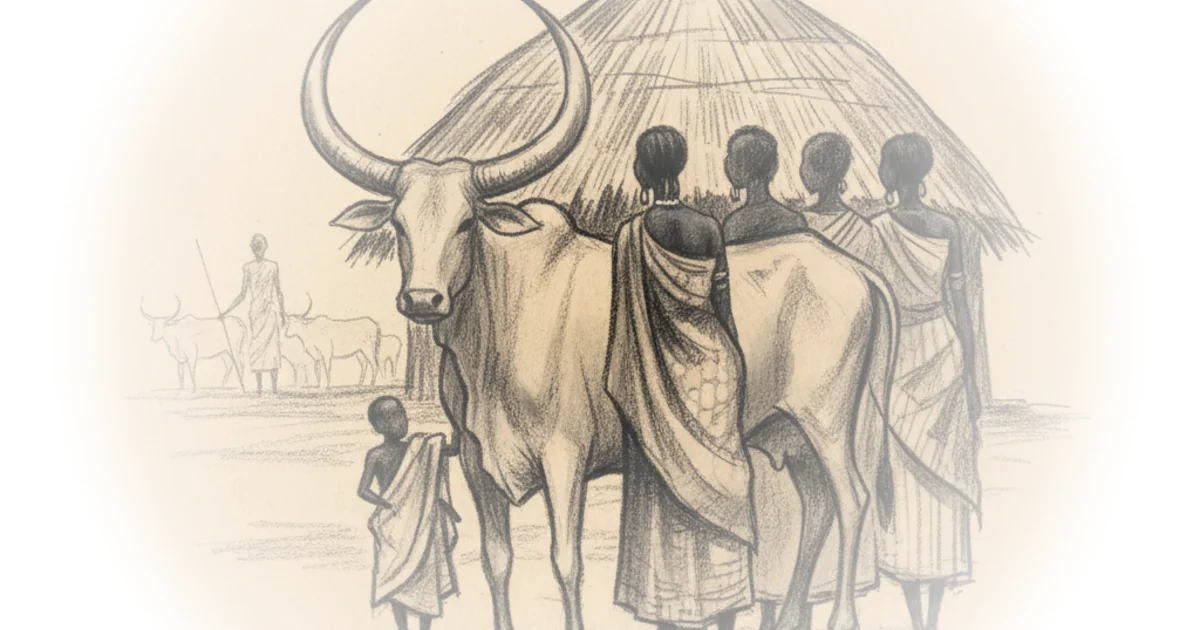
Campbell opens with a startling ethnographic case. Among the Nuer of South Sudan, anthropologist E.E. Evans-Pritchard documented ghost marriages in the 1930s, unions arranged on behalf of dead men so their names would live on. The practice was nearly as common as marriage between the living.
A ghost likes to think of people asking, "whose son is that?" and being told in reply that it is the son of so-and-so. Thus, his name continues on the lips of men.
The arrangement could cascade. A living husband who married on a ghost's behalf might himself die before contracting his own legal marriage, prompting yet another ghost marriage. It is the kind of detail that makes the sheer variety of human kinship systems feel almost inexhaustible.
Hunter-Gatherers and the Freedom of Having Nothing
Campbell traces a clear line from material conditions to marriage structure. Among the BaYaka of the Congolese rainforest, marriage begins when an adolescent couple walks into the forest together and returns a few days later to build a hut. No ceremony, no vows, no bride price.
There is something very romantic about it.
That fluidity, Campbell argues, is a direct product of egalitarian economics. With no stored wealth, no land to defend, and no inheritance to contest, there is little reason to police sexual behavior or restrict divorce. Women can rely on extended family, particularly grandmothers and siblings, rather than husbands for child-rearing support. A review of over 45 studies found that fathers have a surprisingly small effect on child survival in these settings.
The result is serial monogamy in practice, even where the ethnographic record technically classifies societies as polygynous. Women frequently have children with two or even three men over a lifetime.
More Cows, More Wives
The arrival of farming roughly 12,000 years ago changed everything. Wealth could be accumulated. Inequality emerged. And with inequality came polygyny in earnest.
Campbell illustrates the mechanism with a Turkana pastoralist named Imana, who in 1948 had 13 children by four concurrent wives, supported by a herd of over a hundred cows. His neighbor, with only ten cows, had one wife. The logic is blunt: more cows, more wives. But Campbell adds nuance by noting that female choice may also drive polygyny. Women sometimes benefit from being the second wife of a wealthy man rather than the first wife of a poor one.
Taken to its extremes, some men may be so powerful and rich that they can accumulate tens, if not hundreds, of wives. The Azande recount tales of one legendary monarch, Gbudwe, who once spotted an attractive girl as he was walking through his province. Wanting her to be his wife, he stopped to inquire who she was and was told that she was one of his own wives.
When women become a limited resource, daughters become economically valuable. Campbell details the elaborate bride-price system among the Chagga of Tanzania during the colonial period: 62 pots of beer, 4 slaughtered goats, 3 live goats, 15 gourds of milk, and half a cow, and that was merely the pre-wedding deposit. To prevent disputes, fathers would allocate each son a sister whose bride-price could finance his marriage.
Control, Paternity, and the Exceptions
Polygyny, Campbell argues, drives male control over female sexuality. When wealth passes through the male line and fathers invest heavily in heirs, paternity certainty becomes paramount. She cites the Dogon of Mali, whose menstrual huts served as a public signal of fertility cycles, reducing nonpaternity rates. Genetic data confirmed the system worked: nonpaternity was lower among women who used the huts than among Christian Dogon women who did not.
But Campbell is careful to present exceptions that complicate the pattern. The Himba of Namibia are pastoralists who practice polygyny yet are notably relaxed about extramarital relationships. In one sample, 49 percent of children were not biologically the husband's. There is no cuckoldry in the deceptive sense; everyone knows the arrangement.
It's when he stays for tea in the morning, that is when it really upsets me.
What makes the Himba different is that bride prices are low, just one or two cows, and inheritance passes matrilineally. A man knows his sister's children are related to him with certainty. These two features allow men to tolerate high nonpaternity within their marriages.
This is one of the article's sharpest insights. It suggests that the obsession with female fidelity found in many pastoralist societies is not some universal male instinct but a rational response to specific inheritance structures. Change the rules of inheritance, and the policing of women's bodies relaxes.
Why Europe Went Monogamous
Campbell tackles the puzzle of wealthy yet monogamous societies. She argues that monogamy in Europe and parts of Asia was not primarily a product of Christianity or moral enlightenment but of agricultural economics. Dividing farmland among many heirs reduces its productivity in ways that dividing a cattle herd does not. When fertile land ran out in medieval Europe, unigeniture, passing everything to a single son, became the dominant strategy.
Women traded their faithfulness in exchange for an agreement that only their children were legitimate heirs. Virginity was prized, and divorce could become almost impossible.
The article notes that even nominally monogamous societies were not truly monogamous in practice. Roman men kept mistresses and fathered children by slaves. Confucian family law allowed concubines alongside a principal wife. Research finds that monogamous and polygynous societies actually show similar variations in male reproductive success.
The fact that many "monogamous" cultures allow for elite men to have concubines and mistresses highlights the difference between a "mating system" and a "marriage system". Marriage might be more about managing resources than who you have sex with.
This distinction between mating systems and marriage systems is crucial, and Campbell draws it well. It reframes monogamy not as a moral achievement but as an economic arrangement for concentrating wealth.
There is a counterpoint worth raising here. The article leans heavily on the Darwinian framework of reproductive maximization, which can flatten the enormous cultural and psychological complexity of marriage into a single explanatory variable. Not every marriage custom maps neatly onto a fitness calculation, and the article occasionally reads as if it does. The Nuer ghost marriages, for instance, are as much about spiritual obligation and social memory as they are about leaving descendants.
The Modern Dissolve
Campbell's final section argues that contemporary Western marriage is converging on something that resembles no single historical system. Some couples are lifelong monogamists. Others divorce and remarry, echoing hunter-gatherer serial monogamy. Young couples cohabit before committing, much like Samoan trial marriages. True polygamy is illegal, yet wealthy divorced men attract younger second wives.
In my time, your husband could beat you badly and you would stay. Today, the smallest thing, and they divorce.
The erosion of traditional marriage structures, Campbell suggests, tracks the erosion of the economic conditions that sustained them. Women earn their own incomes. Inheritance laws mandate equal distribution. The state provides a safety net. With these changes, the old bargains, fidelity for economic security, paternity certainty for inheritance rights, lose their force.
One might push back on the implied trajectory. Campbell frames the weakening of marriage constraints as largely liberating, but the data she presents on divorce rates and socioeconomic class tells a more complicated story. Wealthier couples divorce less, suggesting that economic interdependence still matters. The freedom to leave a bad marriage is genuine progress; the instability that accompanies poverty-driven family dissolution is a different phenomenon entirely.
Bottom Line
Campbell has written a genuinely ambitious piece that spans 280,000 years of human history, from Nuer ghost marriages to modern ethical non-monogamy, all organized around a single Darwinian insight: marriage systems are shaped by how wealth is created, stored, and inherited. The ethnographic examples are vivid and well chosen, the Himba case alone is worth the read, and the article avoids the trap of treating any single system as natural or inevitable. Where it is weakest is in the final section, where the dissolution of traditional marriage systems is treated with a somewhat breezy optimism that does not fully reckon with the social costs of family instability among the poor. But as a synthesis of evolutionary anthropology and cross-cultural comparison, it is first-rate work that rewards careful attention.