Glenn Greenwald delivers a searing indictment of the current geopolitical trajectory, arguing that the United States is hurtling toward a catastrophic war with Iran without offering the public a single coherent justification. What makes this piece urgent is not just the scale of the military buildup described, but the alarming absence of the usual bureaucratic theater that precedes such conflicts. Greenwald suggests we are witnessing a dangerous precedent where the executive branch is mobilizing for regime change while actively dismantling the very diplomatic narratives that typically precede war.
The Silence Before the Storm
Greenwald's central thesis rests on a disturbing observation: the administration is assembling its largest military force in the Middle East since 2003, yet has failed to articulate why. "One of the most striking and alarming aspects of all of this is that Trump — outside of a few off-the-cuff banalities — has barely attempted to offer a case to the American public as to why such a major new war is necessary." This lack of public justification stands in stark contrast to the extensive, albeit deceptive, campaigns of the past. The author draws a chilling parallel to the lead-up to the Iraq invasion, noting that the Bush administration spent a full year manufacturing consent, whereas the current push toward conflict has occurred in a vacuum of public debate.
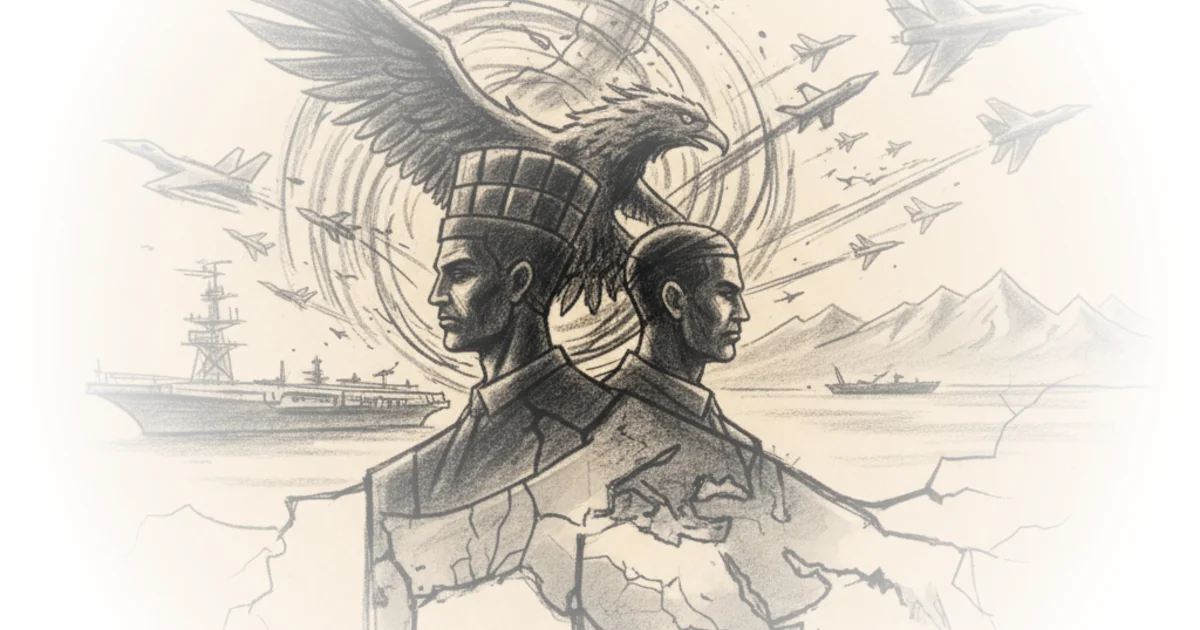
The commentary effectively highlights the disconnect between the stated goal of pivoting to Asia and the reality of deepening entanglement in the Middle East. Greenwald points out that despite vows to reduce involvement, the executive branch has assembled a force capable of "an extremely destructive air campaign against the whole country." This suggests that the pivot to Asia was never a genuine strategic priority, but rather a rhetorical shield for maintaining global hegemony. Critics might argue that military posturing is a standard tool of deterrence that does not necessarily signal an imminent invasion, yet the sheer volume of assets deployed near Iran makes this distinction increasingly difficult to maintain.
The U.S. has inexorably moved toward a war with Iran with stunningly little public debate or discussion.
The Venezuela Precedent and the Erosion of Truth
A significant portion of Greenwald's argument examines how the administration has normalized the use of fabricated or exaggerated pretexts for military intervention. He points to the recent operations in Venezuela as a blueprint for the current situation with Iran. The author notes that the administration initially claimed the intervention was necessary to stop drug trafficking and liberate the populace, only for those justifications to vanish once the operation was complete. "There was not even a live television address to the nation beforehand to explain it. And the role that Congress played was close to non-existent."
This pattern of behavior raises profound questions about the integrity of the executive branch's decision-making process. Greenwald argues that the administration is repeating a cycle where the stated reasons for war are merely "a low-effort smorgasbord to enable supporters... to mount arguments," rather than a genuine attempt to persuade the nation. The reference to the Monroe Doctrine, now rebranded as the "Donroe Doctrine," underscores how historical frameworks are being twisted to justify unilateral action. The historical context of the Monroe Doctrine, originally intended to prevent European colonialism in the Americas, is now being weaponized to justify interference in sovereign nations far beyond its original geographic scope.
The author's critique of the administration's reliance on threats as a diplomatic tool is particularly sharp. Greenwald writes, "Trump appears ready to attack Iran as U.S. strike force takes shape," citing reports that the administration is preparing for an extended assault. He argues that this approach has lost its credibility because the administration has repeatedly contradicted its own public statements. "Trump's words and actions about the current situation with Iran track almost completely his actions and words which preceded Israel's surprise attack on Iran in June."
The Human Cost of Geopolitical Theater
Perhaps the most compelling aspect of Greenwald's commentary is his refusal to accept the dehumanizing language often used to describe military conflicts. He dismantles the argument that human rights concerns are the driving force behind U.S. foreign policy, calling it a "self-serving fairy tale." "I am almost reluctant to critically evaluate this claim, because it genuinely shocks me each time I learn that there really still are sentient human beings living on this planet who earnestly believe that U.S. foreign policy is based on a desire to liberate the world's oppressed peoples."
This section forces the reader to confront the reality that the administration's 2025 National Security Strategy explicitly rejects the goal of stopping repression abroad, yet uses human rights violations as a pretext for war against adversaries. Greenwald highlights the hypocrisy of this stance, noting that the U.S. continues to support some of the world's most repressive regimes while targeting Iran. The argument is that the real driver of this conflict is not the safety of the American people, but the strategic interests of a foreign ally. "If the U.S. goes to war against Iran because of its refusal to destroy or severely limit its ballistic missiles... then that will be one of the clearest signs yet that the U.S. is fighting wars and putting American soldiers at risk in order to advance Israel's interests in the Middle East."
The author's analysis of the role of Israeli Prime Minister Benjamin Netanyahu is unflinching. Greenwald suggests that the frequent visits to the White House are not about building peace, but about inducing the U.S. into a regime-change war. "Netanyahu's great dream for decades has been inducing the U.S. into a regime-change war with Iran to rid Tel Aviv of its most formidable adversary, and his dream is closer than ever to being realized." This reframing shifts the focus from domestic political posturing to the complex, often opaque, dynamics of international alliances.
The willingness of the U.S. to embrace and even support the world's most savage regimes has, in fact, been the staple of U.S. foreign policy since at least the end of World War II.
Bottom Line
Greenwald's most powerful contribution is his exposure of the administration's failure to provide a credible rationale for a war that risks global stability. The argument is strongest in its demonstration of how the administration has abandoned the pretense of democratic accountability, relying instead on a cycle of deception and military escalation. The biggest vulnerability in the piece is its reliance on the assumption that the administration's lack of public justification is a sign of weakness rather than a calculated strategy of surprise. However, the human cost of such a strategy is undeniable, and the piece serves as a vital warning against accepting the status quo of endless war without demanding answers. The reader must now watch to see if the administration can be held accountable for the potential loss of life that this buildup portends.