Then & Now confronts a disturbing resurgence in political discourse: the attempt to soften the historical record of fascism to make authoritarianism seem like a viable alternative to failing democracies. The piece's most provocative claim is that the horror of the Holocaust has been so thoroughly "Hollywoodized" that it now functions as a myth used to legitimize liberal democracy, a narrative that fringe authoritarians are actively trying to dismantle by suggesting the Nazi project might not have been as catastrophic as remembered.
The Mechanics of Dehumanization
The author grounds this abstract political anxiety in the visceral reality of the Nazi occupation, using a 1939 courier's account of Pniewy to illustrate the speed of totalitarian transformation. "The city with the finest historical tradition in all of Poland was now to all appearances a typical German community," the source text notes, highlighting how quickly language, law, and human dignity were erased. This is not merely historical trivia; it is the blueprint for the "biological superiority" that justified the entire regime. As Then & Now writes, "To the Nazis, Slavs and Poles were seen as not being able to govern themselves. Germans, of course, were a biologically superior race."
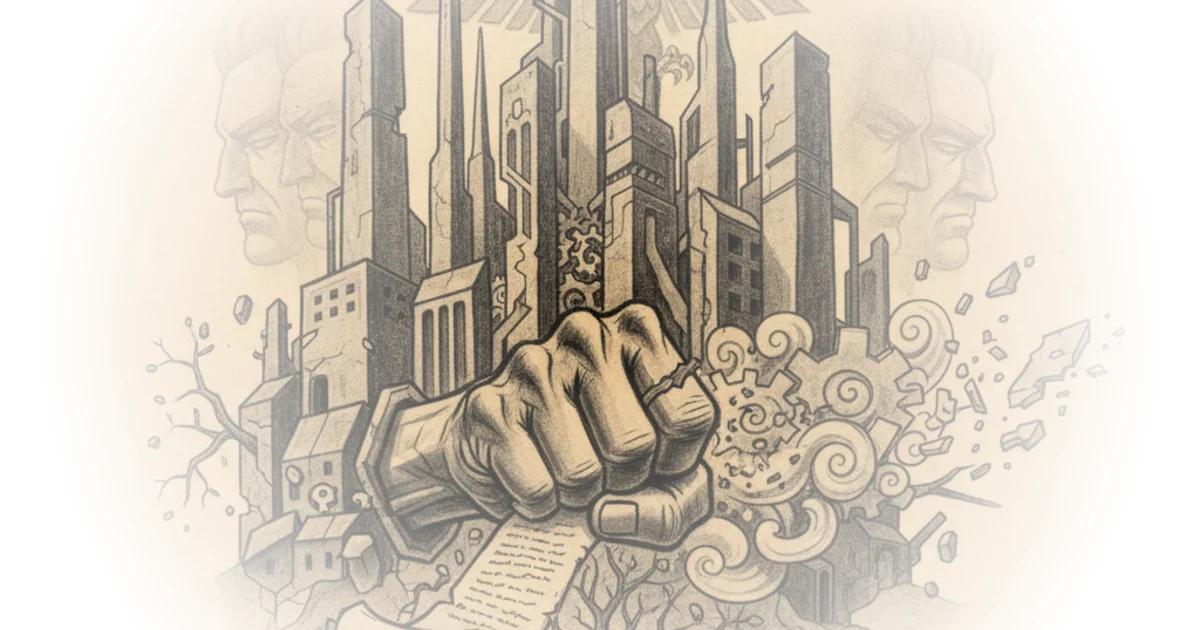
This framing is crucial because it exposes the ideological engine of fascism: the belief that certain groups are sub-human. The commentary effectively traces this from the local level to the highest echelons of power, quoting Joseph Goebbels reporting Hitler's view that Poles were "more like animals than human beings, completely primitive, stupid, and amorphous." The author rightly points out that while colonial brutality was global, the Nazi distinction lay in the explicit, industrial application of this logic. The German newspaper Grenzland stated, "If the good of our fatherland demands the conquest, enslavement, elimination, or destruction of other nations, we should not be restrained from doing this by any Christian or humanitarian scruples." This quote serves as a stark reminder that the removal of moral constraints was a feature, not a bug, of the ideology.
The tyranny of fascism has become the primary myth for the legitimizing of liberal democracy, yet authoritarians now seek to chip away at that foundation by asking, "What if the Nazis were bad? but not quite as bad as we think?"
Critics might argue that comparing modern political skepticism to the specific racial extermination of the 1930s is a slippery slope, but the author's point is about the mechanism of thought, not the equivalence of outcomes. The danger lies in the normalization of the idea that a "strong man" can cut through the "endless talking of parliaments" without consequence.
The Social Darwinist Core
The piece pivots to a deeper analysis of the ideological convergence between Mussolini and Hitler, moving beyond the caricature of Mussolini as a mere pragmatist. Then & Now argues that Mussolini's fascism was increasingly driven by a "spiritual" revolution and a Social Darwinist worldview that mirrored the German model. The author cites Mussolini's 1936 declaration that "A people, a Volk cannot live without space, Lebensraum," linking the Italian desire for a new Rome directly to the German concept of Lebensraum (living space). This connection is vital for understanding the global reach of the fascist impulse, echoing the expansionist logic seen in the Generalplan Ost which envisioned the total displacement of populations in Eastern Europe.
The commentary highlights how this ideology was rooted in a belief in perpetual struggle. Mussolini is quoted saying, "The will to dominate was the fundamental law of the life of the universe... that man was driven by a divine beastality." This is the "soul of fascism" the author seeks to identify: a worldview where conflict is not a failure of politics but the natural state of existence. The author notes that this thinking was not unique to Europe, pointing to Japan's 1905 victory over Russia as a moment that "dovetailed with the influence of racial struggle thinking" across Asia. This broadens the scope significantly, suggesting that the appeal of authoritarianism is a reaction to a perceived global hierarchy that demands a violent overturning.
The Counterfactual Trap
The most urgent part of the argument addresses the modern temptation to imagine a world where the fascists won. Then & Now observes that "thousands of novels, TV series, films, and scholarly articles have tried to get at this big question," but warns that recent discourse has shifted from fiction to a dangerous political strategy. The author identifies a pattern where figures on the fringe right minimize the Holocaust or question the necessity of democracy, arguing that "a strong leader is needed and that historically this has actually been the norm and more successful."
The piece dissects the logic of this "counterfactual history," noting that Hitler's own writings in Mein Kampf and the Second Book suggest a vision of "perpetual struggle" where pacifism is only possible when the "highest form of human specimen has conquered and subjugated the world." The author writes, "He is the shibboleth for what happens when one man has too much power," using Hitler as the ultimate warning against the concentration of authority. The argument is that asking "what if" is not a neutral historical exercise when it is used to justify rolling back democratic norms today. The text notes that even the ambiguity of Hitler's global plans—whether he intended to conquer the world or just dominate Europe—does not matter because the drive was for unlimited expansion.
Remember the root of authoritarian is author. A person who can author the story without guard rails totally can write it themselves by and through their own conditions and ideas.
A counterargument worth considering is that focusing so heavily on the extreme end of the spectrum might obscure the more subtle, incremental erosion of democracy that actually precedes a fascist takeover. However, the author's insistence on the "conceptual logical chain" from skepticism to authoritarianism to fascism remains a powerful diagnostic tool.
Bottom Line
Then & Now delivers a compelling warning that the "myth" of the Holocaust is being weaponized by those who wish to dismantle the very liberal democracy that defeated fascism. The piece's greatest strength is its refusal to treat the rise of authoritarianism as a purely American or modern phenomenon, instead rooting it in the global, Social Darwinist ideology of the 1930s. The biggest vulnerability is the risk that such a stark comparison might alienate moderate readers, yet the evidence suggests that the ideological seeds being watered today are indeed the same ones that grew into the horrors of the past.