This piece from Works in Progress delivers a jarring, necessary correction to decades of public fear: it argues that our global obsession with low-dose radiation is not just scientifically shaky, but actively damaging to humanity's energy future. By dissecting the data behind nuclear disasters and the infamous "Taiwanese apartment" case study, the editors challenge the bedrock assumption that any amount of exposure is intolerable. For a reader navigating a climate crisis where clean baseload power is scarce, this is not just academic nitpicking; it is an argument about whether we are allowing statistical noise to strangle one of our most potent tools for decarbonization.
The Shadow of Chernobyl and the Weight of Fear
The article begins by confronting the elephant in the room: Chernobyl. It is a disaster that defined nuclear anxiety, yet Works in Progress meticulously separates the horror of acute exposure from the myth of low-dose toxicity. The piece notes that while 134 workers received massive doses—with 28 dying shortly after and another 19 before 2004—the broader population fared differently than feared. "While first responders have shown a slight increase in rates of leukemia, there has been no increase in solid cancers," the editors report. Even more striking is the data on thyroid cancer, often cited as proof of widespread harm. The article clarifies that these 6,000 cases were entirely preventable had authorities acted faster, noting that "the iodine has a half-life of eight days."
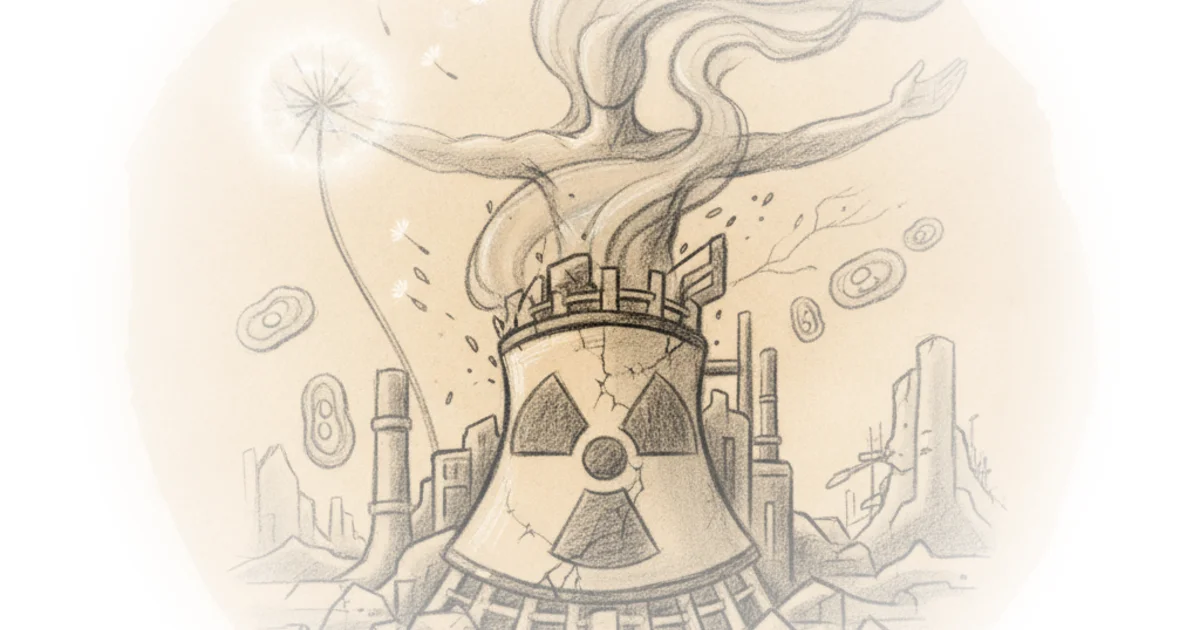
This distinction is crucial because it highlights how policy often lags behind physics. The editors draw a sharp historical parallel to the 1957 Windscale fire in Britain, where contaminated milk was discarded for 44 days, effectively avoiding the thyroid crisis seen later in Ukraine. "Evacuations and relocations to avoid small additional background radiation levels may have caused more harm than they averted," the piece argues. This reframing suggests that our current regulatory regime is driven by a fear of the invisible rather than the reality of the data.
The idea that any release of radioactive material is an intolerable disaster rests on the claim that radiation is harmful even in small, spread-out doses. But this claim is not well supported.
The argument gains further traction when contrasting nuclear incidents with other industrial catastrophes. While Chernobyl is a household name, the article points out that "Chernobyl is the only accident in commercial nuclear history that has exposed people to large enough doses of radiation to poison and kill them." In stark contrast, it reminds readers of the 1975 Banqiao Dam failure in China, which drowned at least 25,000 people, or the Bhopal pesticide disaster. These events killed thousands instantly yet lack the cultural footprint of a nuclear meltdown. The editors suggest this disparity has led to regulations that "increased the costs of nuclear electricity over time to the point where it is widely considered a slow, backward, and ineffective technology."
The Taiwan Anomaly and Statistical Noise
The core of the article's investigation shifts to a unique natural experiment: the "radiation buildings" in Taipei. Between 1982 and 1984, recycled steel contaminated with cobalt-60 was unknowingly used in over 180 buildings, exposing more than 10,000 people to radiation levels far exceeding background norms. This scenario offered a rare chance to test the Linear No-Threshold (LNT) model, which assumes risk scales linearly from zero dose upward.
The data, however, refused to cooperate with the prevailing dogma. "Cancer rates were, unexpectedly, dramatically lower than in the population at large," Works in Progress reports regarding an initial 2006 study. While some researchers tried to spin this as evidence of "hormesis"—the theory that low doses trigger beneficial repair mechanisms—the editors remain skeptical of such a bold claim. They rightly note that early studies suffered from flaws, including a failure to control for age, as the residents were significantly younger than the average Taiwanese population.
However, subsequent studies that corrected for these variables did not yield the expected results either. A 2017 study in the British Journal of Cancer claimed to find elevated risks for breast cancer and leukemia, but the editors dismantle this conclusion by exposing the statistical gymnastics required to reach it. "The way the researchers found these higher rates of cancer was to break cancer cases down into 77 subtypes... This approach has two problems," the piece explains. By slicing data into so many buckets, researchers inevitably find random correlations that look significant but are actually noise.
If being irradiated with hundreds of millisieverts per year appears to have no effect, or even reduces cancer rates compared to the general population, this strongly implies that the links these two papers identify between much smaller doses of radiation and particular kinds of cancer are random noise.
The editors point out a glaring inconsistency: despite claiming specific cancers rose, the overall cancer rate in the irradiated group was 35% lower than the national average. "If they'd entered their research with this hypothesis, it might make the results more credible," the article suggests regarding the cherry-picked subtypes. Instead, it appears researchers are engaging in what is known as "p-hacking"—torturing data until it confesses to a relationship that doesn't exist. Critics might argue that socioeconomic factors could explain the lower overall cancer rates, but the editors refute this by noting that even in Taiwan's wealthiest demographics, the gap is nowhere near 35%.
The Perils of Low-Dose Science
The final section broadens the scope to discuss the "replication crisis" plaguing modern science. Just as psychology has struggled with unreplicable findings like power posing, radiation science faces similar issues where "significant numbers of famous, eye-catching findings were unreplicable." The editors argue that finding a signal in low-dose radiation studies is inherently difficult because populations vary wildly in genetics and lifestyle.
The piece acknowledges the most serious attempt to date: the INWORKS study, which tracked 300,000 nuclear workers across France, the US, and Britain. While this study found a "five percent higher cancer mortality rates" for every additional 100 millisieverts of exposure, the editors contextualize this as a statistical correlation in a massive dataset, not necessarily proof of causation at low levels. The overarching argument remains that we are allowing "unconvincing" studies to dictate policy.
By giving them undeserved credence, we may be foreclosing one of the world's most powerful technologies.
This is where the editorial voice becomes most urgent. The fear of radiation has created a regulatory environment where the cost of nuclear power is inflated not by engineering challenges, but by an intolerance for risk that the data does not support. The editors warn that this "regime" treats any release as intolerable, effectively freezing out a technology that could be central to solving energy poverty and climate change.
Bottom Line
The strongest part of this argument is its rigorous dissection of the statistical methods used to demonize low-dose radiation, specifically exposing how "p-hacking" in the Taiwan apartment studies has been mistaken for scientific consensus. Its biggest vulnerability lies in the inherent difficulty of proving a negative; while the data suggests harm is negligible or non-existent at low doses, absolute certainty remains elusive in epidemiology. Readers should watch for whether future large-scale studies can replicate these findings without the statistical artifacts that have plagued previous research, as this will determine if we continue to let fear dictate our energy policy.