In a 2011 film that predates the current global health crisis by nearly a decade, Steven Soderbergh's Contagion offers a chillingly accurate blueprint for how a novel pathogen spreads, how institutions respond, and how society fractures. Rohin Francis, writing for Medlife Crisis, argues that the movie's greatest achievement isn't its scientific precision regarding viral mechanics, but its prescient depiction of the social and psychological chaos that accompanies a pandemic. This analysis matters now because it separates the biological reality of a virus from the human behavior that often proves more destructive than the disease itself.
The Science of Spillover and Spread
Francis begins by dissecting the film's virology, noting that while the fictional MeV-1 virus is a composite, its origins are grounded in real-world zoonotic events. "Much of the inspiration for the movie came from the 2002 to 2003 SARS outbreak," Francis observes, highlighting how the narrative correctly identifies the jump from animal reservoirs to humans. He explains that the film accurately portrays the mechanism of spillover, where bats act as vectors in wet markets, allowing viruses to mix and mutate before infecting humans. "Bats are a very good source of zoonotic infections," Francis writes, noting their unique immune systems allow them to carry pathogens without falling ill, turning them into perfect biological incubators.
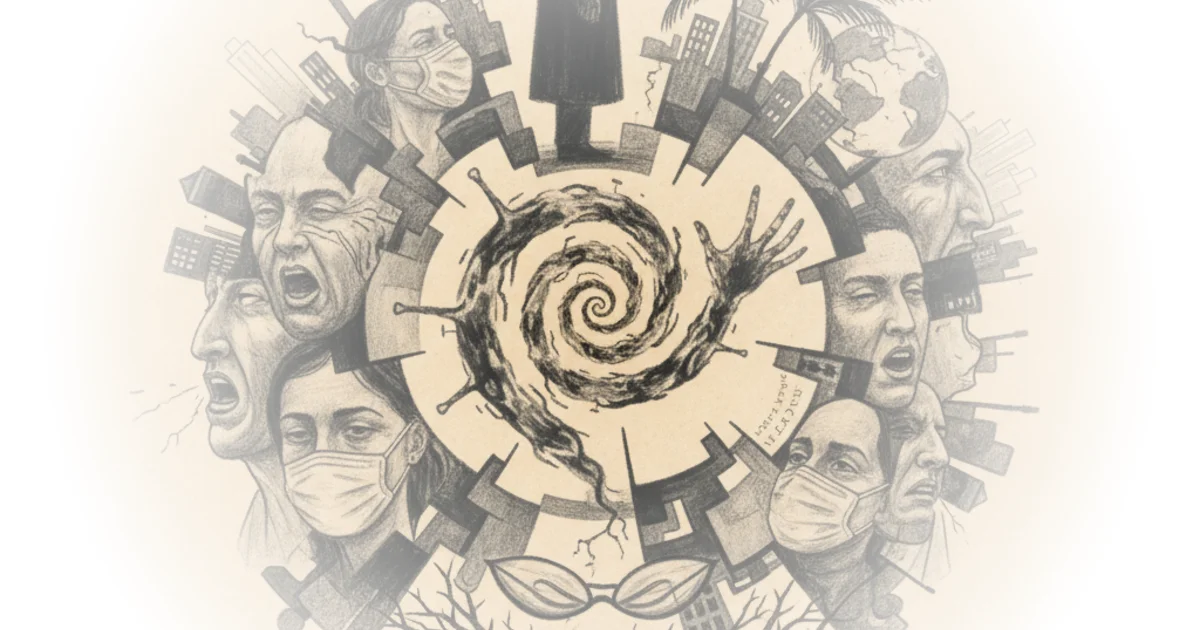
The commentary effectively contrasts the film's fictional virus with real-world counterparts like the Nipah virus and SARS-CoV-2. Francis points out a key distinction: the movie's virus is both highly infectious and highly deadly, a combination the real world has fortunately not yet seen. "The Nipah virus had a fatality rate of 50 to 75 percent... but it's much less infectious," he explains, whereas the current coronavirus is highly infectious but less lethal. This nuance is crucial; it prevents the fatalism that often plagues pandemic coverage while acknowledging the genuine danger of a pathogen that combines high transmissibility with significant mortality.
"In order to become sick you have to first come in contact with a sick person or something that they touched; in order to get scared all you have to do is come in contact with a rumor."
The Institutional Lag and the Whistleblower
One of the most striking aspects of Francis's analysis is his focus on the institutional response, or lack thereof. He notes that in the film, global health bodies like the World Health Organization and the Centers for Disease Control and Prevention are engaged in talks by day five, a timeline that stands in stark contrast to the delayed global coordination seen in recent years. Francis attributes the film's early alarm to the fictional virus's rapid symptom onset, but he uses this to critique the real-world sluggishness of authorities.
He draws a poignant parallel between the film's characters and real-life figures who sounded the early alarms. "Kate Winslet's character is based on a real-life person... Carlo Urbani who was the first to identify the SARS virus," Francis writes, honoring the Italian microbiologist who raised the alarm before succumbing to the disease. He connects this to the tragic story of Dr. Li Wenliang, who faced similar skepticism and tragedy. This framing shifts the narrative from a simple medical crisis to a story of human courage and bureaucratic inertia. The argument lands because it humanizes the epidemiological data, reminding readers that behind every case number is a chain of individuals trying to prevent disaster.
Critics might argue that Hollywood dramatizes the speed of scientific breakthroughs, and Francis acknowledges this. He notes that the film's timeline for vaccine development is compressed, a necessary liberty for cinema but one that risks creating unrealistic public expectations. "The speed of developing a vaccine at this point in the movie only a few months have passed but in reality it's going to take us longer than that," he cautions, grounding the cinematic fantasy in the tedious reality of clinical trials and regulatory approval.
The Virus of Misinformation
Perhaps the most prescient element Francis identifies is the film's portrayal of the information ecosystem. The character of Alan Krumwiede, a blogger played by Jude Law, serves as a vehicle for misinformation, peddling a fake cure to line his own pockets. Francis argues this storyline was remarkably forward-looking. "His self-educated citizen blogger... is instrumental in spreading misinformation about the MeV-1 virus just like we're seeing on a daily now," he writes, linking the 2011 fiction to the modern reality of anti-science sentiment.
The commentary highlights how the film anticipated the weaponization of doubt. Francis points out that the character's rhetoric mirrors modern conspiracy theories, where authorities are accused of collusion and cures are dismissed as hoaxes. "The same anti-science mistrust of authorities that I mentioned in many of my videos is playing out exactly as we would have predicted," he notes, suggesting that the social fracture caused by misinformation is as predictable as the viral spread itself. This is the piece's strongest move: identifying that the battle for public trust is just as critical as the battle for the virus.
"If we even had a viable vaccine right now we would still have to do human trials and that would take weeks... and then train survivors to give inoculations more months, more deaths."
Francis also touches on the human cost borne by healthcare workers, using the film's depiction of a doctor sacrificing her coat to a patient as a metaphor for the selflessness required in these crises. He reminds readers that the toll on medical professionals is not just physical but existential, citing the deaths of real-world heroes like Urbani. This emotional anchor prevents the analysis from becoming purely clinical, ensuring the reader understands the human stakes.
Bottom Line
Francis's commentary succeeds by treating Contagion not as a disaster movie, but as a case study in public health sociology. His strongest argument is that the film's accuracy lies less in its virology and more in its depiction of human behavior—panic, misinformation, and the struggle for truth. The biggest vulnerability in the analysis is the necessary compression of the vaccine timeline, which, while acknowledged, still risks leaving readers with an inflated sense of how quickly science can solve biological problems. As the world navigates future health challenges, the lesson remains clear: the virus is only half the story; the other half is how we choose to respond to it.