What makes Carlin's exploration of archaeology history immediately compelling is how he frames it through the lens of what ancient peoples wanted from the past versus what modern archaeologists want. This distinction — between "how can reconstructions of the past benefit me" versus "how can I better understand my predecessors" — is the piece's most provocative claim.
Carlin opens by proposing a creative organizing framework: "the ghost of archaeology past, ghost of archaeology present and the ghost of archaeology future." He immediately acknowledges this might be too ambitious. "Sounds great in my head, we'll see how it works out in practice."
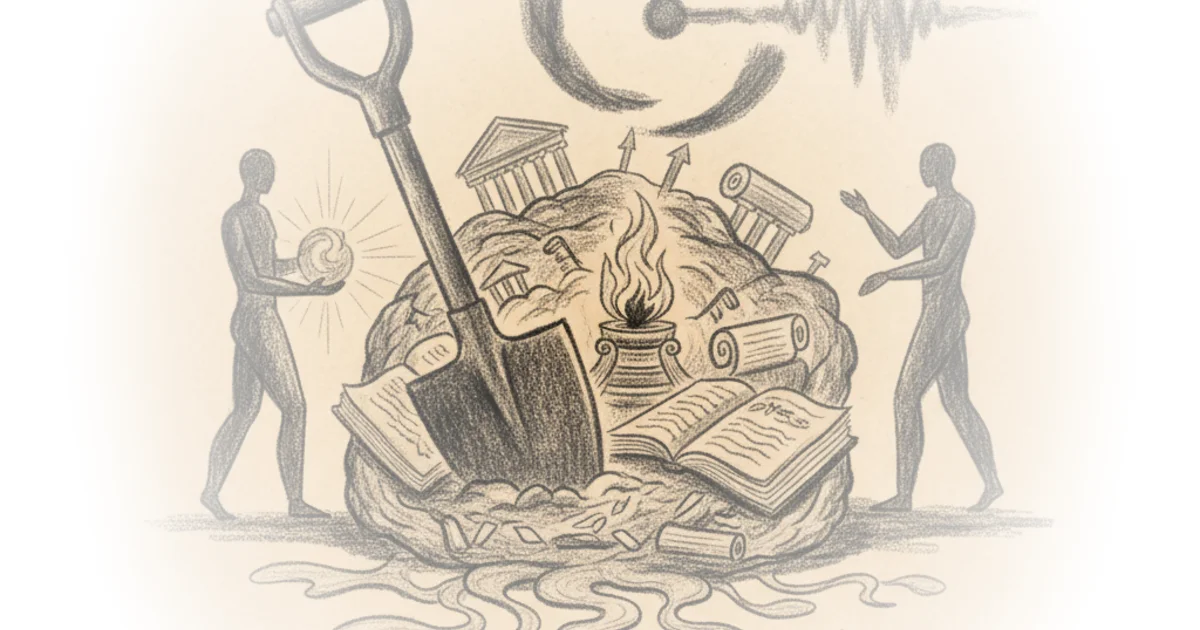
The core argument Carlin makes is that early interest in antiquities was fundamentally self-serving. "It's a little like saying we should talk about history — I mean it's a giant subject, isn't it?" he asks, acknowledging the breadth of archaeology as a field while noting that ancient rulers weren't interested in reconstruction for reconstruction's sake. They wanted connection to legitimacy.
Carlin writes that certain kings and sons of kings in places like Egypt "maintained temples and tomb sites reverently" — but this was connected to religious viability rather than historical curiosity. Once belief systems changed, those sites became either ignored or deliberately shunned. He cites Rome converting to Christianity as an example: "sometimes they were just reused, but other times they were actively avoided because it wasn't that the Christians didn't believe that the previous Gods existed — they did believe they existed sometimes and thought they were demons and devils."
This is Carlin's strongest analytical move: he's not just describing ancient archaeology, he's diagnosing why humans make claims about the past. "So who better to rule?" he asks sardonically about invented genealogies connecting rulers to deities. The question cuts across cultures — Mesoamerican states after Teotihuacan decline all tried to connect themselves to that vanished civilization "whether there was an actual connection or whether it was completely invented because it was a cool story."
In those days, people weren't trying to reconstruct the past so they better understood what came before them. It's more: how can reconstructions of the past benefit me?
The piece pivots when Carlin introduces European colonization's impact. He connects interest in antiquities directly to the Renaissance's rediscovery of classical Greece and Rome. "One thing I read at some point is that the Coliseum in Rome, at a time when pretty much everything was torn down for building materials by later generations, the Colosseum was preserved because some of the early Christians believe that many Christian Martyrs were killed in the Colosseum — so that made it somewhat of a holy site."
The same structure — the same physical ruins — preserved for entirely different reasons across centuries. This is what makes Carlin's analysis sing: "It's interesting how certain things that today we consider archaeological treasures served for very different reasons at various points in their history."
Carlin then turns to what he calls "the Indiana Jones version of archaeologists" — those hired by wealthy Europeans to retrieve artifacts for museums or even personal collections. He cites Napoleon's invasion of Egypt as the catalyst: "40 centuries of History are looking down on you because the pyramids are right there." That line, delivered to soldiers, became part of what starts a craze for Egyptian antiquities.
What follows is darker territory — the scramble among European powers for artifacts, where "normally you would think they would go in there and rape and pillage the antiques" but instead sought official permits from Turkish authorities. The irony Carlin identifies: "fast forward another few generations and people don't necessarily believe that anymore but now they're interested in the Coliseum for its historical importance."
Critics might note that this analysis occasionally conflates different cultures and time periods without fully distinguishing their motivations — ancient Egyptian temple maintenance differs meaningfully from Neo-Babylonian royal genealogy, both from Chinese imperial interest in antiquities. The piece sometimes treats parallel examples as identical when they differ in important ways.
Carlin's most compelling observation is how he describes the shift between "what's in it for me" versus genuine curiosity about the past: "every now and then you find these people and I don't want to tar them with the same brushes — all these what's in it for me types who seem to maybe have a generalized interest."
Bottom Line
Carlin's piece succeeds because he finds something universal in how humans relate to their own history. His biggest vulnerability is that he's describing patterns across radically different cultures without always distinguishing between them — but this broadness is also the piece's strength, showing that self-interest in the past isn't just ancient history, it's current practice too. The "ghost of archaeology" framing may feel ambitious, but it captures something real: we preserve the past for what it gives us, not for what it was.