BobbyBroccoli uncovers a bizarre chapter in academic history where celebrity, aristocracy, and bad science collided to expose the fragility of peer review. This isn't just a story about two French brothers with questionable degrees; it is a forensic look at how the academic establishment can be duped by confidence, obscurity, and the sheer absurdity of post-modern jargon.
The Sokol Precedent
The narrative begins by grounding the Bogdanoff saga in a famous earlier incident: the Sokal affair. BobbyBroccoli explains that in 1996, physicist Alan Sokal submitted a deliberate nonsense paper to a cultural studies journal to test their intellectual rigor. "This is a work of satire it's a joke," BobbyBroccoli notes, highlighting how Sokal combined physics jargon with post-modern buzzwords to prove that editors were prioritizing ideological alignment over factual accuracy. The result was a scandal that shook the humanities, with Sokal arguing that "sloppy sociology like sloppy science is useless or even counterproductive."
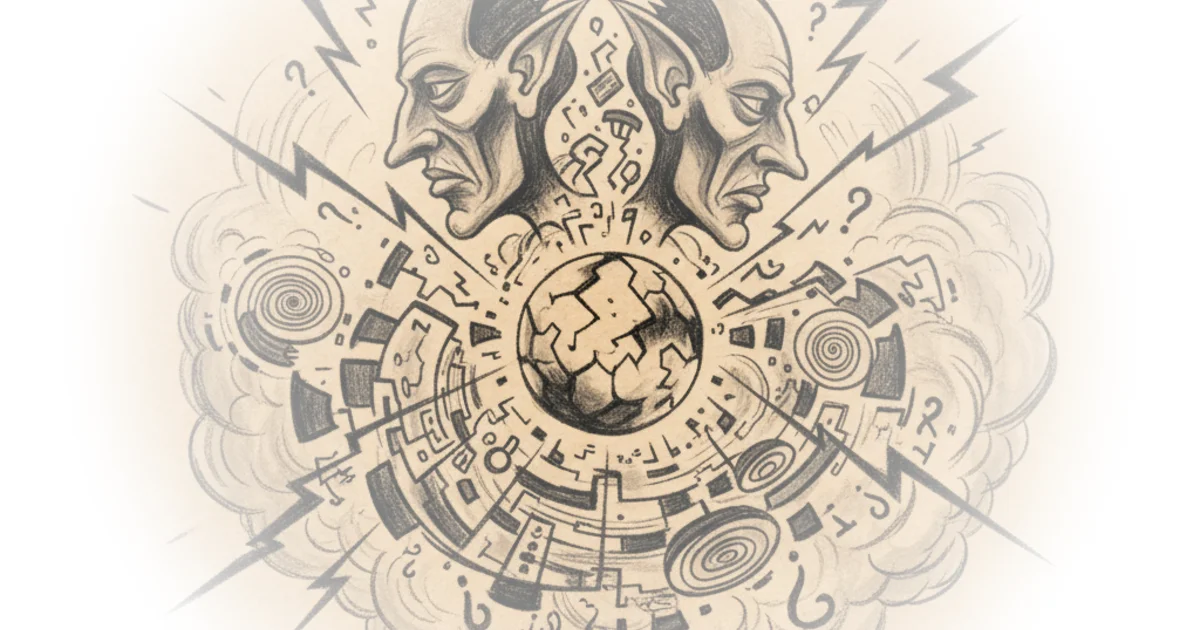
This context is crucial. It sets the stage for the Bogdanoffs not as isolated anomalies, but as the next evolution of a systemic failure. While Sokal was a known physicist pranking the system, the Bogdanoffs were media celebrities attempting to enter the system from the outside. BobbyBroccoli frames this distinction sharply: "you've seen the title of this video this isn't a story about alan sokol it's quite the opposite." The stakes were higher here because the subjects weren't trying to expose a flaw; they were trying to exploit it for legitimacy.
"The mere fact of publication of my parody only proved that the editors of one particular journal and a rather marginal one at that had applied a lacks intellectual standard."
Critics might argue that the Sokal affair was a unique moment of cultural warfare, but BobbyBroccoli suggests the underlying mechanism—publishing based on buzzwords rather than merit—remained dangerously intact. The question shifts from "can a journal be tricked?" to "can a university be tricked?"
The Aristocratic Illusion
The commentary then pivots to the protagonists: Igor and Grichka Bogdanoff. BobbyBroccoli paints a vivid picture of their upbringing, noting they are "the children of two separate aristocratic families which paints a complicated genealogical tapestry." Raised in a castle with tutors and a library of thousands, the twins were groomed for stardom, not scholarship. Their early fame came from a 1980s sci-fi show where they wore "gaudy aluminum jumpsuits" to interview filmmakers about concepts like the internet and genome decoding before they were mainstream.
BobbyBroccoli is careful to separate their media success from their scientific claims, noting that while they are "excellent public speakers," their books are filled with basic inaccuracies. For instance, the author points out that the brothers claimed "a decreasing infinite series always has to approach zero which is not true." This is a vital distinction. The twins were not just popularizers; they were actively spreading mathematical falsehoods. BobbyBroccoli writes, "their books and shows have faced repeated criticism from the scientific community for basic inaccuracies," yet the public remained captivated by their charm.
The author also addresses the twins' drastic physical transformations, noting that "when people are willing to undergo expensive and risky surgeries to modify their bodies like that there is obviously some sort of body dysmorphia going on." However, BobbyBroccoli wisely refuses to make this a punchline, instead urging the reader to focus on the intellectual fraud: "I want you to consider that we're going to see many valid reasons for criticizing the brothers throughout this video that aren't related to their facial features."
The Academic Heist
The core of the piece details the twins' decade-long struggle to obtain PhDs. BobbyBroccoli recounts how they were initially rejected from the University of Bordeaux for trying to base their thesis on their own popular books. "They were very anxious to obtain phds very quickly," BobbyBroccoli writes, quoting a Cambridge professor who described their submitted theses as "laughable compendiums." This highlights a critical vulnerability in the system: the pressure to grant degrees to high-profile individuals, or the sheer confusion of faculty members who couldn't parse the twins' vague, impressionistic writing.
When they finally defended their theses in 1999, the results were damning. Grichka passed with the distinction of "honorable," which BobbyBroccoli clarifies is the "rarely given absolute lowest passing grade for a phd." One reviewer noted, "this only happens to the worst students the students you only want to get out of the system." Igor's situation was even more surreal; he was told to withdraw his thesis due to hostility but was given a bizarre condition to reattempt: publish in three or four journals.
BobbyBroccoli emphasizes the absurdity of this requirement: "to be clear is an extremely bizarre condition for granting a doctorate it's straight up unheard of." Yet, with his brother's help, Igor managed to publish five papers in obscure journals, including the Czechoslovak Journal of Physics and the Chinese Journal of Physics. By 2002, the twins had achieved their goal. "These two 53 year olds were now doctors," BobbyBroccoli states, underscoring the sheer audacity of the feat. The narrative suggests that the academic gatekeepers, perhaps intimidated by the twins' fame or confused by their jargon, allowed a loophole to be exploited.
"They exist as a pair a unit that does not make sense unless treated as a whole they don't seem real and we're just the pawns in whatever cosmic game they're playing."
A counterargument worth considering is whether the twins' success was purely a result of academic incompetence or if there was a deeper cultural bias at play. Did the French academic system, with its own unique traditions of philosophy and science, view the twins differently than their international counterparts? BobbyBroccoli hints at this but leaves the full analysis for the reader to infer from the timeline of events.
The Unraveling
The piece concludes by setting the stage for the inevitable backlash. Once Igor's papers were published, they were no longer hidden in university archives. "They had eyes on them now," BobbyBroccoli writes, noting that it took nearly a year for the scientific community to wake up. The catalyst for the scandal was a single forum post on Physics Forums, where a user named Max Ni began to dissect the twins' work. This marks the transition from a quiet academic anomaly to a public scandal.
BobbyBroccoli's framing here is masterful. By ending on the precipice of the reveal, the author forces the reader to confront the implications of what has just been described. The Bogdanoffs didn't just get degrees; they managed to publish in reputable journals and defend a thesis that the scientific community had already deemed "laughable." The system didn't just fail to stop them; it actively facilitated their ascent.
"This is the story of how igor and grijka became dr igor and dr grichka."
Bottom Line
BobbyBroccoli's piece is a compelling indictment of a system that values celebrity and obscurity over rigor, using the Bogdanoff saga to expose a deeper rot in academic peer review. The strongest element is the detailed reconstruction of the twins' academic journey, which reveals how easily the system can be gamed by those who know how to speak its language without understanding its substance. The biggest vulnerability is the lack of deep analysis into why specific French institutions failed so spectacularly, leaving the reader with a sense of unease about what other "laughable compendiums" might be sitting in university archives today.