In an era defined by alarmist headlines and dire predictions of democratic collapse, Nate Silver offers a jarringly different diagnosis: the United States is not losing its democracy, but rather proving its durability through active, mass resistance. While other analysts fixate on the erosion of norms, Silver brings a data-driven lens to the ground-level reality, arguing that the sheer scale of pro-democracy mobilization in America dwarfs the forces of autocracy, even as the executive branch pushes boundaries. This is not a plea for complacency, but a statistical rebuttal to the idea that the nation has already crossed a point of no return.
The Football Field of Democracy
Silver rejects the common tendency to view democracy as a static scorecard that can only go down. Instead, he reframes the struggle as a dynamic contest of opposing forces. "It’s prudent to consider worst-case scenarios," he admits, but immediately pivots to the evidence of pushback. He writes, "My critique is not so much that these pessimistic accounts overstate the threat to American democracy. Rather, it’s that they underrate the capacity of the world’s longest-standing democracy to play defense." This distinction is crucial; it shifts the narrative from passive victimhood to active institutional resilience.
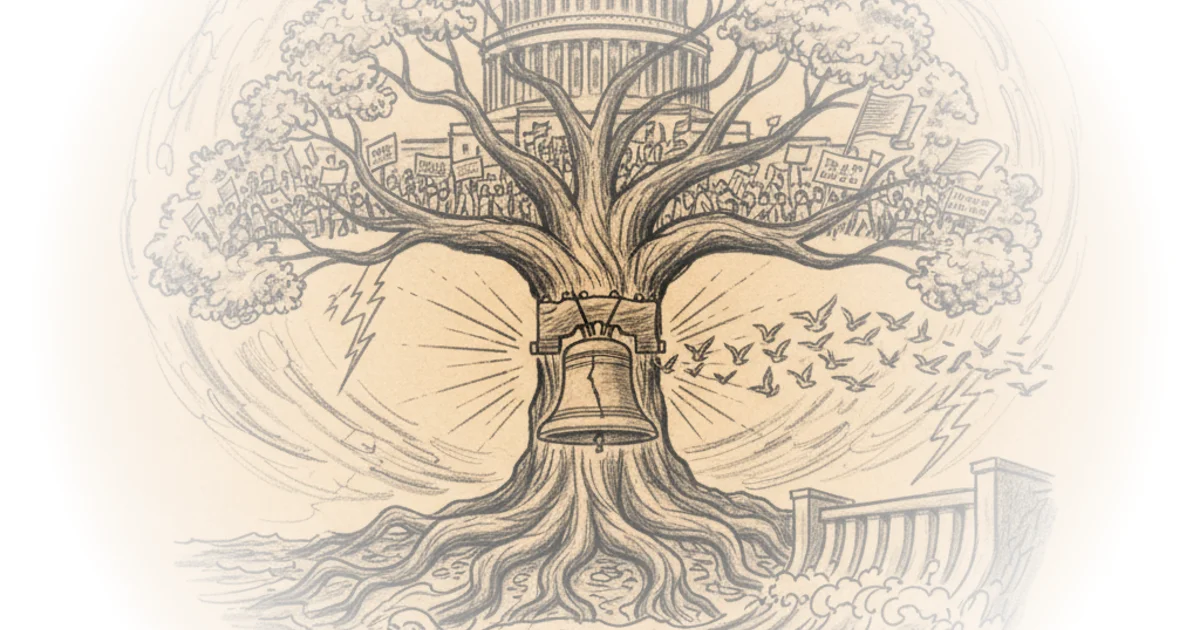
To illustrate this, Silver turns to a sports metaphor that resonates with his audience, comparing the political landscape to field position in American football. He notes that while the executive branch may control the ball, the defense—the courts, state governments, and the public—has significant power to limit gains. "This is closer to the situation that the United States finds itself in," he observes regarding the clash between a formidable offensive strategy and a deeply entrenched defensive system. The argument holds weight because it acknowledges the strength of the opposition without ignoring the structural advantages the current administration holds, such as the rural bias in the Senate.
"Democracy vs. authoritarianism as a two-dimensional problem... field position reflects the net result of two sides pushing back at one another."
Critics might argue that this metaphor sanitizes the stakes of authoritarianism, reducing the potential for systemic rupture to a game of inches. However, Silver’s point is precisely that the game is not over; the defense is still on the field and playing hard.
The Data of Resistance
The piece’s most compelling evidence comes from the Varieties of Democracy Institute (V-DEM), which tracks not just the state of institutions, but the energy of the people. Silver highlights two specific metrics: mobilization for democracy and mobilization for autocracy. He points out a striking disparity in the numbers: "The No Kings protests and the Women’s March each turned out millions of people," while pro-authoritarian rallies, such as the Unite the Right in Charlottesville, attracted "mere hundreds." Even the January 6 insurrection, a massive rupture, involved "a couple of thousand people" compared to the millions who have taken to the streets in defense of democratic norms.
Silver argues that high mobilization for democracy is not a sign of weakness, but of a system that is still responsive. "Pro-democracy mass movements emerge only when democracy is in question," he explains, suggesting that the current surge in protests is a feature of a healthy, albeit stressed, democracy rather than a symptom of its death. He notes that the U.S. ranks second among its wealthy democratic peers in mobilization for democracy, trailing only Poland, a nation that has recently undergone its own intense democratic struggles.
This data-driven approach effectively counters the emotional fatigue of constant crisis reporting. By quantifying the resistance, Silver makes the abstract concept of "the people" concrete and measurable. The evidence suggests that while the executive branch has the power to initiate authoritarian measures, the capacity for mass opposition in the U.S. is historically unprecedented.
The Gap Between Policy and Power
A critical nuance in Silver’s analysis is the distinction between policy preferences and the methods used to enforce them. He acknowledges that many Americans support the goals of the current administration’s immigration policy, yet overwhelmingly reject the implementation. Citing a YouGov poll, he writes, "One can want fewer immigrants coming through the southern border while not wanting poorly-trained masked agents running around a Midwestern city killing protestors." This insight is vital: it suggests that the administration’s vulnerability lies not in its policy platform, but in its overreach.
Silver illustrates this with the recent events in Minneapolis, where the backlash to the conduct of federal agents forced the White House to demote a high-ranking official. "The people have pushed back," he states, noting that "the normies are with the protestors, not the cops." This moment of retreat by the executive branch serves as a case study for his broader thesis: the system has feedback mechanisms that can correct the course when the administration crosses a line.
"Only 18 percent of U.S. adults... thought that 'federal immigration agents were justified' in the amount of force they used... against 55 percent who did not."
However, a counterargument worth considering is that relying on public opinion as a check on power is risky in an era of deep polarization. If the administration can successfully frame its actions as necessary for national security or border control, public sentiment may shift, or the administration may simply ignore the backlash if it believes its base is secure. Silver acknowledges this tension, noting that voters are capable of making finer distinctions than pundits assume, but the durability of that distinction remains an open question.
Bottom Line
Nate Silver’s strongest contribution here is the refusal to accept the inevitability of democratic collapse, grounding his optimism in hard data rather than wishful thinking. The argument’s greatest vulnerability is its reliance on the assumption that public outrage will consistently translate into institutional checks, a dynamic that may falter if the administration successfully insulates itself from accountability. Readers should watch for whether the mobilization for democracy can sustain its momentum as the political season heats up, or if the fatigue of crisis mode will eventually erode the very resistance Silver celebrates.