Alex O'Connor, the host of Cosmic Skeptic, delivers a startling thesis: the algorithm is not merely a tool for distribution but a new evolutionary pressure shaping human cognition itself. He argues that social media represents a linguistic inflection point comparable to the invention of the printing press, where the medium's constraints actively rewrite the rules of thought. For the busy professional navigating a fragmented information landscape, this is not just linguistics; it is a warning that our collective reality is being compressed by invisible corporate metrics.
The Medium as the Architect
O'Connor anchors his argument in the principle that "the medium is the message," suggesting that the architecture of our communication tools dictates the structure of our ideas. He notes that while children have always invented slang to differentiate themselves from adults, the internet introduces a new variable: "language is evolving through their kind of constraints, their guidances, their things that they're optimizing for become what our language is." This reframing is crucial. It shifts the blame from individual users to the systemic incentives of big tech companies that prioritize attention over nuance.
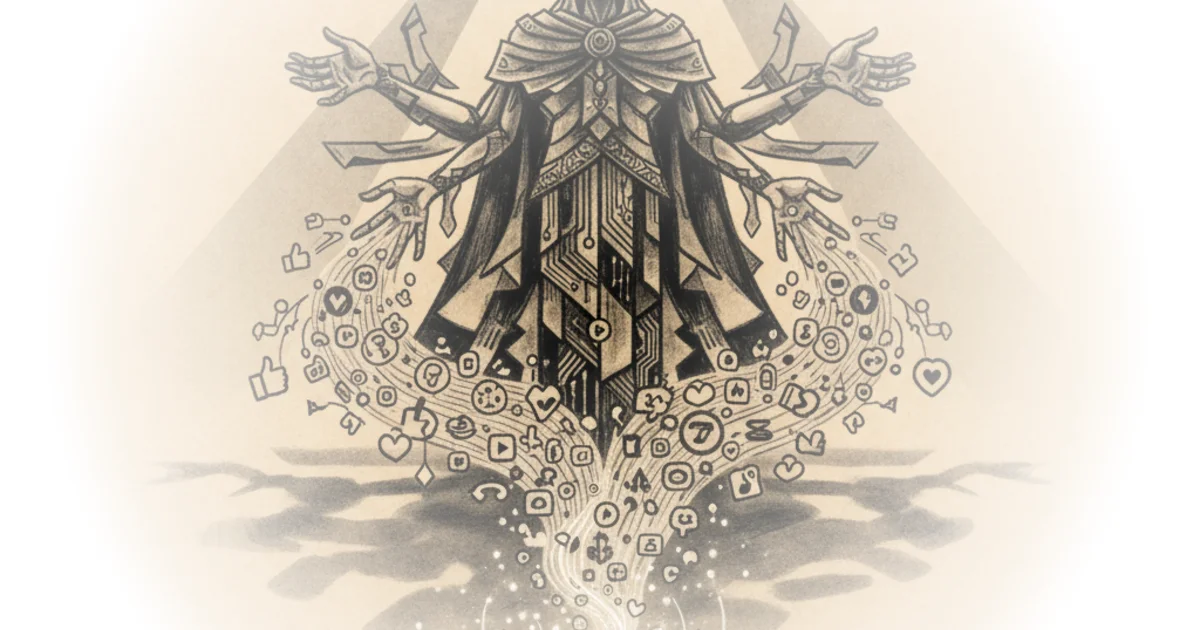
The author draws a parallel between the standardization of spelling after the printing press and the current homogenization of digital speech. Just as Shakespeare's variable spelling gave way to rigid norms, O'Connor suggests we are witnessing a similar compression online. "There's a pressure online to um there's a certain kind of way that's expected of speaking and we need to conform to it." This observation is bolstered by the concept of "algospeak," a phenomenon where users deliberately alter their vocabulary to evade automated censorship. As seen in the companion deep dives on shadow banning, this has led to a bizarre lexicon where "corn" replaces "person" and "unalive" substitutes for "dead." O'Connor correctly identifies this not as a failure of creativity, but as a survival mechanism within a controlled environment.
"We have these big tech companies with control and uh these metrics optimizing for attention and our language is evolving through their kind of constraints, their guidances, their things that they're optimizing for become what our language is."
Critics might argue that language has always been shaped by external forces, from the church to the state, and that the internet simply accelerates a natural process. However, O'Connor's point about the speed and opacity of algorithmic pressure distinguishes this era. Unlike a human editor, an algorithm optimizes for engagement without understanding context, creating a feedback loop that rewards outrage and simplicity over complexity.
The Loss of Cognitive Diversity
The commentary takes a darker turn when addressing the global erosion of linguistic diversity. O'Connor cites the sobering statistic that "one language dying out every 2 weeks," warning that we are losing unique frameworks for understanding the world. He illustrates this with the concept of linguistic relativism, noting that different languages unlock different ways of thinking. "Language is like a pair of glasses you can put on a new new frame for seeing the world and our frames are getting more and more limited the more languages are compressed."
This argument challenges the notion that a universal English is purely beneficial. O'Connor points out that specific cultural concepts, such as the Pawa Tommy expression for "to be a Saturday" as a verb, represent ways of experiencing time that vanish when the language does. The internet, while offering tools to preserve niche dialects, simultaneously exerts a massive gravitational pull toward English and standardized digital norms. "There's always a push and pull... but yeah, it's it's sad. Mostly it's like Papa Newu Guinea or it's in the Amazon River basin or something like that."
"Language is like a pair of glasses you can put on a new new frame for seeing the world and our frames are getting more and more limited the more languages are compressed."
While the loss of regional dialects is often romanticized, O'Connor's focus on the loss of conceptual diversity is the more pressing concern. If we lose the words for specific emotional or ecological realities, we lose the ability to think about them at all. This aligns with the broader discussion on how medium theory affects cognition; when the medium compresses language, it inevitably compresses the range of human thought.
The Embodied Nature of Thought
In a fascinating pivot, O'Connor explores the biological and sensory roots of language, moving beyond abstract semantics to the physical sensation of speech. He discusses "phonemes" and how certain sounds evoke specific physical feelings, such as the "sl" sound in "slimy," "slick," and "sleek" conveying slipperiness. "I think we can't really separate our embodied sensations from how we experience language. I think it's silly. I think a lot of the academic linguistic tradition has tried to treat language as this science which is separate from the observer that we can look at objectively."
This section serves as a reminder that language is not just a code but a physical act. The "Bouba/Kiki" effect, where people associate round shapes with soft sounds and sharp shapes with harsh sounds, persists across cultures and writing systems. O'Connor suggests that the algorithm's preference for certain types of content might be clashing with these deep-seated biological responses. If the algorithm favors short, punchy, aggressive phrasing, it may be overriding the natural, embodied rhythms of human communication.
Bottom Line
Alex O'Connor's most compelling contribution is the assertion that algorithms are not neutral observers but active participants in the evolution of human thought, compressing our linguistic diversity and reshaping our cognitive frameworks. The argument's greatest strength lies in connecting the abstract mechanics of social media algorithms to the concrete loss of cultural nuance and the physical sensation of speech. However, the piece occasionally underestimates the resilience of human adaptation, assuming a level of determinism that may overlook how communities subvert these constraints to create new, rich forms of expression. Readers should watch for how these algorithmic pressures manifest in future policy debates, particularly as governments attempt to regulate the very platforms that are rewriting our language.