Alberto Romero delivers a searing indictment of the prevailing narrative surrounding OpenAI, arguing that the company's frantic expansion into hardware, social media, and government contracts is not a roadmap to artificial general intelligence, but a desperate scramble to become "too big to fail." In an era where market valuations ignore basic economics, Romero forces a confrontation with the possibility that the AI boom is a structural bubble propped up by the fear of systemic collapse rather than genuine utility. This is not a story about technological triumph; it is a forensic look at a corporate entity that may have already outgrown its own mission.
The Illusion of Inevitability
Romero begins by dismantling the idea that OpenAI's diversification is a natural evolution of innovation. He points out that the company's massive deals with Nvidia, Oracle, and the Department of Defense, alongside promises of a $1 trillion valuation, suggest a singular objective: insulating the firm from market forces. "From this view, OpenAI CEO Sam Altman would be intertwining his influence, like a master weaver, across the economic layers," Romero writes, suggesting that the goal is to ensure a bailout if the underlying technology fails to deliver returns. This framing is crucial because it shifts the debate from "will AI save us?" to "is this company too dangerous to let die?"
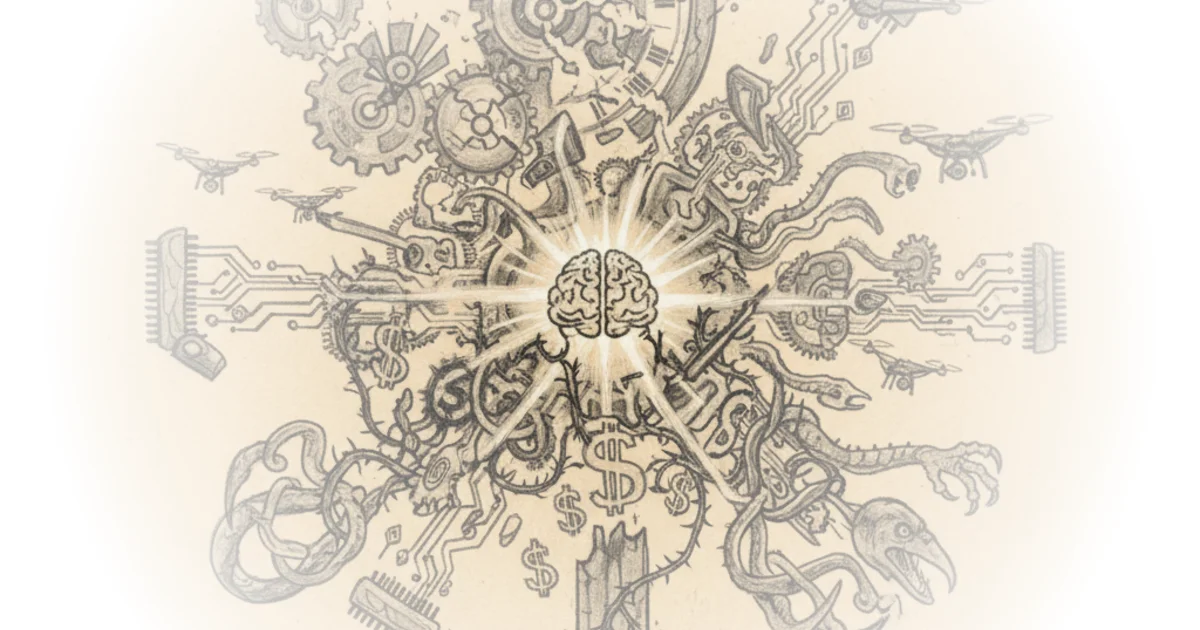
While economists like Tyler Cowen argue that the AI sector acts as a necessary engine for a languid American economy, Romero remains skeptical of this techno-optimism. He notes that despite Nvidia's market cap rivaling the GDP of major nations, the fundamental math doesn't add up. "Microsoft's last earnings report revealed OpenAI incurred a $12 billion loss just the last quarter," Romero notes, highlighting the disconnect between hype and financial reality. The argument here is that the industry is not a sign of a new economic renaissance, but a symptom of a market that has lost its ability to distinguish between value and speculation.
The unsettling truth is that no one knows where the United States is going with the immense investment in AI.
Critics might argue that high capital expenditure is simply the cost of building infrastructure for a future revolution, much like the early internet. However, Romero's comparison to the 2008 financial crisis adds necessary gravity. He draws a parallel between the "interconnected" nature of today's tech giants and the complex financial instruments that nearly collapsed the global banking system. "The lessons of the financial crisis earlier this century weren't just that the banks were too big to fail, they were too interconnected to fail," he observes. If OpenAI stumbles, the fallout isn't just a stock drop; it's a potential systemic risk that could force the government to intervene, effectively socializing the losses of a private gamble.
The Competitive Squeeze
The piece takes a sharp turn into the competitive landscape, where Romero argues that OpenAI's early lead has evaporated. He challenges the notion that Google is a laggard, asserting instead that the search giant is now the dominant force. "Google DeepMind is winning. They are winning so hard right now that they're screaming, 'Please, please, we can't take it anymore, it's too much winning!'" Romero writes with a mix of irony and data, pointing out that Google covers every major AI segment from models to hardware.
The core of Romero's argument is that OpenAI is running out of time. While the company pivots to new revenue streams, its competitors are solidifying their grip on the most profitable sector: enterprise. Romero cites a Menlo Ventures report showing that OpenAI has lost its lead in the enterprise market to Anthropic. "By the end of 2023, OpenAI commanded 50% of the enterprise LLM market, but its early lead has eroded," he explains, noting that Anthropic now holds 32% of the market share. This is a critical vulnerability because enterprise contracts provide the stable, high-value revenue that consumer subscriptions cannot match.
ChatGPT won't be a business-to-consumer product forever. Generative AI is, fundamentally, a business-to-business technology.
Romero's analysis here is particularly astute. He argues that the company's reliance on consumer subscriptions is a trap, as the cost of training models far outpaces what individuals are willing to pay. "OpenAI doesn't want to sell you $20/month subscriptions, but your employer $20000/month services," he writes. The shift to enterprise is not just a business strategy; it is an existential necessity. Yet, as Anthropic captures the developer market with superior coding tools, OpenAI finds itself squeezed from both sides: unable to monetize its massive user base and losing ground to rivals who are better positioned for the long-term B2B future.
The Leadership Crisis
Perhaps the most damning section of Romero's commentary focuses on the internal culture and leadership of OpenAI. He does not shy away from the allegations of misconduct that led to the ousting of Sam Altman in late 2023. Citing testimony from former executives, Romero paints a picture of a leader whose behavior undermined the company's stability. "Sam exhibits a consistent pattern of lying, undermining his execs, and pitting his execs against one another," Romero quotes from a plan document revealed during a lawsuit deposition.
The argument is that Altman's leadership style, while effective at securing deals, is fundamentally at odds with the mission of building safe, beneficial AI. Romero highlights the deep distrust among the company's founding scientists, noting that Ilya Sutskever and Mira Murati had planned to remove Altman long before the public boardroom coup. "Mira Murati: 'I don't feel comfortable about Sam leading us to AGI,'" Romero writes, underscoring the severity of the internal rift. This is not merely corporate gossip; it is a question of whether the person steering the ship is capable of navigating the ethical minefields of artificial intelligence.
The board no longer has confidence in his ability to continue leading OpenAI.
Romero acknowledges that Altman is a "wartime CEO" skilled at deal-making, but questions if that is the right skillset for the next phase. The company's restructuring from a non-profit to a capped-profit and now a for-profit entity has drawn sharp criticism from co-founder Elon Musk and others who fear the mission has been compromised. Romero suggests that the "masterful performance" of securing the company's survival may come at the cost of its soul. "First, he told us that OpenAI was this underdog... and we believed him. Later, he told us that they needed more money... and we believed him," Romero writes, tracing a pattern of shifting narratives that has left the public and investors questioning the company's true intentions.
Is OpenAI big enough already to survive the fall?
Bottom Line
Romero's most compelling contribution is his refusal to accept the "too big to fail" narrative as a victory; instead, he frames it as a admission of failure. The strongest part of his argument is the synthesis of financial data, competitive analysis, and internal testimony to show that OpenAI is not a juggernaut on the verge of godhood, but a fragile entity fighting for its life. The biggest vulnerability in the piece is its heavy reliance on internal leaks and lawsuits, which, while damning, are part of a chaotic corporate war that may not tell the whole story of the technology's potential. Readers should watch for whether OpenAI can actually pivot to enterprise profitability before the capital runs out, or if the "systemic risk" Romero warns of will indeed force a government rescue that validates the bubble he describes.