This piece cuts through the hype of artificial intelligence to reveal a starkly uneven reality: progress is not a rising tide lifting all boats, but a series of jagged, unpredictable spikes. Jack Clark's analysis forces us to confront a disquieting truth—that while machines are rapidly outpacing humans in finding software flaws and solving specific math problems, they are hitting a wall when it comes to optimizing their own core algorithms. For the busy professional trying to gauge where to invest time or capital, this distinction between "lumpy acceleration" and stagnation is the only metric that matters.
The Geography of Acceleration
Clark begins by dismantling the monolithic view of AI progress, citing a new study from METR that maps exactly where these machines are actually making a dent. The data reveals a bizarre asymmetry: we are seeing a dramatic explosion in the discovery of cyber vulnerabilities, yet the optimization of the AI models themselves remains stubbornly flat. "The rate of vulnerabilities reported across many projects has dramatically accelerated in 2026 compared with 2025," Clark notes, pointing to major targets like OpenSSL and Firefox. This is not just a technical footnote; it is a security crisis unfolding in real-time, where the very tools meant to secure our infrastructure are being weaponized by the same technology to find cracks in the foundation.
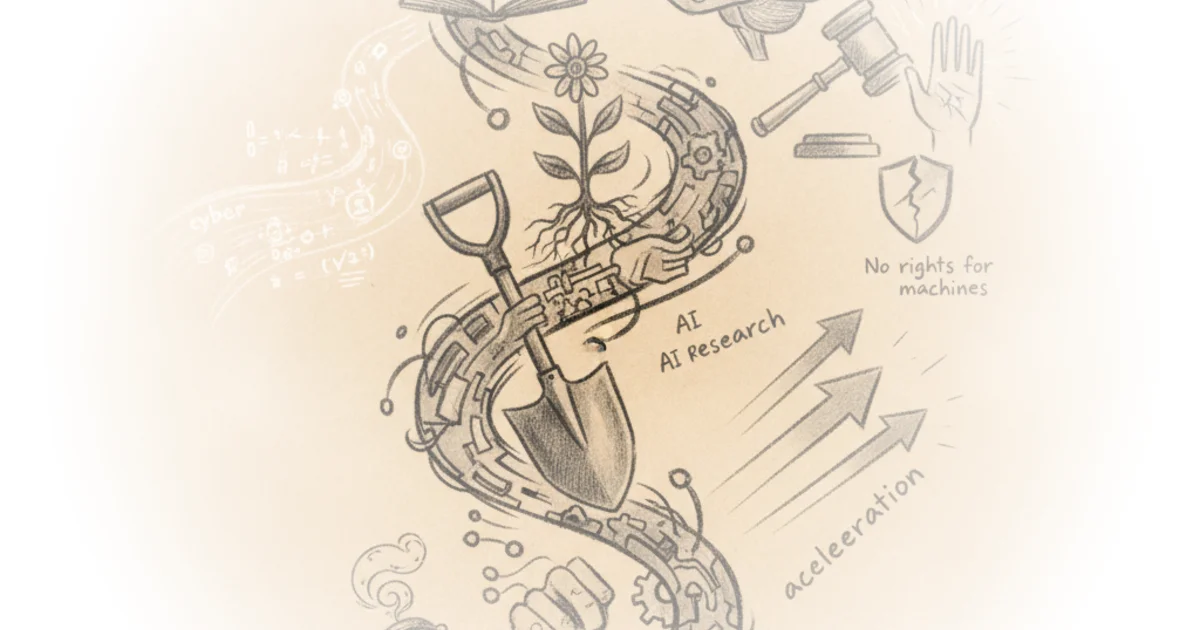
In mathematics, the picture is murkier but no less significant. Clark observes that while AI is clearly driving a surge in volume—submissions to repositories have doubled in some fields—measuring the actual quality of these contributions is "difficult." Yet, the exceptions are telling. He highlights that prestigious, decades-old problems have finally yielded, including "the Jacobian conjecture from Smale's list," a problem that has baffled mathematicians since the 1980s. This specific breakthrough mirrors the historical context of the Sieve tube element in biology, where a complex transport mechanism was only understood after decades of incremental, then sudden, insight. The implication is that AI is not just doing more work; it is unlocking doors that human cognition had left barred for generations.
"AI is causing advances in some parts of science and technology, but the effect isn't unified across fields, rather there are pockets of lumpy acceleration."
Critics might argue that finding vulnerabilities is a negative externality rather than a scientific triumph, but Clark's point is structural: the technology is hitting "phase changes" in specific domains like coding and cyber, while remaining static elsewhere. The question for the executive branch and private sector alike is whether this unevenness is a permanent feature or a temporary glitch before the next wave of general capability.
Bootstrapping Intelligence with Synthetic Worlds
The newsletter then pivots to a technical breakthrough that attempts to solve the data bottleneck: SPADE. Developed by a consortium of universities including MIT, Stanford, and the University of Washington, this framework allows AI models to generate their own training environments. It is a form of recursive self-improvement where a model acts as both the "Environment Designer" and the "Reasoning Agent."
Clark explains the mechanism with clarity: the system creates a puzzle, tries to solve it, and is rewarded based on the "gap between its reward with and without privileged hints." This is a clever way to measure learning without needing a human to grade every answer. The results are compelling. At the 30-billion parameter scale, the system achieved a suite average of 58.3, a significant jump over fixed-environment baselines. "By representing environments as Python programs... the framework unifies single-turn reasoning and multi-turn agentic tasks," the authors write, a claim that suggests we are moving toward a future where AI can teach itself complex, long-horizon tasks without human intervention.
However, Clark offers a necessary caution. This is not magic; it is limited by the imagination of the base model. "It doesn't allow models to bootstrap themselves massively beyond the imaginative capabilities of the base model used for environment generation." This is a crucial distinction. We are building a feedback loop, but the ceiling of that loop is still defined by the initial human input.
"The lesson here is that we as a species might write a bunch of gold-label helper systems, and then machines will use this to bootstrap above and beyond our own capabilities."
The Hardware Bottleneck and the Human Cost of Efficiency
While SPADE generates the data, another project, Hawkeye, is optimizing how that data is processed. Researchers from Harvard, Stanford, and Caltech have created a system that allows AI agents to write highly optimized code for specific GPU hardware. This is the unsung hero of the AI revolution: the kernel. Without efficient kernels, even the smartest model runs like a snail.
The Hawkeye team introduced a "minimal and comprehensive taxonomy of unit tests" that teaches agents how to exploit hardware features. The results are staggering. On emerging attention variants, the system reached an "18.9x geomean speedup against expert-authored Triton kernels." This is not a marginal gain; it is a fundamental shift in the economics of computation. Clark argues that with "just a little bit of human-curated hand-selected knowledge, AI systems can learn to match and exceed highly-optimized and complicated bits of human work."
This capability raises a profound economic question. If AI can write better hardware code than the engineers who designed the hardware, what becomes of the human expert? The article touches on this indirectly, but the implication is clear: the barrier to entry for high-performance computing is collapsing, but the value of human intuition in low-level optimization may evaporate.
The Crisis of Meaning and the Question of Rights
The piece concludes by stepping away from code and into the realm of philosophy, addressing the psychological toll of this rapid success. Julian Togelius, a prominent AI researcher, describes a "crisis of faith" born from the fear that human genius is becoming obsolete. "I sometimes wake up at 3 am, heart pounding, from the dread of a future where human talent, knowledge, and even genius does not matter," Togelius writes. Clark validates this sentiment, noting that even Turing Award winners like Geoffrey Hinton have pivoted to policy advocacy, driven by the same existential dread.
This leads to the contentious debate over AI rights. Taylor Belrose argues vehemently against granting personhood to machines, fearing it would lead to "the complete replacement of humans by artificial intelligence." Belrose's argument rests on the biological uniqueness of consciousness: "We flow like rivers, while computers tick like clocks." The distinction is drawn between the asynchronous, chemical firing of neurons and the rigid, clock-synchronized logic of silicon.
"If we start treating AIs like people, society will be led down a slippery slope leading to the complete replacement of humans by artificial intelligence."
Critics might note that Belrose's reliance on the "clock vs. river" metaphor is a form of carbon chauvinism, assuming that consciousness must look like biology to be real. However, the practical stakes are high. If we grant rights to entities that can be paused, copied, and deleted, we risk creating a class of beings that are legally protected but fundamentally disposable. The tension between the efficiency of machines and the sanctity of human agency is the defining conflict of the next decade.
Bottom Line
Jack Clark's commentary succeeds in reframing the AI narrative from a story of inevitable dominance to one of uneven, domain-specific acceleration. The strongest part of the argument is the evidence that machines are already outpacing humans in cybersecurity and specific mathematical proofs, while simultaneously hitting a ceiling in their own algorithmic optimization. The biggest vulnerability lies in the philosophical leap: assuming that because we cannot yet simulate consciousness perfectly, we never will. As we move forward, the focus must shift from whether machines can think to how we structure a society where human meaning persists alongside machines that can do everything better.