N.S. Lyons delivers a provocative diagnosis for the modern West, arguing that the crisis facing liberal democracy is not a failure of the system, but a successful takeover by a specific class of unelected managers. While most observers blame polarization or populism, Lyons identifies the true antagonist as the "managerial bureaucracy" itself—a self-perpetuating engine that views the public not as citizens to be represented, but as problems to be managed. This is a stark departure from standard political analysis, reframing recent global unrest not as a breakdown of order, but as a rational immune response to an increasingly authoritarian technocracy.
The Global Pattern of Democratic Erosion
Lyons begins by dismantling the comforting narrative that democratic backsliding is an anomaly. Instead, he presents a coordinated pattern of suppression across the Western world, where elected officials and unelected bodies alike are tightening their grip on dissent. He points to specific, jarring examples to illustrate this shift. In France, he notes that "the most popular candidate of the most popular political party has been barred from challenging that government in upcoming elections, on legal grounds that are openly political." Similarly, he describes how in Romania, authorities "simply canceled the election outright" when an outsider candidate threatened to win, fabricating excuses of foreign interference to justify the move.
The argument gains traction as Lyons connects these disparate events into a single trend. He cites a Bloomberg headline that encapsulates the elite anxiety: "2024 is a year of elections, and that's a threat to democracy." This framing suggests that for the current ruling class, the unpredictability of the ballot box is the enemy. Lyons extends this critique to the United Kingdom, where he claims "more than 12,000 people per year... are now arrested for speech- and literal thought-crimes," including instances of silent prayer. He argues that these are not isolated incidents of overreach but a systematic strategy where governments are "weaponizing the law, criminalizing dissent, and suppressing any meaningful political opposition."
Critics might argue that Lyons conflates legitimate national security concerns with political suppression, particularly regarding the handling of protests and migration. However, his central point remains that the scale and nature of these restrictions have shifted from protecting the state to protecting the regime from the people.
The Managerial Regime and the Rise of the Professional Class
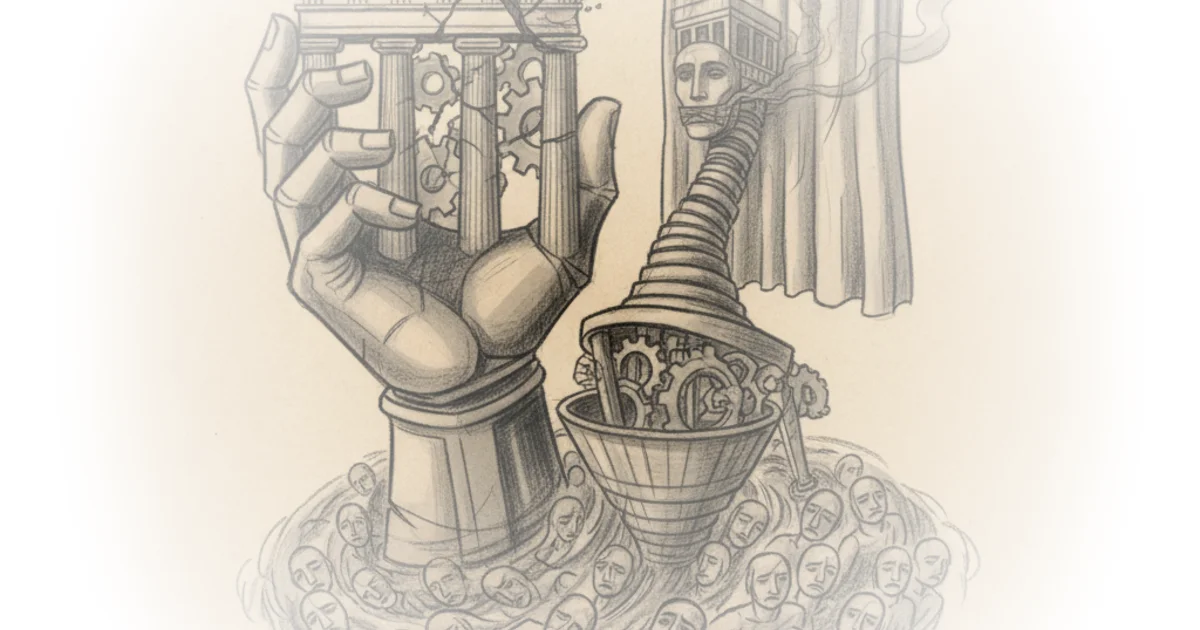
The core of Lyons' thesis identifies the culprit not as a specific ideology like communism or fascism, but as a structural shift toward "managerialism." He argues that real power has migrated away from elected leaders to "faceless bureaucracies, nameless processes, and numberless so-called 'non-governmental' institutions." In this new order, the public is viewed with disdain. Lyons quotes Woodrow Wilson to capture this elite sentiment, describing the people as "a clumsy nuisance, a rustic handling delicate machinery."
"The business of managers is not producing or building anything... but rather the constant manipulation and management — that is, surveillance and control — of people, information, money, and ideas."
Lyons posits that the managerial class has a unique incentive structure: they thrive on complexity. He explains that "bureaucracy expands to meet the needs of the expanding bureaucracy," creating a feedback loop where inefficiency is rewarded with more jobs and more power. This dynamic has led to an explosion of administrative roles that far outpaces productive work. He notes that in Canada, "one in four Canadians now works for the government," a statistic he attributes not to economic demand but to the "managerial doom loop."
This section is particularly effective in explaining why so many citizens feel disconnected from their institutions. The system is not broken; it is functioning exactly as designed to prioritize the interests of the administrators over the governed. Lyons suggests that movements often labeled as "woke" or progressive are, in this view, merely "a massive jobs program for the ever-expanding managerial class," designed to create new domains of social life that require top-down "expert" intervention.
The Myth of Scientific Administration
Lyons traces the philosophical roots of this regime to the Enlightenment's faith in reason, which evolved into a desire to "de-risk and 'depoliticize' politics by handing over decision-making to technocratic 'experts.'" The goal, he argues, was to replace contentious debate with "scientific administration." This vision required the creation of a "universal class" of civil servants who could supposedly govern with superior objectivity.
However, Lyons contends that this project has morphed into a moralistic crusade. The managerial elite, seeing themselves as the "saviors and guardians of all humanitarian peace," have developed a belief system where they "can, in their own eyes, do no wrong." He references Christopher Lasch's The Revolt of the Elites to describe this group as a new priestly class, "worshipping proceduralism and their own credentialed expertise." The danger, Lyons warns, is that this class is insulated from accountability because their authority is derived from their perceived expertise rather than the consent of the governed.
"The story of the managers' rise to power everywhere... is the story of the fall of liberal democracy — and perhaps of something even more precious than that as well."
While Lyons provides a compelling narrative for the rise of technocracy, he perhaps underplays the genuine complexities of modern governance that necessitate specialized knowledge. Not all administrative growth is a conspiracy; some is a response to the intricate challenges of modern economies and global crises. Yet, his warning about the spirit of this governance—that it treats citizens as subjects to be managed rather than partners in a democracy—resonates deeply with current public frustration.
Bottom Line
N.S. Lyons offers a chilling but coherent explanation for the global sense of political suffocation, identifying the managerial bureaucracy as the primary threat to democratic vitality. His strongest insight is the recognition that this system is self-perpetuating, expanding not to solve problems but to create new ones that justify its own existence. The argument's vulnerability lies in its tendency to view all administrative growth as inherently malicious, potentially overlooking the legitimate need for expertise in complex societies. However, for any reader feeling that their voice no longer matters, Lyons provides a powerful vocabulary for why that feeling is not just in their head, but a structural reality of the modern state.