The Architects of Their Own Decline
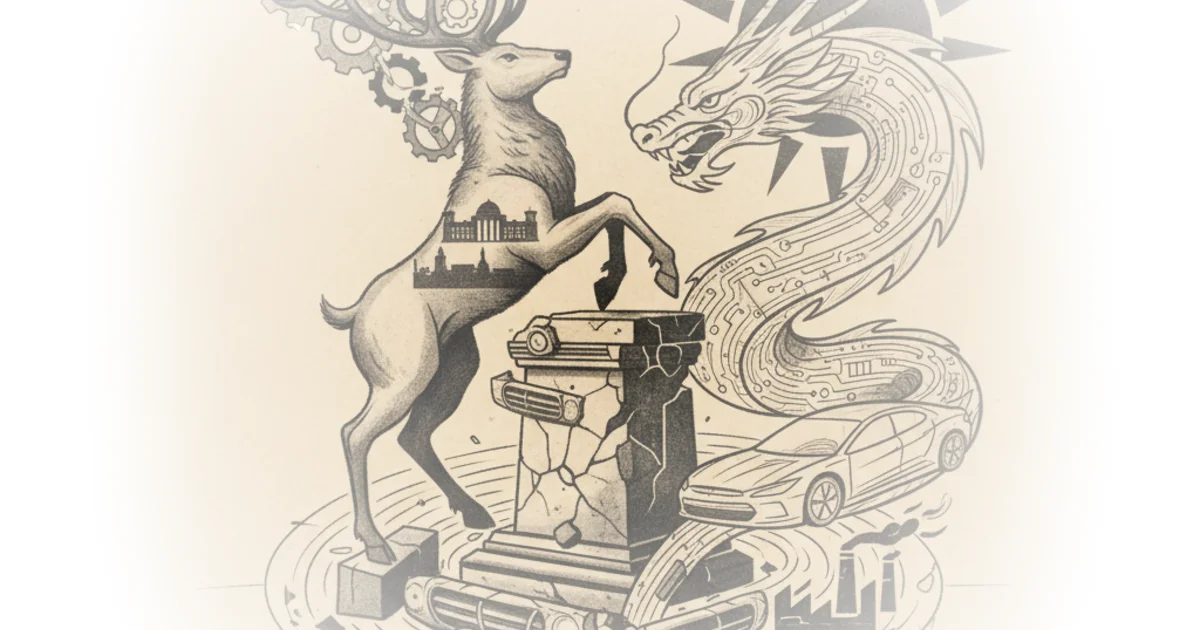
For a century, German automakers occupied a position so dominant it seemed permanent. Mercedes, BMW, Porsche, Volkswagen — these were not merely car companies but pillars of European industrial identity. Yet the story unfolding in 2025 reads less like a competitive challenge and more like a strategic ambush, one that Berlin's political class appears unable or unwilling to counter. The Good Times Bad Times analysis of Germany's automotive crisis against China lays bare the uncomfortable arithmetic: a $230 billion state-subsidized Chinese auto sector is systematically dismantling the industry that powered the European Union's economy.
The numbers are difficult to argue with. In 2020, Chinese brands held 36% of their domestic market while German manufacturers still commanded a respectable 24%, with Volkswagen alone at 17%. Four years later, Chinese automakers control 69% of their home market, and German brands have cratered to roughly 15%. Mercedes sales in China dropped 13% in 2024. BMW plunged 30%. The trajectory is unmistakable.
The Subsidy Question Nobody Wants to Answer
At the heart of this confrontation sits an asymmetry that free-market advocates struggle to reconcile. Between 2009 and 2023, Chinese automakers received approximately $230 billion in state support for electric vehicle and battery development. BYD, China's most powerful automotive company, reportedly accumulated losses exceeding $10 billion in the first three quarters of the current year alone. As the article frames it:
Such razor thin margins reveal Beijing's true goal — to wipe out foreign competition sustained by the government's financial drip feed. Once rivals fall, China's champions will dictate global prices just as Germany's once did.
This is the predatory pricing playbook writ large across an entire industrial sector. The median net profit margin for Chinese automakers collapsed from 2.7% in 2019 to just 0.83% in 2024. No private enterprise in a genuinely competitive market could sustain such margins. Yet the analysis notes that according to Alex Partners, roughly 15 Chinese automakers will survive this culling by 2030, each producing over a million cars annually and controlling 75% of the domestic new energy vehicle market.
There is a counterargument worth considering. State subsidies alone do not explain Chinese dominance. As Greg Ip observed in the Wall Street Journal, China's rise comes from a "unique blend of industrial policy, protectionism, and fierce internal competition." That internal competition — 120 Chinese brands and 20 foreign ones fighting for market share — has produced genuine innovation, particularly in software and battery technology. A senior Chinese manager quoted in the piece explained her switch from a BMW X3 to a Chinese electric Stellato S9 by noting that Chinese cars now match German build quality but offer far superior software, including advanced autonomous driving features BMW simply lacked.
Berlin's Strategic Paralysis
Perhaps the most damning element of this analysis is not China's aggression but Germany's response to it. The October 2025 automotive summit in Berlin brought together government officials, carmakers, the VDA automotive association, and labor unions to discuss one question: how to save the German car industry. The result was essentially nothing.
The meeting ended with less substance than expected.
Chancellor Mertz offered vague hints about asking the European Commission to review the 2035 combustion engine ban. Vice Chancellor Klingbeil insisted the strategic goal of electromobility remained unchanged while simultaneously declaring the priority must be "a strong future for the German car." The Bavarian and Saxon premiers warned that 100% electric mobility by 2035 was "not realistic." Meanwhile, Professor Ferdinand Dudenhoeffer from the Center for Automotive Research argued the opposite:
A dual path, combustion and electric, only weakens us. We must commit fully to electromobility, cut costs and expand infrastructure. Everything else is nostalgia.
This internal division is precisely what Beijing is counting on. Germany cannot agree on whether to defend the combustion engine or accelerate the electric transition, and while its politicians debate, China executes. The piece draws a striking parallel to Nokia's failure in the smartphone era — German media have called this the industry's "iPhone moment" — and the comparison is apt. Nokia did not fail because it lacked engineering talent. It failed because it could not commit to a strategic direction fast enough.
The Rare Earth Chokehold
Beyond subsidies and price wars, China wields a weapon that receives insufficient attention in most analyses: control over critical raw materials. A modern electric vehicle contains roughly 10 kilograms of rare earth elements, two kilograms of which are neodymium — essential for EV motors. Beijing expanded export licensing in October 2025 to cover 12 rare earth elements, giving it effective veto power over who gets access.
A sudden halt of rare earth exports from China to the US would have severe consequences for the Euro zone.
The ECB itself issued this warning. Nearly 80% of Europe's major manufacturers remain dependent on Chinese supplies. When the Netherlands seized control of Nexperia, a European chip maker owned by China's Wingtech, Beijing retaliated by blocking exports of all parts containing Nexperia chips. Eighty percent of those chips are produced in China. The existing stockpile lasted only weeks before Beijing chose to ease restrictions — a demonstration of leverage, not a resolution.
The article describes this as a "boiling frog strategy," and the metaphor is well-chosen. China has restricted graphite sales to Europe since December 2023, imposed controls on lithium iron phosphate exports, blocked Western access to lithium processing technologies, and announced export quotas on lithium-ion batteries. Each measure individually seems manageable. Cumulatively, they represent a systematic effort to raise European manufacturing costs to uncompetitive levels.
The German Trap
The deepest irony in this saga is that German automakers are effectively lobbying against their own long-term survival. With a 15% share of the Chinese market still generating significant revenue, Volkswagen, BMW, and Mercedes cannot afford to provoke Beijing. They successfully pressured Berlin to block higher EU tariffs on Chinese EVs. BYD faces a total tariff of just 27% in Europe, compared to over 100% in the United States.
From Beijing's perspective, it is actually smart to let German brands keep that 10 to 15% foothold in China because it ensures they will keep lobbying against EU tariffs that could protect Europe's own market.
This observation is the sharpest in the entire analysis. China has effectively turned German automakers into lobbyists for Chinese market access to Europe. The short-term revenue from Chinese sales blinds them to the structural threat. It is, as the piece puts it, "a slow motion drive toward the cliff where passengers are still being served coffee and cake."
Yet the defeatist framing deserves some pushback. Europe still produces over 10 million new cars annually. German automakers boosted R&D spending by 5% in 2024 to a record 31 billion euros. BMW invested 10 billion euros in new models and a plant in Debrecen, Hungary. ZF has unveiled the i2SM motor, the first in the world requiring no magnets or rare earth metals. These are not the actions of an industry that has surrendered. The question is whether innovation can outpace the structural advantages China has built through state intervention — and whether European political leaders will buy their industries enough time to find out.
Bottom Line
The German automotive crisis is not primarily a story about engineering failure. German cars remain superbly built. It is a story about strategic incoherence meeting state-directed economic warfare. China committed early and massively to electromobility, subsidized its champions through unprofitable years, secured control over critical supply chains, and now exploits Europe's political divisions. Germany, meanwhile, cannot decide whether to defend combustion engines or accelerate electrification, cannot agree on tariff levels, and watches its automakers lobby against protective measures out of short-term self-interest. The 14 million European jobs tied to the automotive sector deserve a more decisive response than another summit that ends without substance. Whether that response materializes before China's local European factories — BYD in Hungary, Chery in Spain — go online will likely determine whether "Das Auto" remains a German phrase or becomes a historical footnote.