Perun delivers a startling reframing of modern maritime conflict: the United States is no longer just policing the seas; it is actively redefining the very concept of freedom of navigation as a conditional privilege rather than an inherent right. While headlines fixate on political theater, Perun exposes a silent, high-stakes escalation where the U.S. Navy is seizing vessels in international waters, effectively turning the global ocean into a zone of unilateral enforcement. This is not merely about oil; it is a fundamental shift in how the world's most powerful navy interprets its role, with implications that will ripple through global trade for decades.
The Anatomy of the Shadow Fleet
Perun begins by dismantling the misconception that these operations are simple law enforcement. He clarifies that the "shadow fleet" exists in a legal gray zone, operating outside the direct reach of United Nations mandates. "When we're talking about these ships that might be carrying Venezuelan, Iranian, or Russian oil, what they're doing in the international law sense isn't usually strictly illegal," Perun writes. Instead, the pressure comes from the ecosystem surrounding the ships. The author notes that international shipping is a fragmented global chain: "built in Asia, owned in Greece, insured in Britain, flagged to Panama, Liberia, or the Marshall Islands, and then ultimately ends up recycled in Bangladesh, India, or Pakistan."
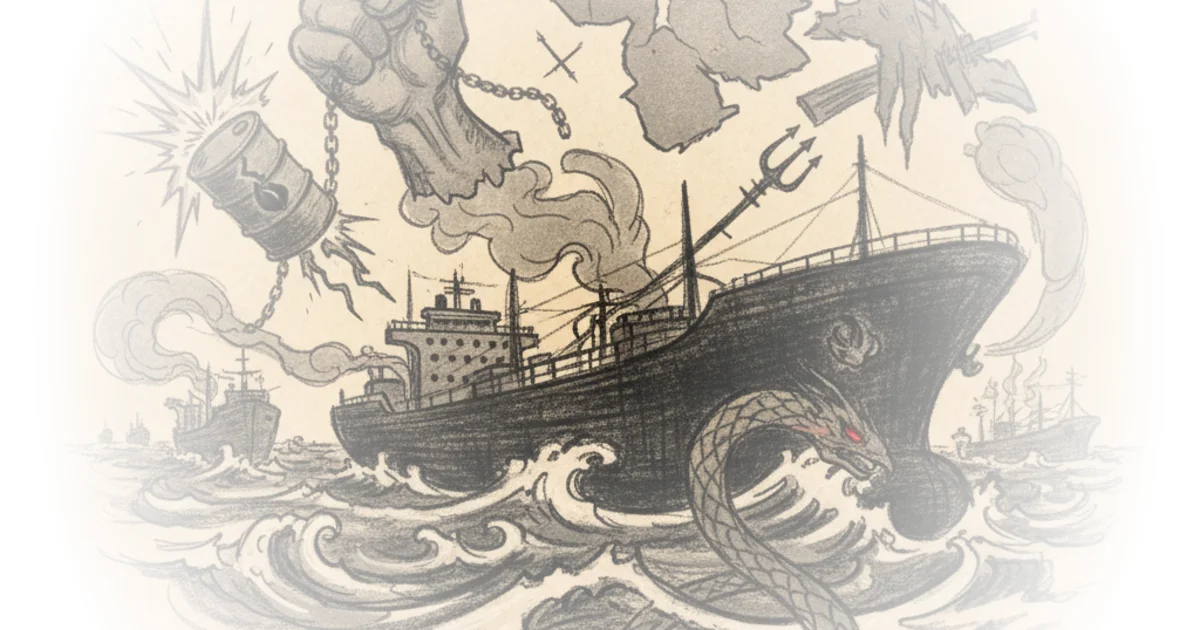
This fragmentation is the vulnerability the West exploits. By denying insurance and port access, sanctions create economic suffocation without needing to fire a shot. Perun describes how these vessels, often old and poorly maintained, are the "opportunistic" response to this pressure. "A lot of these ships are not in great condition," he observes, noting they are often hulls scheduled for scrapping that have been repurposed for one last run. The scale is massive, with estimates suggesting over 500 large tankers linked to Russia alone, carrying millions of barrels of oil that bypass price caps. The strategic brilliance here is the reliance on economic friction rather than kinetic force, at least until now.
"If I go stand out the front of his pub with a shotgun threatening to shoot anyone who goes through the door, that's closer to a blockade."
Critics might argue that relying on environmental regulations and insurance denials is a slow, bureaucratic weapon that fails to stop determined regimes. However, Perun suggests this approach has been effective enough to force hundreds of ships off the water, proving that the "soft power" of maritime infrastructure is a potent deterrent.
The Legal Gray Zone and the Blockade
The commentary shifts sharply when addressing the recent U.S. actions against Venezuela. Perun highlights a critical distinction in President the administration's rhetoric: the use of the word "blockade." "Therefore, today I am ordering a total and complete blockade of all sanctioned oil tankers going into and out of Venezuela," Perun quotes from the announcement. This is not a minor semantic choice. In international law, a blockade is a belligerent act, a feature of war, not a standard police action.
Perun argues that the legality of these seizures hinges on whether the U.S. is acting under domestic law or international mandate. He dismisses the obsession with U.S. domestic statutes as strategically irrelevant, noting that "countries laws can be changed. They can be ignored." The real question is whether the U.S. is willing to treat the high seas as a war zone. He points out that historically, blockades require a clear state of war or UN authorization, neither of which seems present here. "A blockade is a prohibited use of military force ag[ainst]..." Perun notes, citing UN experts who warn that such actions could be illegal under international law.
The author's analysis suggests the U.S. is testing the limits of its own power. By seizing ships in international waters, the U.S. is effectively declaring that the "freedom of navigation" it has guarded for decades is now a privilege granted only to those who comply with American sanctions. This is a radical departure from the post-WWII order. "The classic rights of freedom of navigation of the seas suddenly weren't so free," Perun writes, capturing the essence of the geopolitical earthquake. The U.S. is no longer just a guardian of the seas; it is becoming a gatekeeper.
Strategic Implications and the Future of Trade
The final section of Perun's piece zooms out to the broader economic and strategic consequences. If the U.S. Navy decides that freedom of navigation is a privilege, the cost of global trade skyrockets. Every ship becomes a potential target, and the insurance industry, already wary, may refuse to cover vessels that risk U.S. interception. Perun warns that this could lead to a "strangulation of the German economy" scenario, but on a global scale. "What it might mean for international trade and maritime assumptions as a whole if the United States Navy... decides that it's more like a privilege than a freedom," he asks, leaving the reader with a chilling question.
The author also touches on the response from adversaries. Russia has already dispatched naval vessels to escort sanctioned tankers, a direct challenge to U.S. authority. "Russia taking one sanctioned tanker under its legal protection and dispatching naval vessels to escort it, only for the United States to call the bluff and go ahead and seize it anyway," Perun describes. This escalates the risk of direct naval confrontation, turning the ocean into a potential flashpoint for great power conflict. The "shadow fleet" is no longer just a logistical workaround; it is a frontline in a new kind of economic warfare.
"Domestic law can be strategically relevant. But normally, when someone is describing an action like this as legal or illegal, they're talking about it from an international law standpoint."
Bottom Line
Perun's strongest argument lies in his reframing of the U.S. blockade not as a legal enforcement action, but as a strategic pivot that redefines the rules of the road for global commerce. The piece's greatest vulnerability is its reliance on the assumption that the U.S. will continue to act unilaterally without significant pushback from other major powers, which could fracture the very alliances needed to enforce these sanctions. Readers should watch closely to see if the U.S. follows through on its "blockade" rhetoric or if the legal and diplomatic costs prove too high to sustain this new, aggressive posture.