Sabine Hossenfelder delivers a rare, unvarnished autopsy of modern academia, arguing that the system no longer rewards truth-seeking but rather rewards the ability to manufacture grant proposals. This is not a rant about a bad boss; it is a structural indictment of how financial incentives have hijacked scientific progress, turning researchers into temporary laborers in a "paper production machine." For the busy professional wondering why breakthroughs feel scarce despite record funding, Hossenfelder offers a chilling explanation: the system is working exactly as designed, just not for the reasons we were told.
The Myth of the Meritocracy
Hossenfelder begins by dismantling the romanticized image of science she absorbed from biographies, contrasting it with the brutal reality she encountered as a woman in the 1990s. She describes a naive expectation of a community of thinkers, only to find an institution where gender bias was institutionalized under the guise of support. "I wasn't offered a job because I'm a woman," she writes, recounting how the institute head directed her to a scholarship exclusively for women so the institution wouldn't have to pay her salary or provide benefits like pension and health insurance.
This anecdote serves as the entry point to a broader critique of how institutions manage risk and cost. Hossenfelder argues that these "special" programs, while well-intentioned, often reinforce the prejudice that women are less capable or more expensive to employ. The system forced her into a precarious position where she was technically not an employee but a scholarship holder, a distinction that left her vulnerable to exploitation. "I was then ordered into his office in which he gave me a very angry speech According to which I wasn't loyal to all the other students who did their part," she recalls, detailing how she was eventually physically shoved out of an office after refusing to work for free on a professor's commercial textbook project.
The irony, as Hossenfelder points out, was that the professor could not fire her because she was never hired in the first place. This moment of realization—that the institute was not about knowledge discovery but money-making—became the catalyst for her entire career trajectory. The narrative holds up because it moves beyond individual malice to show how the structure itself encourages such behavior. A counterargument worth considering is that some institutions do successfully balance overhead with genuine research support, but Hossenfelder's experience suggests these are the exception rather than the rule in the current climate.
The moment you put people into big institutions the goal shifts from knowledge Discovery to moneymaking.
The Paper Production Machine
The core of Hossenfelder's argument lies in the mechanics of academic funding. She explains that universities rely on "overhead"—a percentage of every grant awarded—to fund their administration and permanent staff. This creates a perverse incentive where the institution's survival depends on researchers constantly securing new money, regardless of the scientific merit of the work. "The easiest way to grow in Academia is to pay other people to produce papers on which you as the grant holder can put your name," she writes, describing a cycle where students and postdocs are burned through to generate the output required for the next grant application.
This dynamic forces researchers to tailor their work to what is fundable rather than what is true. Hossenfelder notes that successful proposals must be "mainstream enough but not too mainstream," fitting into existing frameworks while appearing slightly edgy. The time horizon of grants, typically three to five years, further constrains ambition, favoring quick, wrap-up-able projects over long-term, high-risk inquiry. "I began to understand what you need to do to get a grant or get hired," she admits, acknowledging that she eventually played the game to survive, applying for grants she knew would not lead to historical impact simply to make a living.
The tragedy here is the self-deception required to maintain one's sanity within the system. Hossenfelder confesses that she tried to tell herself she was doing "real" research on the side, but the demands of the grant machine consumed all her time. "I knew it was just as most of the work in that area is currently and just as most of academic research that your taxes paid for is almost certainly the real problem," she states, highlighting the disconnect between public funding and private institutional gain. Critics might argue that peer review still filters out the worst ideas, but Hossenfelder suggests the filter is tuned for consensus and grantability, not necessarily for paradigm-shifting truth.
The Human Cost of Institutional Rigidity
Beyond the financial mechanics, Hossenfelder addresses the profound human toll of this system, particularly on women and families. The expectation of constant geographic mobility for postdoctoral positions creates a hostile environment for personal stability. "It's incredibly hostile to personal life detrimental to mental health and women suffer from it more because our reproductive reality is that we need to start families earlier than men," she argues, detailing her own years of commuting between Frankfurt and Stockholm.
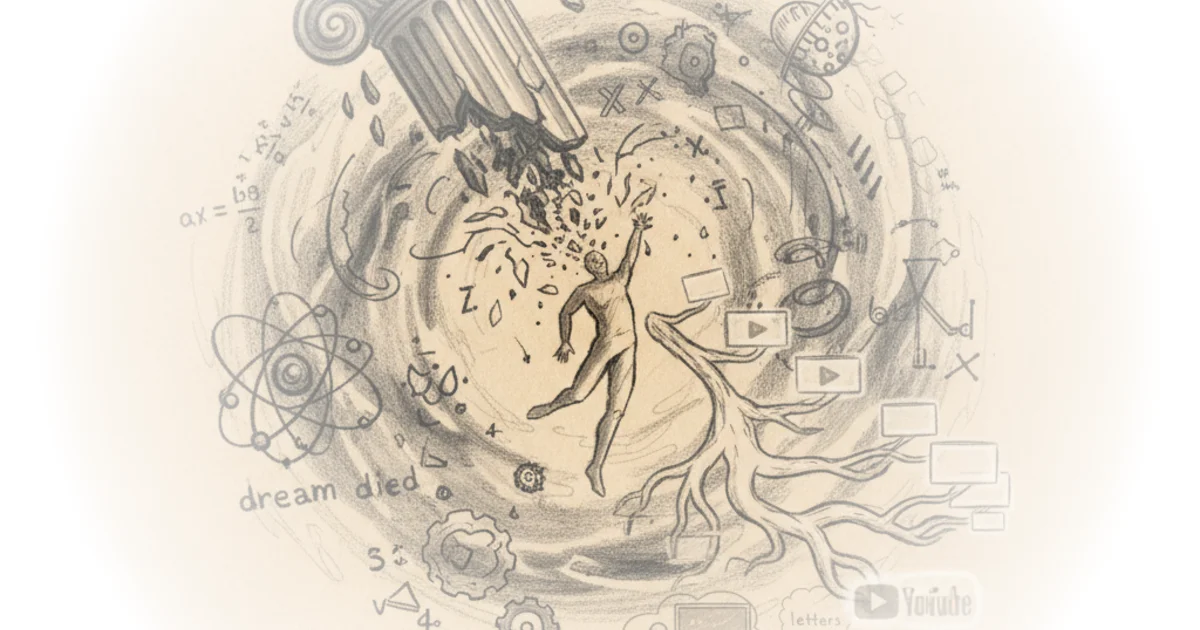
The pressure to conform to the "machine" eventually led to a breaking point. Hossenfelder describes a period of severe mental health decline, including nervous breakdowns, driven by the guilt of not working enough and not being present for her children. The pandemic served as a final wake-up call, reminding her of life's brevity and prompting a pivot away from the grant-chasing cycle. "My dream died, and now I'm here," she reflects, explaining her transition to YouTube as a move toward an "honest trade" where knowledge is exchanged directly for attention, bypassing the gatekeepers who rejected her work on the foundations of physics.
She acknowledges that her experience is not universal, noting that many scientists love the current system. However, her refusal to lie to herself about the nature of her work led her to leave. "It's not that they say there's something wrong with your proposal it just doesn't excite them because it's not the main current interest," she explains, identifying the subtle but powerful mechanism of exclusion that keeps the status quo intact. The shift to self-employment allowed her to address "obscure problems in the foundations of physics" that the academic machine deemed too risky or unprofitable.
Bottom Line
Hossenfelder's most compelling contribution is her diagnosis of the "overhead" problem, which transforms universities from centers of learning into grant-processing factories that prioritize revenue over discovery. Her argument is strongest in exposing how the system incentivizes mediocrity and punishes the very risk-taking required for scientific breakthroughs. The biggest vulnerability in her case is that it relies heavily on personal anecdote, which, while powerful, may not capture the nuances of every discipline or institution, yet it remains a vital warning for anyone invested in the future of science. Watch for how other researchers begin to challenge the overhead model, as the pressure to produce "papers" rather than "progress" is reaching a breaking point.