Yascha Mounk delivers a stinging critique of how a national tragedy was obscured by journalistic groupthink and a collapse of professional standards. The piece is not merely about a reporting error; it is an autopsy of a media ecosystem that prioritized narrative urgency over factual verification, turning a sensitive historical inquiry into a polarizing battleground where truth became collateral damage.
The Anatomy of a Reporting Failure
Mounk begins by exposing the gap between the emotional weight of the story and the technical reality. Five years ago, the Tkʼemlúps te Secwépemc First Nation announced findings that shocked Canada, citing ground-penetrating radar data. However, Mounk points out a critical distinction often lost in the headlines: "Tkʼemlúps had not actually found any remains in 2021—and still has not." What was identified were "ground anomalies," not confirmed human bodies, yet the press corps treated the preliminary data as definitive proof of mass graves.
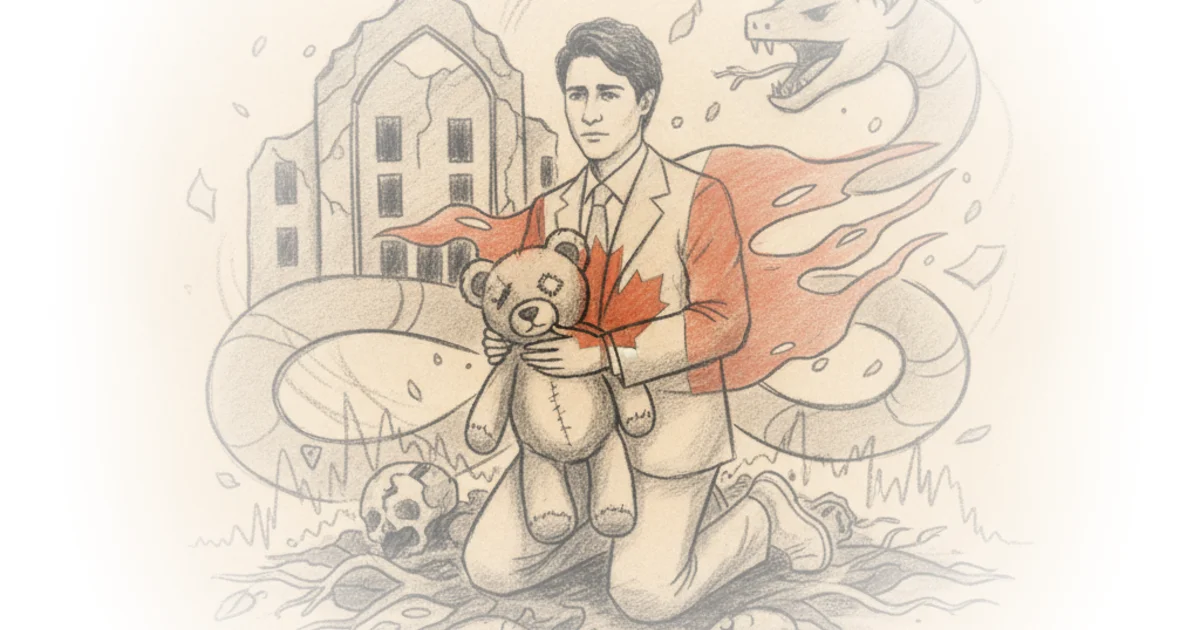
The author argues that this failure was systemic. Economic pressures and a shrinking newsroom created an environment ripe for timidity. Mounk writes, "Economic challenges have paved the way for timidity and groupthink." When journalists are afraid to lose their jobs or face social ostracization, they stop asking hard questions. This dynamic was exacerbated by an American-style polarization that crossed the border, where Canadian outlets began emulating US commentators who argued that traditional guardrails should be suspended in the face of perceived existential threats.
"The fact of the crimes committed against Indigenous children at residential schools over many decades does not automatically validate claims that hundreds of students were dumped into unmarked graves at Kamloops and other residential schools. That is an extraordinary assertion, one that requires proof."
This quote from The Globe and Mail editorial board, cited by Mounk, represents a rare moment of institutional self-correction. It highlights the core flaw: the conflation of historical guilt with specific forensic claims. While the Truth and Reconciliation Commission documented at least 3,200 student deaths across the country—many from disease—the leap to "mass graves" required evidence that simply did not exist at the time. Critics might argue that demanding immediate excavation in remote areas is impractical, but Mounk's point stands: reporting on "probable burials" as "confirmed remains" was a failure of basic verification.
The Erosion of Objectivity
The commentary shifts to examine the cultural shift within newsrooms. Mounk details how the concept of objectivity was increasingly framed as an obstacle rather than a tool for truth. He notes that headlines began to question whether "objectivity is an outmoded value," with some journalists arguing it could be "harmful." This intellectual climate made it dangerous to scrutinize the graves story.
When ground-penetrating radar specialist Sarah Beaulieu clarified in July 2021 that they could never say definitively what the anomalies were without excavation, the correction was largely ignored. Mounk observes, "Still, this did little to penetrate the established narrative." Instead, the media latched onto oral histories and unverified rumors, allowing the term "mass grave"—popularized by The New York Times—to stick despite early corrections from other outlets.
This rush to judgment created a vacuum. As Mounk puts it, "The press corps' lack of incisive coverage ultimately created a vacuum of information." In that void, conspiracy theories flourished, and the conversation became increasingly toxic. The slogan "Dig Up or Shut Up" gained traction, and political rhetoric escalated to the point where some officials labeled the entire discovery a hoax.
The Cost of Silence
Perhaps the most damning part of Mounk's analysis is the treatment of dissenters. He highlights the case of Terry Glavin, a veteran reporter who attempted to question the narrative in The National Post. His work was denounced as "residential school denialism," and he faced intense professional pressure, including public calls for his interview to be cancelled.
Mounk writes, "If I was a young journalist today, I can't imagine myself going anywhere near this story." This chilling admission from Glavin underscores the self-censorship that took hold. The fear of being labeled a denialist silenced legitimate inquiry. Even as late as 2023, the Royal Canadian Mounted Police classified questioning the graves story as "denialism," further entrenching the idea that skepticism was synonymous with hate.
"I think that this is absolutely a lesson about what happens when we get drunk on our own righteousness... I think that is what happened to me."
This reflection from podcaster Jesse Brown, who initially pressured Glavin to drop his story, serves as a powerful indictment of the media's hubris. Mounk uses this to illustrate how the pursuit of moral certainty can blind journalists to factual uncertainty. The result was a polarized public where 63 percent of Canadians now believe more evidence is required to accept the graves claim, according to an Angus Reid poll.
A Path Forward
Mounk concludes by highlighting the work of Aaron Pete, Chief of the Chawathil First Nation, who refused to let the debate become a zero-sum game. Pete interviewed critics and insisted that "a public that asks hard questions is not necessarily a hostile public." This approach, Mounk argues, is essential for democracy.
The author contends that restoring trust requires a return to rigorous standards. "We must return to a standard of objectivity, subjecting all claims to equal scrutiny, regardless of the identity of those making them," Mounk writes. The path to reconciliation cannot be paved with unverified facts; it requires the hard work of establishing a shared reality.
Housing policy was built on racist foundations, and we never tore them up. We just stopped talking about it.
Critics might argue that in cases involving historical trauma, strict adherence to objectivity can sometimes feel like a delay in justice for victims. However, Mounk's argument suggests that without factual rigor, the cause of truth is ultimately undermined, allowing bad-faith actors to exploit the confusion.
Bottom Line
Yascha Mounk's strongest contribution is his unflinching diagnosis of how professional cowardice and ideological fervor combined to distort a national narrative. The piece's greatest vulnerability lies in its heavy reliance on the perspective of those who felt silenced, potentially underestimating the genuine urgency Indigenous communities felt regarding their oral histories. The reader should watch for whether Canadian media institutions can truly operationalize this return to objectivity or if they will continue to prioritize moral posturing over forensic truth.