Shirvan Neftchi makes a startling claim: Canada's path to true sovereignty may not lie in diplomacy, but in the steel and concrete of a $25 billion pipeline. While most analysis focuses on the environmental toll of fossil fuel expansion, Neftchi reframes the Trans Mountain expansion as a geopolitical shield, arguing that energy independence is the only viable defense against a protectionist neighbor to the south.
The Trap of Single-Market Reliance
Neftchi opens by exposing a critical vulnerability in the North American economic architecture. "Canada is so reliant on the US for its oil exports that even if a 10% tariff were applied, it would still have no choice but to continue selling to the US." This observation cuts through the noise of trade rhetoric to reveal a hard economic reality: without alternative routes, Canada lacks leverage. The author argues that the current dynamic forces Canadian producers to accept lower prices simply because the Alberta oil sands are landlocked and the existing infrastructure funnels almost all output to the American Midwest.
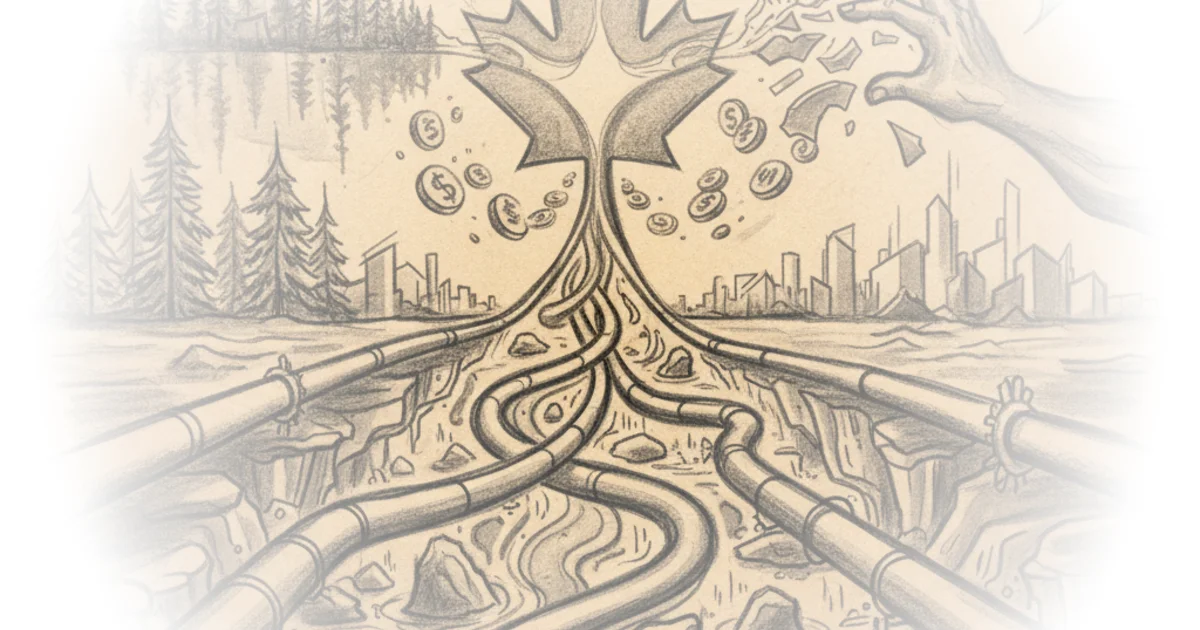
The core of the argument is that interdependency has become detrimental. Neftchi writes, "Any nation that bets on one buyer gambles with its future." This framing is effective because it shifts the conversation from environmental morality to national security strategy. By highlighting that 98% of Canadian crude goes to a single market, the piece underscores how a shift in US trade policy could cripple the Canadian economy regardless of global oil prices.
Critics might note that this analysis downplays the domestic political cost of doubling down on fossil fuels, especially as Canada commits to net-zero emissions by 2050. However, Neftchi anticipates this by suggesting that the urgency of external threats may force a re-evaluation of internal priorities.
Pipelines carve paths that politics cannot erase.
The Strategic Pivot
The commentary details the arduous journey of the Trans Mountain expansion, a project that took over a decade and ballooned to a $25 billion price tag. Neftchi notes that the federal government stepped in to buy the pipeline after private investors fled, driven by a "grand strategic objective" to reduce reliance on the United States. The expansion, now operational, triples export capacity, theoretically allowing Canada to access Asian markets in Japan, China, and India.
Neftchi writes, "For Trudeau, the project's completion comes as a relief," acknowledging the political pressure the government faced from environmental campaigners and Indigenous groups. The author suggests that the project is more than just infrastructure; it is an "opportunity to have a different conversation, reduce interdependency, and strengthen Canada's sovereignty." This is a compelling narrative arc: turning a controversial asset into a tool for geopolitical resilience.
However, the piece glosses over the complexity of the global market. While new capacity exists, Neftchi admits that "the United States is and will remain Canada's biggest customer." The argument holds weight only if Asian demand remains robust and if the logistical hurdles of shipping from the Pacific coast are manageable.
The Hidden Dependency
Perhaps the most surprising insight in the coverage is the revelation of Canada's internal logistical paradox. Neftchi points out that Canada depends on the US not just for exports, but for domestic distribution. "The oil used in Ontario and Quebec travels through a pipeline that runs from Canada into the United States and then comes back into Canada." This bizarre loop means that even domestic energy security is outsourced to American infrastructure.
The author argues that this is a "bad hand to have" given the current political climate in Washington. "Canada is dependent not only on the US single market for its exports, but also on domestic distribution." This point is crucial; it suggests that the vulnerability is systemic, not just a matter of trade balances. The solution proposed is the revival of cancelled projects like Energy East and Northern Gateway, which would connect Alberta directly to the Atlantic and Pacific coasts.
Yet, the financial reality is stark. Neftchi notes that while Northern Gateway might cost a similar $25 billion, Energy East is four times the length and likely four times the price. "The companies involved... have no interest in restarting them." This creates a paradox where the federal government would need to step in again, requiring a level of national consensus that has been elusive for years.
Hostility builds bridges faster than diplomacy.
The Unlikely Catalyst
Neftchi concludes with a provocative thesis: the very rhetoric that threatens Canada's economy might be the catalyst for its unity. The author observes that former prime ministers have noted a surge in Canadian patriotism in the face of external threats. "If Canadian lawmakers can gather the needed consensus, they could build energy east and northern gateway and strengthen the country's long-term resilience."
The argument is that a common external enemy can force internal cooperation. Neftchi writes, "With Trump in office, however, there is an opportunity to bring Canadians together." This is a bold claim, suggesting that the political friction caused by the US administration could be the necessary pressure to overcome domestic gridlock on infrastructure.
A counterargument worth considering is that this approach relies on a perpetual state of crisis. If the external threat dissipates, the political will to build controversial pipelines might vanish just as quickly. Furthermore, the environmental opposition is not merely a political hurdle but a fundamental shift in societal values that cannot be easily overridden by nationalist sentiment.
Bottom Line
Neftchi's strongest move is reframing energy infrastructure as a matter of national survival rather than just economic policy, effectively using the threat of protectionism to justify the expansion of fossil fuel networks. The piece's biggest vulnerability lies in its optimism about political unity; it assumes that the threat of a trade war is sufficient to overcome deep-seated environmental concerns and the astronomical costs of new infrastructure. Readers should watch whether the Canadian government can actually mobilize the consensus required to build the next generation of pipelines before the geopolitical landscape shifts again.