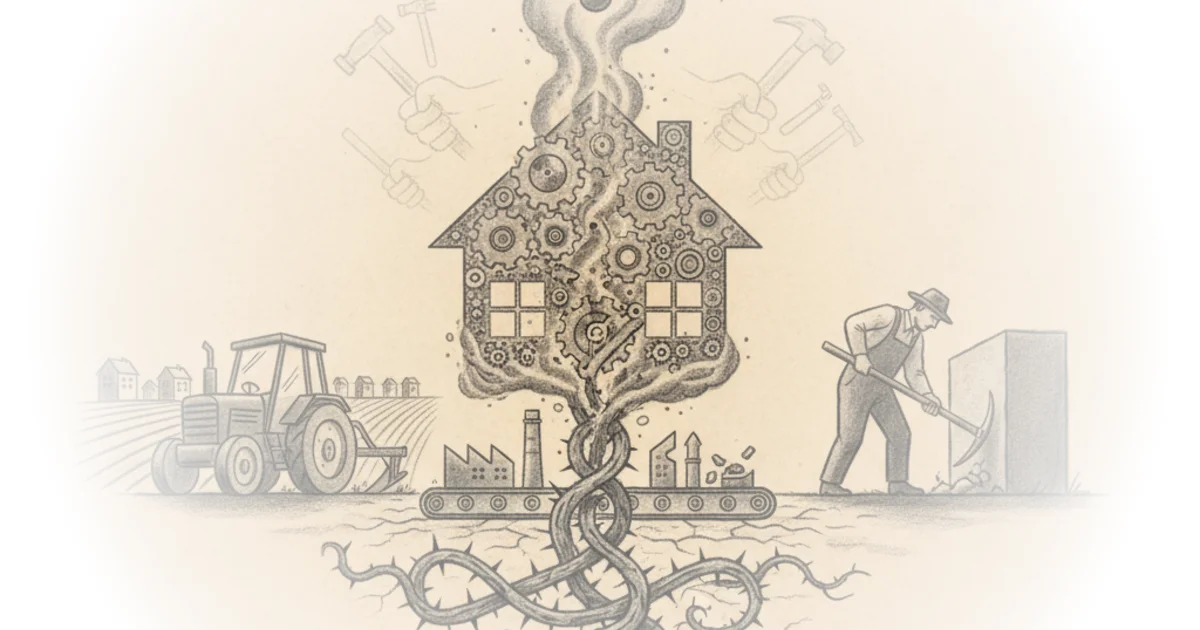
The promise of factory-based homebuilding has long inspired hope. But after nearly a century of efforts to industrialize construction, those hoped-for cost savings remain elusive — and the reasons why illuminate both the limits of analogy and the stubborn nature of building.
It's long been believed that rising costs of new home construction, and lackluster improvements in construction productivity more generally, are fundamentally a problem of production methods. Most houses in the US are still built on-site, using manual labor and hand tools — a manner of construction that doesn't seem all that different from construction in the 19th century. By contrast, sectors like agriculture and manufacturing have shifted from this type of \"craft production,\" where work is done primarily by skilled manual labor, to industrialized, factory production, where work is mainly done by high-volume, highly automated machinery.
Direct labor — the labor needed to actually physically produce something — makes up only about 10-12% of the cost to manufacture a modern car. It's roughly half of the cost of building a new single family home. Extending this line of thinking suggests that if construction could be similarly industrialized — if homes were built in factories and then delivered to their sites, rather than built on-site, by hand — we'd see falling costs and rising productivity in construction similar to what manufacturing has achieved.
The Promise of Industrialization
The concept of industrializing homebuilding began to be articulated almost as soon as the benefits of mass production became apparent. Around the 1920s, Alfred P. Sloan, president of General Motors, extolled the virtues of industrialized production. An $800 Chevrolet would cost $5000 if made by hand, he noted — and suggested that the costs of building a home could be similarly reduced using factory methods.
In 1928, the German architect Walter Gropius noted that between 1913 and 1926 the price of new cars had halved, while the price of construction had doubled. Gropius attributed this to the different production methods of car manufacturing versus homebuilding. Contemporary building methods were \"far behind the times\" and \"not fit to solve the problem\" of building affordable homes. The greater proportion of hand-work involved in building increased the price in accordance with increasing labor costs. Refinement of mass production, on the other hand, considerably lowered the price of automobiles.
A decent dwelling became unattainable for the poor, yet the car became an everyman's tool.
The potential efficiency gains and cost savings of factory-based construction have been the driver of numerous prefabricated homebuilding efforts. They were behind the Lustron Corporation, which received $37.5 million (over $500 million in 2026 dollars) in government funding to produce enameled-steel panel homes in an enormous former aircraft engine factory following WWII. They fueled Operation Breakthrough, a 1970s US government initiative to kickstart the industrialized production of housing. They formed the core thesis of Katerra, a construction startup that in 2018 raised over $2 billion in venture capital on promises of driving down costs with factory methods.
However, these hopes have yet to bear out. Achieving cost savings with prefabricated construction has proved highly elusive in practice.
The Elusive Savings
Factory-based building methods have been tried extensively both in the US and abroad, but it's hard to find examples of prefabricators achieving significant cost savings above more traditional methods. The savings that have occurred are frequently in the realm of 10-20%, a far cry from the huge reductions that followed the industrialization of car manufacturing. Often these cost savings don't materialize at all; instead, prefabricators emphasize other benefits like reduced construction time and increased quality.
In cases where major savings do occur — such as with mobile homes — it's often within somewhat narrow categories of building that haven't generalized to the broad construction market.
Critics might note that comparing construction to car manufacturing oversimplifies the relationship between these industries. Cars are fundamentally standardized products with relatively uniform specifications, while residential construction involves far more variability in site conditions, buyer preferences, and local codes. Still, the core insight holds: the promised cost reductions from factory-based homebuilding haven't materialized despite decades of effort.
What We Might Expect
Before examining the history of cost savings with prefabricated construction, it's worth articulating what we might hope to gain by using factory-based methods.
Prior to mass-production, cars were assembled using craft production methods. In \"The Machine that Changed a World,\" a study of Japanese car manufacturing, the authors describe how cars were assembled at Panhard et Levassor, a French machine-tool company which at the end of the 19th century was the world's leading car manufacturer. The workforce was overwhelmingly composed of skilled craftspeople who carefully hand-built cars in small numbers. Different contractors, using slightly different gauges, made the parts, then ran them through an oven to harden their surfaces enough to withstand heavy use. However, the parts frequently warped in the oven and needed further machining to regain their original shape.
When these parts arrived at P&L's final assembly hall, their specifications could best be described as approximate. The job of the skilled fitters was to take the first two parts and file them down until they fit perfectly, then file the third part until it fit the first two, and so on until the whole vehicle — with its hundreds of parts — was complete. By the time the fitters reached the last part, the total vehicle could differ significantly in dimensions from the car on the next stand that was being built to the same blueprints.
Because P&L couldn't mass-produce identical cars, it didn't try. Instead, it concentrated on tailoring each product to the precise desires of individual buyers. This was time-consuming and labor intensive; cars produced in this manner were expensive. In the early 1900s a new car cost $2000 to $3000 ($77,000 to $116,000 today).
Henry Ford's systems of mass production changed all that. By introducing manufacturing improvements — machine-made interchangeable parts, the moving assembly line, special-purpose automated machine tools — Ford dramatically reduced the cost of producing a car. In 1908, Ford's Model T cost $850, far less than competing cars. And as production methods improved and manufacturing scale increased, costs fell further: by 1925, a Model T was selling for just $260, a reduction of more than 80% in inflation-adjusted terms.
Notably, the enormous reductions didn't come at the expense of quality. An analysis of Buick's 1911 Model 10 noted that \"anyone comparing a Model T Ford side by side with a Model 10 Buick would be unable to find anything superior on the Buick other than it had more brass trim.\" The Buick was crudely constructed, in essence years behind a Model T in terms of manufacturing ease and serviceability, performance, and reliability. This increase in quality meant reduced maintenance costs; the Model T cost around $100 a year to maintain at a time when other cars cost $1500.
Since automobiles transitioned from craft to industrialized production, the cost of cars has continued to fall in inflation-adjusted terms. And this pattern holds more broadly with manufactured goods: they tend to get cheaper over time. If we look at categories of manufactured goods in the consumer price index over the last several decades, nearly all of them have fallen in price in real terms.
This shift to industrialized production isn't dependent on the success of a single firm. Ford's share of automobile sales peaked at around 60% of the US car market in the early 1920s, but by the 1930s it had fallen behind General Motors and Dodge, and by the middle of WWII the company \"was on the brink of collapse,\" to the point where the government considered taking it over. But even if Ford had gone out of business, the industry wouldn't have shifted back to craft-methods of production.
Similarly, a dramatic decline in the overall car market — sales declined by about 75% during the Great Depression, and by nearly 50% following the global financial crisis — didn't cause a shift back toward craft methods. Once industrialized production arrives, its benefits ensure it sticks around even in the face of major firm failures or market downturns.
The promise of factory-based construction is that new methods so superior would result in great decreases in cost while offering equal or even superior quality — making a return to old methods unthinkable. People often articulate other benefits of prefabricated construction, and these benefits are often real and valuable. But it's the promise of durably improved efficiency and reduced cost that has continuously inspired enthusiasm for the concept.
A Brief History of Prefabrication
The history of prefabricated construction dates back hundreds of years. In 1624, English colonists brought a prefabricated panelized house with them to Cape Ann, Massachusetts, which was disassembled and reassembled several times. During the California Gold Rush of 1849, thousands of prefab homes were exported to California from the eastern US as well as England, France, Germany, and even China: by 1850, 5000 homes had been ordered and shipped from the New York area alone.
In 1861, the lumber dealers Skillings & Flint patented a \"portable house\" made of panelized wood construction which could be erected in three hours. Many were sold to the Union Army during the Civil War. In 1892, Ernest Hodgson began to sell prefabricated cottages made from wood panels, which the company continued to sell in one form or another until the 1970s.
But it was really in the 1930s when prefabrication as a strategy for reducing costs of building a home began to emerge. The ongoing Depression, and the high costs of housing, had put homes out of reach for many Americans. The success of mass production, or \"Fordism,\" in driving down the costs of cars inspired entrepreneurs to try similar strategies with homebuilding.
An article in the Brooklyn Daily Eagle from 1935 noted that \"mass production of prefabricated housing promises to revolutionize homemaking for the average family.\" One early example was the Motohome, which debuted that same year as the \"prefabricated house that comes complete with food in the kitchen.\" Promotional material noted that other goods had become cheap thanks to mass production, and it was only logical to apply such methods to homebuilding:
THE greatest social and economic problem that has grown out of the depression has been the necessity of reducing the cost of homes to a price that is not out of balance with the price you pay for other necessities of life. Home building for years has remained on an antiquated basis. That is why the cost of homes has been going steadily higher and higher in relation to the cost of other things that have been lowered through the aid of mass production. It is obvious that by manufacturing homes on a mass-production basis, the cost can be brought down to a point where you may again afford to own your home and give your children their chance in life.
The Motohome was not particularly successful, selling only 150 units. Subsequent home designs from its manufacturer American Houses reduced the extent of prefabrication to \"precutting [material] and partial preassembly of panels.\"
But other prefab companies found more success. In 1934, Foster Gunnison, a salesman of lighting fixtures, founded \"Gunnison Magic Homes\" (later shortened to Gunnison Homes), which aimed to \"bring the full benefits of mass production technology to a backwards industry.\" Gunnison hired manufacturing experts from car manufacturing and developed a system of panelized construction using stressed-skin plywood construction — where the plywood exterior carries the weight of the structure, rather than wood studs — first developed by the US Forest Products Laboratories. Gunnison aimed to make his company \"the General Motors of the homebuilding field,\" and by 1944 Gunnison Homes' factories were producing 600 houses a month.
And in 1940, brothers George and James Price founded National Homes, producing prefabricated wood panel homes in their factory in Lafayette, Indiana. Within two years, National Homes had produced over 3600 homes. Overall, between 1935 and 1940 prefabricators produced an estimated 10,000 homes in the US.
Prefabricated construction gained further traction during WWII, when it was widely used to rapidly build homes for war workers moving into defense production areas. The 1942 Lanham Act authorized five manufacturers to produce 70,000 prefab homes for $153 million, and by 1943 there were at least 20 firms which had each manufactured more than 1000 houses, and several firms producing several hundred prefab homes a month. By the end of the war an estimated 200,000 prefabricated homes were built — roughly 12.5% of the 1.6 million homes built in America during the war.
Following the war, US housing expediter Wilson Wyatt planned to use prefabrication to rapidly build large numbers of homes to address an \"acute housing shortage\": 250,000 prefab houses were planned for 1946, and 600,000 for 1947. This didn't come to pass — Wyatt resigned after less than a year, and the actual number of prefabs built in 1947 was around 25-35,000.
But by the 1950s prefabrication was nevertheless beginning to carve out an increasing fraction of the US housing market. In 1954 prefabs were around 5-8% of total single family home construction; by 1959 that fraction had risen to 6-12%. Many of these prefab homes were mobile homes: permanently occupied travel trailers. But conventional prefabricated construction was also becoming more popular.
National Homes, in particular, became a force in the prefab industry. In 1953 National Homes produced just over 14,000 homes — roughly 2% of all US houses built. In 1959, the company merged with seven other prefabricators, giving it a network of nine plants across the US (some of which it was eventually forced to divest thanks to an anti-trust lawsuit).