In a landscape dominated by alarmist predictions of economic collapse, Joeri Schasfoort offers a startlingly nuanced counter-narrative: the trade war that was supposed to wreck the American economy has, six months in, produced a paradoxical mix of muted inflation and resilient markets. What makes this analysis essential for the busy listener is not just the data, but the specific mechanism Schasfoort identifies—how foreign exporters are absorbing costs and how political chaos is inadvertently forcing allies to fix their own internal trade barriers. This is not a story of total victory or total defeat, but a complex recalibration of global power dynamics that defies the binary headlines.
The Myth of Immediate Inflation
Schasfoort immediately dismantles the most feared consequence of tariffs: a sudden spike in consumer prices. He notes that while economists predicted a dramatic rise in import costs, "inflation has not gone up. It continued to fall." This observation is crucial because it challenges the conventional wisdom that tariffs are a direct tax on the consumer. Instead, Schasfoort points to a more subtle reality where companies are absorbing the shock. He cites research suggesting that "foreign exporters are paying 53% of US tariffs so far," a figure that validates Trump's claim that others are footing the bill, even if the mechanism is less direct than a simple price hike.
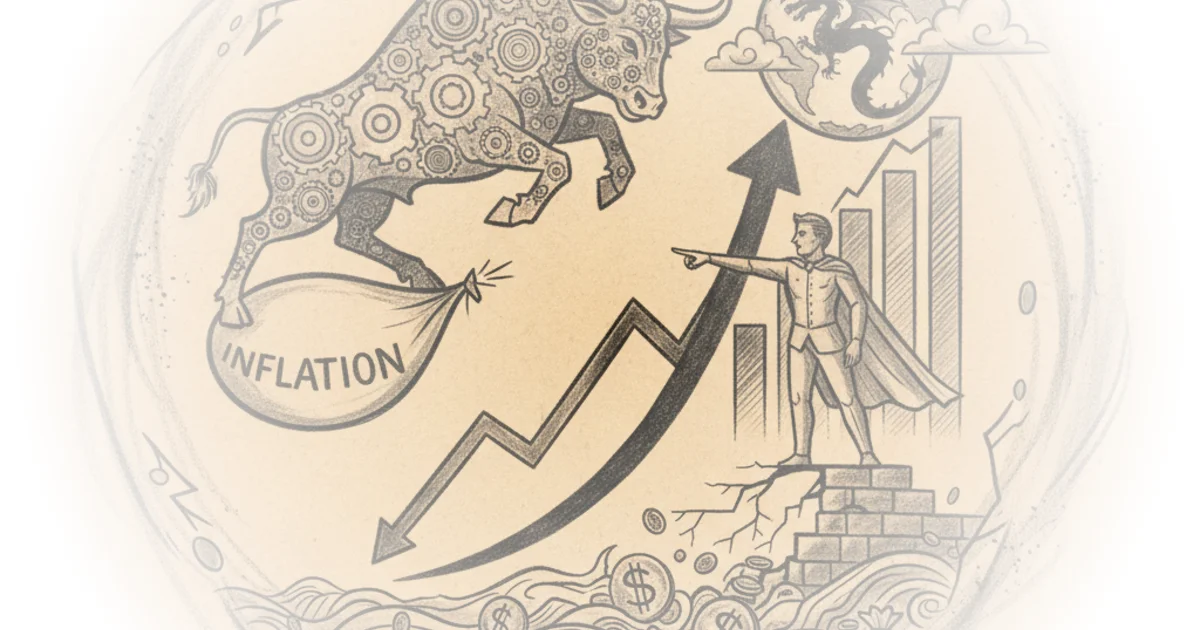
This evidence holds up well against the backdrop of recent data, though critics might note that this absorption of costs is likely temporary. If foreign firms continue to slash margins to maintain market share, their own domestic economies could suffer, eventually forcing a price adjustment that hits US consumers later. Schasfoort acknowledges this by noting that importers also stocked up on goods before the tariffs hit, creating a buffer that may eventually run dry.
The Dollar and the Stock Market Paradox
Perhaps the most counterintuitive finding in the piece is the behavior of the US dollar. Traditional economic theory suggests that tariffs reduce imports, which should strengthen the currency. Yet, Schasfoort observes that "the US dollar went down by a lot since Trump started talking about tariffs." He attributes this to a shift in investor sentiment, where "foreign investors... have increasingly been looking to invest in relatively stable places like Taiwan, Switzerland, and the Euro area rather than in the United States."
This distinction between trade flows and capital flows is the piece's analytical high point. It explains why the market initially crashed on "Liberation Day" only to recover. Schasfoort attributes the recovery to two factors: massive corporate tax cuts and a market belief that Trump will eventually "chicken out" on the most extreme tariffs. As he puts it, "what some people on Wall Street have called the taco trade where taco stands for Trump always chickens out." This framing captures the speculative nature of the current market, where investors are betting on policy volatility rather than economic fundamentals.
The taco trade is real: investors are betting that Trump's most extreme threats are bluffs, and so far, the market has been right.
Unintended Consequences for Allies
The most surprising section of Schasfoort's coverage is his examination of how US trade aggression has paradoxically benefited America's traditional rivals and allies. He argues that the chaos has forced the European Union to confront its own internal fragmentation. "Facing trade barriers from the US, the EU realized that its most important trade barriers are actually still inside the block and set out to try to remove them." Similarly, he notes that Canada is now actively working to reduce internal trade barriers between its provinces, which the IMF estimates are equivalent to a 21% tariff.
This is a compelling argument for the idea that external pressure can catalyze internal reform. Schasfoort writes, "Trump's aggressive conduct has caused Canada to take a long hard look at its internal trade barriers... if Canada can now remove these thanks to pressure from Trump, he could have ended up doing them a major service." This reframes the trade war not just as a bilateral conflict, but as a global stress test that is revealing structural weaknesses in trading partners. A counterargument worth considering is that this "benefit" comes at the cost of short-term economic instability and damaged diplomatic relations, which may have long-term geopolitical costs that outweigh the efficiency gains of a unified market.
The Bottom Line
Joeri Schasfoort's analysis succeeds by refusing to accept the binary narrative of total economic ruin or unqualified success. His strongest point is the detailed breakdown of how foreign exporters are currently absorbing tariff costs, a dynamic that keeps inflation low but may not be sustainable. The piece's biggest vulnerability lies in its reliance on the assumption that Trump's "chickening out" will continue; if the administration follows through on its most aggressive threats, the current market stability could evaporate instantly. Readers should watch for whether the foreign absorption of costs persists or if the bill eventually comes due for American consumers.