In an era where artificial intelligence promises to democratize writing, a more radical claim emerges: that the very act of conveying information is the death knell of true prose. This piece cuts through the noise of algorithmic generation to argue that language is not data, but a living, rhythmic force rooted in human chaos—a perspective that feels urgently necessary as the literary world grapples with the rise of the "Replicant Voice."
The Anatomy of a Living Sentence
The best writers on the Stack anchors their argument in a stark distinction between utility and art. They invoke the 1970s poet Richard Hugo to frame the central thesis: "I caution against communication because once language exists only to convey information, it is dying." This is a provocative stance, suggesting that the primary goal of journalism and functional writing is fundamentally at odds with the goals of fiction. The author elaborates on this by noting that in news, "the relation of the words to the subject is a strong one. The relation of the words to the writer is weak," whereas poetry requires the opposite dynamic. This reframing is powerful because it shifts the metric of quality from clarity to connection. If the goal is merely to transmit facts, a machine can do it; if the goal is to transmit a feeling, the machine fails because it lacks the necessary internal friction.
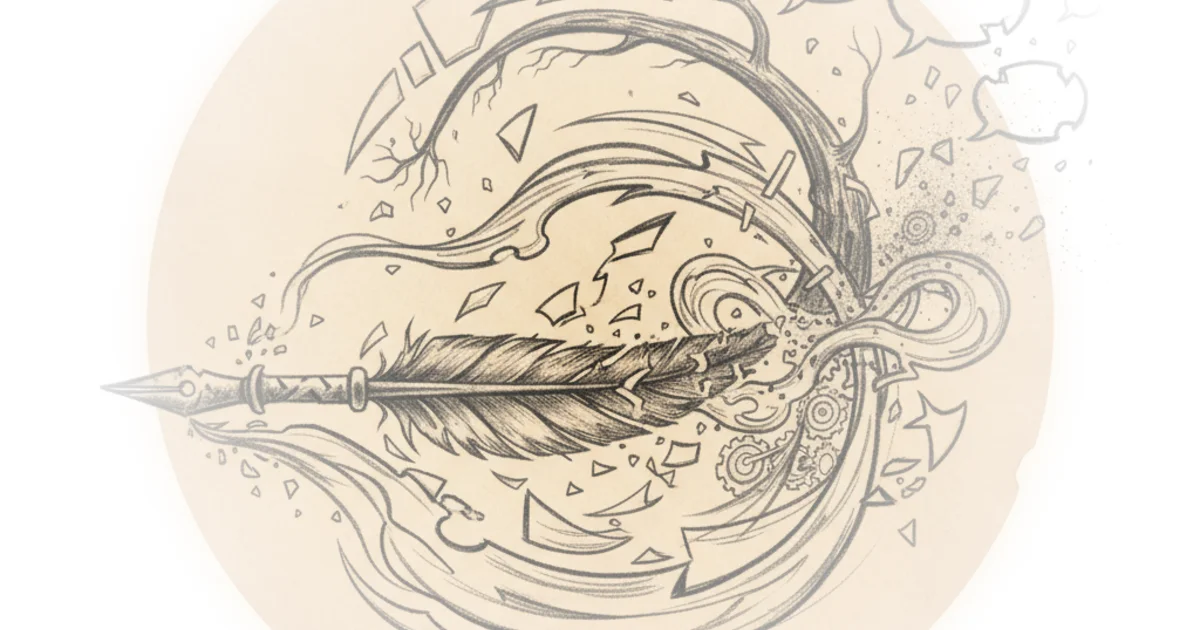
The commentary on AI writing is particularly sharp, dismissing the notion that algorithms can replicate human creativity. "Algorithms don't have ears. Not to mention hearts," the author writes, capturing the essential void in machine-generated text. They argue that because computers operate on immutable mathematical laws while language operates on "mechanisms of association," AI is fundamentally incapable of the nuance required for great literature. The piece describes AI attempting to write poetry as "like a 2D stick figure trying to see a 3D world: they miss everything." This metaphor lands with force, illustrating that the problem isn't just a lack of vocabulary, but a lack of dimensionality in perception. Critics might argue that this view underestimates the evolving capabilities of large language models to mimic stylistic patterns, but the author's insistence on the "you"—the specific, flawed human consciousness behind the words—remains a compelling counter to the idea of the perfect, sterile sentence.
"Once you're writing to convey information, the prose is dead."
The Rhythm of Control and Chaos
Moving from theory to practice, the piece dissects the opening lines of the novel Happy Bad, demonstrating how style can mirror a character's psychological unraveling. The author, Delaney Nolan, explains that the narrator's initial voice is "buoyant and energetic" but deliberately starts in a place of stillness to avoid "stylistic throat-clearing." The opening lines—"I lived in a box in the desert. I slept in stiff white sheets. All night my dreams swam with the things the girls drew on class assignments and birthday cards: lilies and blades and lopsided skulls..."—are analyzed not just for their imagery, but for their rhythm. The author notes that the language is designed to reflect the character's attempt at control: "she is trying to be controlled, direct, and unmoved. Fairly quickly she gets rattled, and by halfway through the book she's more or less lost control, and the language, the sentences that weave through the brambles and grow more playful, reflect that."
This analysis connects deeply with the history of the Iowa Writers' Workshop, where the author studied. While the Workshop is often criticized for producing a homogenized, "flavorless" style, the author pushes back, noting that their own cohort was driven to experiment. "I really don't think it's because people are aiming to avoid criticism," they argue regarding the flattening of prose. Instead, they suggest the issue lies in a literary canon that is "often overly stuffy and classical, focused on domestic narratives and clean American prose." The author's own background in investigative journalism adds weight to this critique; having worked as a journalist, they reject the common advice to emulate Hemingway's journalistic stripping-down. "If I see one more person refer to how Hemingway used journalism to improve his writing style, I'm going to lose my mind," they write, pointing out that their own journalistic experience actually fuels a maximalist, voice-driven approach in their fiction.
The Digital Attention Economy
The piece also tackles the broader cultural shift in reading habits, asking if published prose is adapting to the "reduced attention spans that apparently result from heavy internet use." The author acknowledges that the style of prose has shifted, citing Sally Rooney as a modern example of a writer who balances a contemporary feel with rich character work. However, the danger lies in the confusion of purpose. "The challenge for the writer is being clear with themselves that the purpose is the writing, not clicks, etcetera," the author asserts. This is a crucial distinction in an age where the "bloggy style" of the early 2000s has become a default for online content. The author reflects on their own time in the era of Alt Lit, noting how the accessibility of online magazines helped them see literature as "contemporary and malleable," but warns that the internet's demand for immediate engagement can erode the ability to sustain focus.
The author references Patricia Lockwood's essay "How Do We Write Now?" to emphasize the difficulty of finding a creative space in a hyper-connected world. "Looking at the internet first thing in the morning makes it hard to find the door," they write, echoing Lockwood's sentiment about the need to protect the inner creative space from external noise. This section serves as a reminder that the struggle for style is also a struggle for attention and autonomy. While the author is optimistic that "restrictions breed creativity," they admit that the risk of becoming "truly unable to sustain focus" is real. This balance between adaptation and preservation is the piece's most nuanced point, acknowledging that language must change without losing its soul.
Bottom Line
The strongest part of this argument is its unapologetic defense of the human element in writing, framing the "Replicant Voice" not just as a stylistic failure, but as an ontological impossibility. The author's rejection of the idea that journalism improves fiction, combined with their defense of the MFA's capacity for experimentation, offers a refreshing counter-narrative to the current anxiety about literary homogenization. The piece's biggest vulnerability is its potential dismissal of the utility of AI in drafting or brainstorming, which some writers might find overly purist. However, for any reader concerned about the future of literature in the age of algorithms, this is a vital reminder that the "physical effect" of great prose comes from the messy, unquantifiable presence of the writer. Watch for how the literary world responds to this challenge: will we see a retreat into maximalist, voice-driven fiction, or will the pressure to be "click-friendly" continue to erode the complexity of our stories?