Naomi Kanakia delivers a startlingly subversive fable that dismantles the romantic mythology of the warrior class, arguing that the very institutions designed to protect society are often its greatest parasites. In a genre saturated with tales of heroic knights, this piece daringly posits that true strength lies not in the armor one wears, but in the moral clarity to reject the game entirely.
The Illusion of Martial Artistry
Kanakia constructs a dialogue between Erdric, a celibate vegetarian paladin, and Ser Andras, a nobleman who believes his social status is earned through combat. The author strips away the glamour of the tournament immediately, framing it not as a test of skill but as a theater of insecurity. "You are like all the villagers," Ser Andras says to the paladin, "You look down upon knights who barely hold their seats, but you fail to realize the immense training and courage it takes to ride straight towards an enemy lance." Kanakia uses this exchange to expose the cognitive dissonance of the ruling class: they justify their privilege by claiming a specialized, dangerous skill set that, as the story reveals, is largely performative.
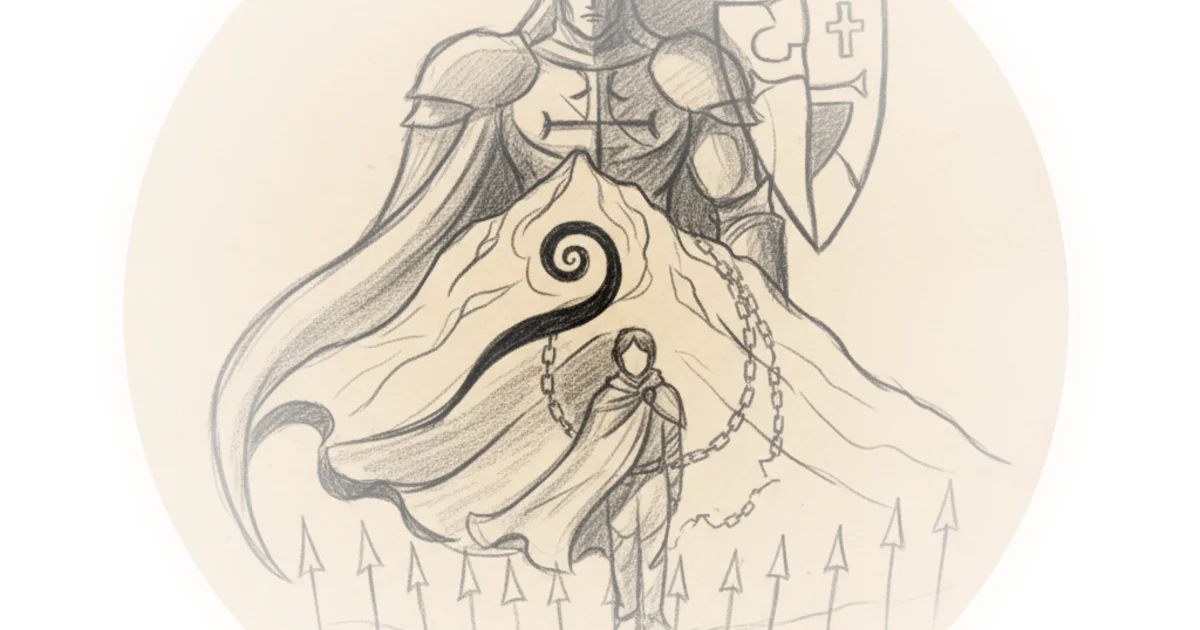
The paladin's rebuttal is the story's philosophical anchor. "The horse does the riding," Erdric says. "You only sit upon it." This line cuts to the core of Kanakia's argument: the nobility's power is an illusion maintained by the belief that they are indispensable. The author suggests that the "art" of knighthood is a self-congratulatory construct designed to mask the reality that the villagers are the ones truly enslaved by their own fear. "They train in order to convince themselves that their lives are blessed by God," the Paladin says. "They train so that they can continue to believe it is worthwhile for them to profit off the labor of others." This framing is effective because it reframes the conflict from a physical battle to an ideological one, where the weapon is truth and the shield is willful ignorance.
There is no art to being a knight. They train so that they can continue to believe it is worthwhile for them to profit off the labor of others.
Critics might argue that Kanakia oversimplifies the complexities of feudal defense, suggesting that any villager could easily defeat a trained knight if they simply "were good." History shows that training and equipment often matter more than moral virtue in a physical confrontation. However, the story is not a manual for guerrilla warfare; it is a critique of the necessity of the warrior class. The author's point is that the system creates the danger it claims to solve, and the "art" is merely a justification for the status quo.
The Performance of Power
As the narrative progresses, the tension shifts from philosophical debate to the spectacle of the tournament itself. Kanakia masterfully illustrates how the nobility relies on ritual and excess to maintain their authority. The paladin, Erdric, is baffled by the drinking and feasting, noting, "I wonder that these men are not ashamed of this waste, of this terrible display." The author uses the character of Lady Nerys to reveal the deep insecurity beneath the bravado. She explains that the knights pretend to be drunk to avoid the shame of losing while appearing sober, a detail that humanizes the oppressors without excusing them. "It is the custom, amongst men. They are so afraid, men, of being seen to want to win," she says.
The climax of the story occurs when Erdric takes the place of the incompetent Ser Andras. The transformation is not magical; it is a result of removing the performative elements of knighthood. "His horse was calm. His manner was smooth, without jittery movements or bravado," Kanakia writes. The crowd's reaction—shifting from derision to adoration—highlights how easily public perception can be manipulated by the trappings of authority. When Erdric finally unseats the Golden Knight, the crowd cheers for the idea of the hero, not the man. "They cheered for their hero, for their champion, Ser Andras," the text notes, even though the real Ser Andras was nowhere near the field. This irony underscores the author's thesis: the system is so fragile that it cannot distinguish between the real thing and a competent imposter.
The Cost of Legacy
The story's ending offers a haunting reflection on how these systems perpetuate themselves across generations. Lady Nerys, desperate for a son to inherit her husband's legacy, turns to a peasant woman after her husband refuses to acknowledge the truth of her situation. "It didn't matter. This boy was strong, and they could teach him to be good," she reasons. Kanakia suggests that the nobility is willing to adopt the very people they oppress if it means preserving the illusion of lineage. The boy, raised on stories of the Paladin, eventually wins his place not through birthright, but through the same competence that Erdric displayed. "He didn't often ride in the lists, but when he did, he won," the author concludes.
This resolution is bittersweet. While the boy breaks the cycle of incompetence, he is still absorbed into the system he was meant to challenge. The story implies that the "tournament" is an endless loop, where the only way to win is to play by the rules, even if those rules are fundamentally flawed. "Men gain strength from their fathers. That is known by all," Lady Nerys insists, but the Paladin corrects her: "Men gain strength from goodness. And you cannot teach a son to be good. That is why you ought to be thankful you have none." This final exchange leaves the reader with a lingering question: can a system built on exploitation ever truly produce goodness, or is it doomed to repeat its own failures?
Bottom Line
Kanakia's "The Tournament" is a sharp, necessary critique of the mythologies that sustain inequality, proving that the most dangerous weapon a warrior can wield is the refusal to play the game. While the story's idealism—that moral clarity alone can defeat structural violence—may feel naive to some, its power lies in exposing the fragility of the elite's self-image. The strongest takeaway is the realization that the "art" of war is often just a performance designed to hide the fact that the masters are as weak as the servants they claim to protect.