Scott Alexander challenges a foundational assumption of the art world: that the "experience" of art is a singular, holistic event. Instead, he argues we are conflating sensory delight with novelty, context, and fashion, a confusion that prevents us from seeing what is actually beautiful. This is not a gentle critique of taste; it is a demand for the same methodological rigor in aesthetics that we apply to medicine.
The Medical Model of Aesthetics
Alexander begins by dissecting the eight distinct components often lumped together under "good art," ranging from sensory delight to political point-making. He notes that "sensory delight" is preconscious and widespread, while "novelty" rewards the first person to do something, regardless of its enduring quality. The author's central thesis is that by mashing these together, we free ourselves from the hard work of isolating what actually moves us.
"I will instead take the bold stand that conflating many different things is bad: it frees people from thinking too hard about any particular one of them, or the ways they interact."
This framing is striking because it treats art criticism with the skepticism of a clinical trial. Alexander invokes the "Parable of the Steakhouse" to illustrate his point. He imagines a critic who eats blindfolded to eliminate the bias of ambience, reputation, or a chef's charming backstory about their childhood in Sardinia. In the real world, critics admit that "ambience" and "context" are part of the experience. Alexander, however, finds this deeply unsatisfying. He argues that just as we wouldn't accept a drug's efficacy being tied to the doctor's white coat, we shouldn't accept art's power being tied to its provenance.
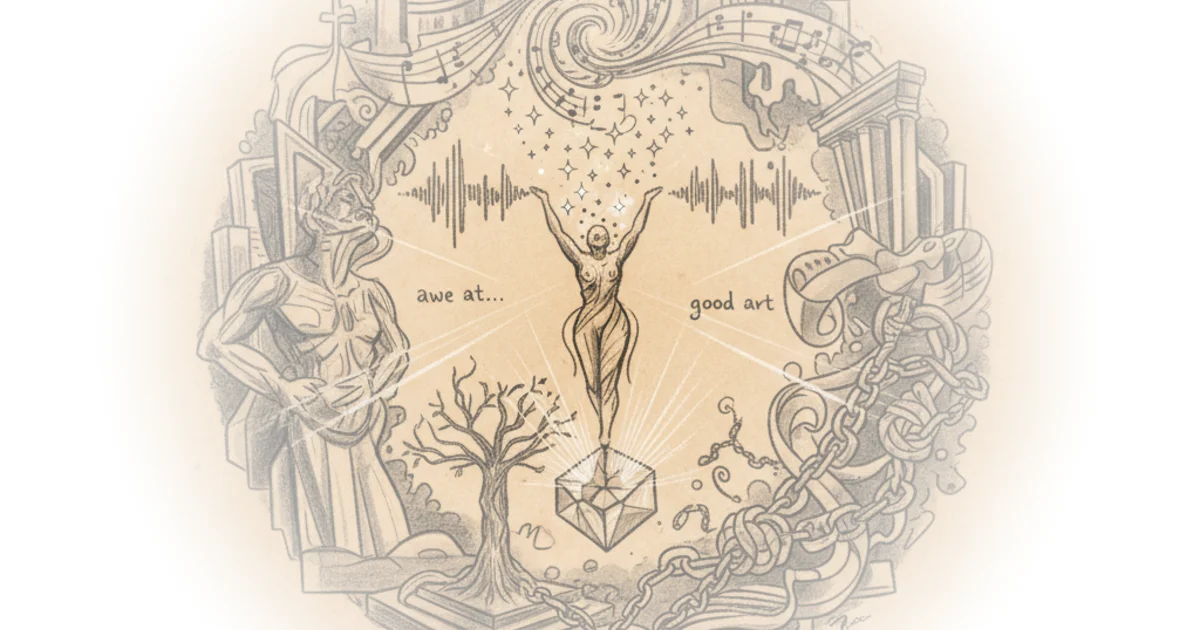
The argument gains depth when Alexander references the Salvator Mundi, the Leonardo da Vinci painting that sold for a record $450 million. The piece's value was inextricably linked to its attribution; without the "Leonardo" label, the sensory and historical impact would have collapsed for the market, even if the visual experience remained identical. Alexander suggests that if we truly valued the "Beauty" in Dostoevsky's sense, we would be willing to strip away the "Leonardo" label to see if the awe remains.
Critics might note that this approach risks sterilizing art, removing the very cultural conversation that gives it meaning. Alexander anticipates this, acknowledging that context is "part of the experience" for most people, but insists that true seekers of Beauty must be willing to separate the signal from the noise.
"If seekers of Truth respect their discipline enough to separate real from placebo effects, why shouldn't Beauty-seekers do the same?"
The Crisis of Provenance
The piece pivots to a thought experiment that exposes the fragility of our current taste. Alexander asks us to imagine standing before a sculpture that fills us with awe, only to learn it was mass-manufactured in 1995 by a Boomer from Ohio, not carved by Michelangelo. Would the feeling of awe retroactively become "embarrassing"?
He argues that if we truly believe in the transformative power of art, the origin story should be irrelevant. "It would be as if people took medications based on how cool the story behind their invention was," he writes. This analogy is powerful because it highlights the absurdity of valuing the story over the effect. If a poem by G.K. Chesterton moves us to tears, Alexander posits, we should feel the same way if a forger produced an identical poem, provided we didn't know it was a forgery.
"If I genuinely believe in the power of art to awe and transform, it's strange to also care about its novelty and provenance."
This section forces a confrontation with the "novelty" component of taste. Alexander admits that if he discovered a book of lost Chesterton poems, he would be overjoyed. But if he later learned they were forgeries, he would face an "aesthetic crisis." The ideal resolution, he suggests, is to realize that the quality of the poem is what matters, not the name on the page. If a forger can write like Chesterton, perhaps the "genius" isn't a unique spark but a replicable skill set we haven't yet learned to identify.
This line of reasoning echoes the debate surrounding the Angelus Novus, Walter Benjamin's famous painting. The image's power lies in its specific historical moment and its connection to Benjamin's philosophy of history. If one were to remove the context of the interwar period and the philosopher's tragic end, does the image retain its "angelic" terror? Alexander would argue that the sensory and emotional impact should stand on its own, yet our culture insists on the biography as the primary source of value.
"Anyone who says such a thing obviously doesn't like poetry, they like - I don't know, the experience of affiliating themselves with cool famous poets."
The Bottom Line
Alexander's argument is a rigorous, almost uncomfortable, call to purify our aesthetic judgment. The strongest part of the piece is the insistence that "novelty" and "context" are often masquerading as "beauty," preventing us from recognizing genuine excellence in derivative or unheralded works. However, the biggest vulnerability is the assumption that human perception can ever be fully divorced from its context; we are, by nature, storytelling creatures who find meaning in history and origin. The reader should watch for how this framework applies to modern art, where the "idea" is often the art itself, making the separation of "context" from "object" nearly impossible.